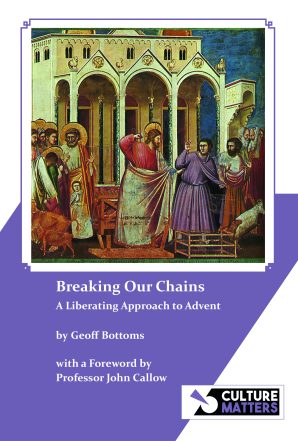
Available here for £10.00 inc. p. and p.
By Geoff Bottoms
For millions of people, Advent and Christmas have been thoroughly domesticated and reduced to a season of sentimental nostalgia, frantic consumerism, and depoliticised goodwill. Under the glare of Black Friday sales, corporate advertising, and depoliticised charity drives, Advent is reduced to a countdown to consumption.
Yet at the core of the season lies a theme that has haunted empires and ruling classes for two millennia: the promise that the mighty will be cast down from their thrones, the hungry filled with good things, and the chains of oppression broken.
When I set out to write Breaking Our Chains: A Liberating Approach to Advent my aim was to place this revolutionary theme front and centre, inviting socialists and believers alike to reclaim Advent as a season of active resistance and hope.
The central theme of the book is deceptively simple yet profoundly subversive: true liberation is never handed down from above, nor can it be separated from material reality. In developing this perspective, I draw directly on the insights of Latin American liberation theology. Forged in the 1960s and 1970s amidst popular struggles against US-backed dictatorships, oligarchic land ownership, and crushing poverty, thinkers such as Gustavo Gutiérrez, Leonardo Boff, and Oscar Romero insisted on God’s “preferential option for the poor.” They understood that faith cannot remain neutral in a class-divided world, and that sin is not merely private failing, but structural exploitation built into economic systems.
Applied to Advent, this perspective reveals that the Christmas narrative is no escapist fairy tale about a distant heaven. Instead, the Incarnation represents a decisive act of solidarity with the poor, the marginalised, and the exploited. To “incarnate Christ’s message of love” cannot mean settling for seasonal goodwill or patronising philanthropy while leaving the structures of poverty intact. It demands confronting the economic and social chains that bind working people today, from low wages and insecure housing to imperialist war and ecological destruction.
This insistence on connecting spiritual conviction with material emancipation unites Latin American liberation struggles with a proud, often overlooked British radical tradition. Throughout history, oppressed people have repeatedly drawn on biblical imagery of exodus, jubilee, and liberation to articulate their demands for a classless society. From the Diggers and the Levellers in seventeenth-century England to the Christian socialists and trade union pioneers of the industrial era, the vision of building “the kingdom of heaven on earth” has long served as a rallying cry against private property and exploitation.
Crucially, the book explores how culture itself is a decisive battleground in the fight for liberation. Edited by Mike Quille and illustrated with stark, compelling black-and-white digital woodcuts by Ignacia Ruiz, Breaking Our Chains weaves together prose, poetry, historical quotations, and visual art across the four weeks of Advent. This blend of forms reflects a vital socialist principle: breaking our chains requires liberating the creative imagination as well as the workplace and all areas of class struggle.
Ruling-class hegemony thrives on convincing the working class that exploitation is permanent, that history has ended, and that cynicism is the only realistic option. Poetry, art, and shared ritual, much like the base ecclesial communities of Latin America, push back against this fatalism, creating space for collective reflection and awakening a sense of what is possible when people organise together.
In our current moment. which is marked by relentless austerity, reactionary nationalism, racism, climate crisis, and widening inequality, the theme of Breaking Our Chains feels especially urgent. Throughout the book, I reframe the traditional Advent motif of “waiting” from passive endurance into active, disciplined preparation. Waiting for a better world does not mean sitting quietly on the sidelines; it means building solidarity in our workplaces, communities, and trade unions right now. In embracing the Church’s Social Teaching together with the Marxist analysis and praxis of liberation theology, I hope to show that revolutionary optimism is not naive wishful thinking but a vital weapon against despair.
Ultimately, Breaking Our Chains: A Liberating Approach to Advent is a reminder that culture is never neutral. Either we allow the market and the political right to monopolise and commodify it, or we democratise it in the interests of the working class. My hope is that this slender volume will encourage readers to look past the tinsel and remember what the season is truly about: casting off our chains and fighting for a world built on justice, peace, and human solidarity.
Available here for £10.00 as a paperback with free UK postage, or £5.00 here as an e-book