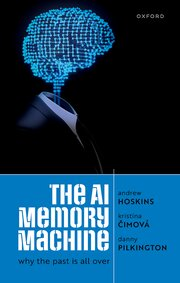
The AI Memory Machine (Oxford University Press, 2026), by Andrew Hoskins, Kristina Cimova and Danny Pilkington, is available here
By David McKinstry
The AI Memory Machine: Why the Past Is All Over, by Hoskins, Cimova and Pilkington, is a timely critique of AI and its use by neoliberalism to erode public institutions and our individual and collective memories in pursuit of profit. This is an important study of how AI is being used by capitalism in its age-old pursuit of accumulation. What is strikingly innovative about this accessible read, however, is how the authors warn that AI is becoming a new and existentially dangerous tool for attacking our collective consciousness and individual human agency.
The authors offer a clear and alarming warning about the use of AI by big tech companies. The emergence of “techno-tsars” such as Jensen Huang—whose goal, the authors argue, is to atomise individuals into compliant consumers rather than collective, free-thinking citizens—is well documented in the text. Hoskins et al. cite a Forbes magazine report that eight of the ten billionaires at the top of its list were senior figures at X, Facebook, Amazon and other big tech companies.
With the emergence of AI, however, capitalism is entering a new phase of digital acquisition. This has led to particularly worrying developments for young people born after 2010. The authors call this demographic “Generation F(orget)” and describe how Big Tech’s use of AI to control digital platforms is having a devastating impact on this generation. They point to the development of deliberately addictive AI tools designed to induce dopamine hits and ensnare young users. In a largely unregulated AI landscape, these companies have operated with the zeal of Wild West robber barons, designing AI tools to shape compliant screen consumers regardless of the impact on their physical and mental health. The authors’ worrying point is that Generation F is in danger of developing atomised “Zombie Memories” rather than forming individual and collective lived memories that are authentically their own. They observe that humanity is in danger of reaching a point where “there is no authentic you.”
The book superbly outlines an emerging and possibly ominous future for humanity if collective control is not exercised to counter Big Tech’s Wild West approach to using AI. The authors also point out that unregulated AI is not only a future danger but a clear and present one for Palestinians. The book observes that Israel’s aggression in the Gaza Strip, which the United Nations has described as genocidal, was aided and abetted by AI. The IDF deploys Automated Target Recognition (ATR) technologies to identify and generate targets for bombing. This use of AI has resulted in the deaths of thousands of Palestinian civilians.
The authors of this essential book present us with an Orwellian warning: without a systematic, collective response to AI, we risk losing one of our most essential human characteristics—the capacity for memory that shapes us as individuals and as a society.