Veronica Ryan’s exhibition is on at the Whitechapel Gallery, 77-82 Whitechapel High St, LondonE1 7QX until 14 June 2026
By Nick Moss
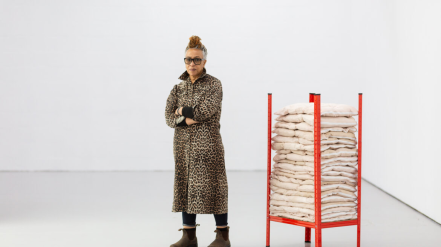
Veronica Ryan’s work is ostensibly simple but asks powerful questions, about space, materiality, and value, and about how these interact in the context of the production of a work of art. There is constant interplay between material and memory in her work, which is based around a quiet, determined practice committed to both conceptual and textural diversity. She employs a range of traditional materials such as plaster, bronze and marble alongside crafts such as crochet and quilting.
This exhibition, staged as part of the Whitechapel Gallery’s 125th year celebrations, is a gentle, but powerful, celebration of the best of what the gallery has come to represent- a commitment to art as political practice, art as community practice and resource, and art that recognises and reflects the place where it is made – rooted in and speaking to Whitechapel, as a place formed by immigration, displacement, refuge and solidarity, and caught up in an ongoing struggle against racism and the history and impact of empire.
The Whitechapel Gallery, at its best, has always tackled all this unflinchingly. Veronica Ryan’s work was shown in the Whitechapel’s From Two Worlds exhibition in 1986, a key exhibition in the development of Black British art, which also featured Rasheed Araeen, Saleem Arif, Franklyn Beckford, Zadok Ben-David, Zarina Bhimji, The Black Audio Film Collective, Sonia Boyce, Sokari Douglas Camp, Denzil Forrester, Lubaina Himid, Gavin Jantjes, Tam Joseph, Houria Niati, Keith Piper, and Shafique Uddin.
From Two Worlds was, at that time, the most substantial exhibition of Black artists’ work to have featured at a major London gallery. It demonstrated the Whitechapel’s explicit determination to provide a space for art that functioned away from and against the market, and the return of Veronica Ryan, now as 2022 Turner Prize winner, allows for celebration of her own achievements and for the Whitechapel’s success as a platform for and champion of her work.
Ryan works with a variety of materials and across a range of scale. She makes work from junk she finds discarded in the street. Immediately you enter the gallery you encounter a range of stacked avocado boxes – with Ryan concerned to celebrate the accidental aspect of these – that they fall into slightly different shapes as they compress, and that they begin to discolour. Maybe “discolour” is probably the wrong word to use in this context. What Ryan is saying is that there is no “discolouration” – there is simply another form, a new stage of transition, an evolution occurring that has its own beauty, and that transience is worthy of celebration. She has noted previously of these works “There’s a moment where they’re stable, and then if it gets to a certain point, they’re suddenly not stable anymore.” For Ryan, we shed skin into dust, but under a microscope, the dust becomes a carnival.
In 2004, many of Ryan’s works were destroyed in the Momart fire, and she, while grieving for the ruin of her work, determined to incorporate the flux between permanence and loss as a feature of her art. All of this compounded a legacy of trauma and bereavement that now suffuses her work and gives it a gentle mien and particular grace.
In 1995, her birth town of Plymouth, Montserrat turned into site of exclusion when a long-dormant volcano erupted and covered much of the island in ash. From feeling a generalised displacement and restlessness, living variously in London, Colchester, Cornwall, and New York, the Montserrat disaster appears to have forced Ryan to see herself as entirely exiled, not at home anywhere, and thus embracing impermanence as a kind of holding place – transitoriness as ontological truth to be acknowledged, if not embraced.
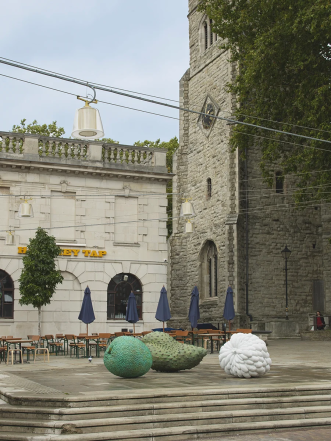
You can see some of this being worked through in her framing of various items of detritus –old throwaway bottles for example – arranged as still life displays. Orange peel, herbs, soursop seeds, all are displayed as if totems to hold off the flux and weft of time. A key work here is in fact named Totem (2025–26), a wonderful ceramic sculpture derived from casts of stacked plastic bottles. Her Hackney Council Windrush commission is an illustration of this on an even larger scale. Custard Apple (Annonaceae), Breadfruit (Moraceae) and Soursop (Annonaceae), 2021 (below) – the UK’s first permanent public sculpture by a Black woman – is a three-piece marble and bronze sculpture of fruits Ryan recalls her mother buying at Ridley Road Market.
A core aspect of her practice is a focus on how things impact on other things. Thus she displays felt and fabric pieces which are distorted and twisted by her repeated insertion of pins into the surface; a tiny bronze sculpture is wrapped in orange peel; yoghurt cartons and bottle tops are wrapped with crocheted cotton. Everything touches everything else. The works that appear to sit alone are placed on doilies or cushions, worked on by the air moving around them and the dust in the air. Nothing is solitary. Everything is impacted. As Ryan shows us, this is neither good nor bad, but it can be, straightforwardly, beautiful.
Ryan is a materialist at a fundamental level. She is concerned with the “thingness” of things. She plays with weight and size and the illusion of lightness. She incorporates “slippage” into her work – the way the work is displayed in one place may be different in another; bits of works get lost as they are moved from space to space: sometimes the works themselves break down, decay.
There are large-scale sculptures made from plaster and beaten lead. There are stocking-like structures, holding clusters of crystal rocks, drift seeds, shrivelled mango stones, crushed plastic bottles or yoghurt pots. There is a duvet cover; and these in turn hark back to other works shown as part of a photography/video installation elsewhere in the Whitechapel Gallery – Chicagoan Senga Nengudi ‘s R.S.V.P. piece, which consists of an evolving series of works combining sculptural forms with performance and dance, using nylon tights as its primary material.
The use of the tights has a clear feminist context, in that it can be seen to reflect on and deconstruct the manufacture of gender, but is essentially concerned with plasticity and the way a body in movement can impact on and adjust to this. The tights are pulled, twisted, knotted and filled with sand, tethered to gallery walls and stretched across the space, while the performer interacts with and then seeks to escape them.
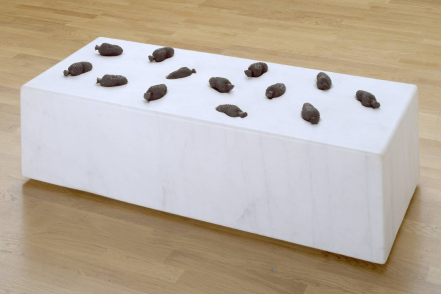
Quoit Montserrat
Nengudi and Ryan were influenced by the Fluxus movement and its utilisation of found objects, the operation of chance, anti-art, the refusal of art as commerce. There is a hanging work, The End of All Things (2025), a deep Indigo-dyed duvet shaped and gathered up with elastic hairbands, displayed alongside Residue (1988), a crumpled bronze form with a stark, striking blue patina.
Elsewhere Ryan shows a different side to her complex, beautiful, humbling (and at times strikingly humble) work, with a series of lowering gouache and pastel drawings illustrating the aftermath of the Soufrière Hills volcanic eruption. Also on view are some rarely displayed, candid and jolting collages incorporating family photographs overpainted with dense black clouds obliterating personal features that hint at despair, breakdown, repression.
This is an exhibition that shows how art can be a form of rendering of beauty from wreckage, finding a kind of peace even in displacement. It shows how significance can exist (indeed perhaps most often exists) in the smallest, most vulnerable things. It showcases Veronica Ryan as one of our most important artists, tackling the impact of loss, ecological destruction and recovery – of scale, of perspective, of recognition of fragility – from the detritus of our time.
Which is why the critical reception of the exhibition has seemed so bizarre. The Guardian has described some of the works as produced by someone “let loose at the tip, minimalism at the recycling centre.” (Eddy Frankel, The Guardian 31 March 2026) Frankel adds “Turning trash into sculpture has been done a million times in a million ways.” Not untrue – but the same is true of lead, plaster and wood.
What matters is what results, and Ryan’s work makes everyday trash into “a treasury of things invented” (to quote the Rhetorica ad Herennium). Laura Cumming (The Observer 9 April 2026) sneered at Ryan’s work “No household rubbish is beneath her.” Cumming ponders:
A bronze cast of a mango stone is one of a series, all caught up in brightly coloured nets like fish, or string grocery bags. Given that you can barely see them at all, still less lift them, you might wonder why they are cast in heavy bronze.
There is here an almost wilful refusal to engage with the work, as if the questions it asks about colonialism, migration, displacement, loss are all passé now and we should move onto something more interesting. Cumming even has a snide dig at the Whitechapel gallery itself as turning into “a safe player, or a follower in the London scene” in its 125th year. She does this without, seemingly, being at all aware of the history that links Veronica Ryan and the Whitechapel.
Jung once wrote that we should “think our thoughts through to the end” and the critical response to this exhibition suggests a real failure to do so. There will be some for example, who will encounter Ryan’s sculptures of breadfruit, or the bronze mango stone, and will instantly recall them as linked to a home elsewhere, to another time in their lives. They will serve them as memory aids. For others, though, they will not have such instant resonance. Should they then just shrug and move on? What does “thinking through to the end” mean in this context? What might Ryan intend? Either art is simply there to serve as a dopamine hit, or it ought properly to call for a different kind of engagement.
Ryan’s art asks us to imagine what the mango seed might mean for someone who grew up with the fruit close to hand, or someone like an artist who chooses to use it as a key to their art. It asks us to think harder, to empathise. To work out what the seed or stone might be a key to. This is an art that can serve as an aid to memory or to solidarity. The critical reception misses the point – where Ryan’s work is most powerful is sometimes when it speaks most quietly.
Also on display as part of the Senga Nengudi exhibition are her 1970s New York-based Spirit Flags series. These are prints showing her flag-like forms, in jagged human shapes, hung outdoors in alleyways and across fire escapes, which she intended as memorials for drug users dying in the streets of New York, as the city died around them. They are simple and extraordinarily powerful – like Ryan’s work, they call us to recognition, to mourning, and to action.