By Chivonne Barrington Head
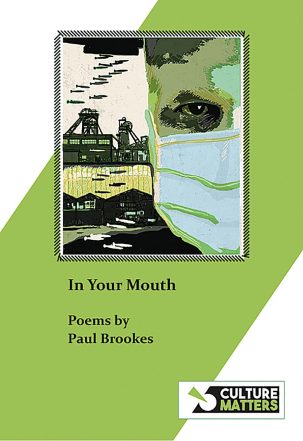
I first met Paul at Ian Parks’ Read To Write Workshop in 2024 where I purchased a copy of another collection of Paul’s based on the title alone: “Random Acts Of Wildness” (Glass Head Press, 2023).
I noted the Zen nature of Paul’s writing style then; his style reminds me of the Zen proverb “chop wood, carry water,” intended to carry the connotation that true wisdom is finding extraordinary peace and presence in the occurrence of the everyday life duties we’re all bound to. I could feel the space in between the lines, allowing me to silently slot my own sincerities of daily occupation and reflect back, between words and worlds.
This collection has a similar feel to it, although the subject matter is very different. It is as though Paul is pouring a drink and then leaving it up to the reader to describe how the drink tastes, whether it is hot or cold – fizzy or still – then giving space for the reader to project their own private thoughts and feelings. IN YOUR MOUTH is a fitting title, let’s get into how the water feels.
The first section of the book, On Covid Till, opens with a poem called Not Seen which I enjoyed enormously.
Not seen…
Bread for seven days in shops, he says,
Marvels at the scarce blocks of bread
He brings to my till:
These were the last two.
O
He spot’s a flaw.
One of the loaves’ blue packaging
split down its serrated edge
a pair of jaws.
A full mouth of individual long
white teeth.
I can’t take this. Take it back.
I say the bread is OK. It’s just the packaging.
No, the bread is hard.
I arrange a refund.
The stylistically experimental ‘O’ I found fascinating. I haven’t seen this used before. It leaves the reader guessing; is it an exclamation of surprise, resignation, or does it represent a hole, a gap where more should be?
The next few poems in this section describe life behind the till as a COVID worker – Paul makes it clear that he does not feel like a hero working through the pandemic- he describes bi-polar customers, navigating social distancing rules within the COVID context in a relatable way without hyperbole, which stimulates the mind rather than the emotions. I found myself becoming more curious as the COVID till poems continued, about the shop Paul works in and its surrounding areas, and the placid relationships he has with his patrons. Not once does he express annoyance or any negativity towards his predicament. He simply describes the events as they unfold. Perhaps the one I found most memorable was:
A stooped old woman
bumps into a younger one at my till.
The younger one says to me:
I have a daughter with low immune syndrome.
They don’t get it, do they? She nudges her head
in the direction of the old woman
unloading shopping on to my conveyor belt.
The old woman appears not to hear as she is
turned away from us. As the younger woman
begins to pay with her card, the older one
turns to us and shuffles forward. I politely
ask her to step back to where the red dot is
for social distancing. The old woman does so
without comment.
The young woman and I share glances.
I ask her to Stay Safe. She says You too…
I inferred from this poem the indicative nature of a wider problem – the lack of respect for elders replaced by a type of bullying, the stooped old woman who is clearly infirm and may need extra support is the subject of reprimand from a younger woman who has a daughter with low immune syndrome. The need to protect ‘our own’ over wider humanity and the implication that older people must make an ignominious retreat into isolation, without comment, as Paul’s poem says, despite possibly not having the means to do so. As a personal aside, I cannot tolerate the shaming of anyone, it serves no purpose and there is always a more skilled way to go about things.
Paul then talks about his respect for cleaners in the pandemic in other poems, and that calling them ‘unskilled’ is something he heartedly disagrees with, an opinion on which I stand vehemently beside him.
In the next section, Daily Self Isolation Sonnets, the themes take on a more personal tone as Paul and his wife remain at home during COVID times. There are poems about he and his wife getting COVID, which is the only place in the book where I can feel an inkling of peril from Paul about the nature of this deadly virus, inciting me to relive those times in my own mind and how those times affected the collective psyche of the nation and indeed the world.
What also shines through is Paul’s love for his wife and vice versa. Enduring love and commitment in a marriage is something I always enjoy reading about, if it is genuine, which it clearly is. There is no pretence in Paul’s writing, which is refreshing.
The next section of the book, My Conflict Sonnets, covers a different theme. One of my favourites from this section was War’s Plastic Spade:
left stood on the beach in the rush to go.
Beside the moat dug around the castle,
eroded by weapons of gust, rain, snow.
A home is a temporary vessel.
Unless you are your hearth home. Traveller.
Sometimes it is not your choice to move on.
Sometimes the tide comes in, unraveller
of all your belonging, time to be gone.
Home is your fireside hearth that burns even,
when your outside home’s flames are put out, snuffed.
Fire is a grief a child’s loss of a friend,
that plastic spade, that castle engulfed.
Go, move, shift, says the stern voice of war, waves,
day’s end pack up and leave others their graves.
I found the idea of this poem fascinating, the waves of the sea being compared to the destruction humanity makes in war, moving, without being flippant or obvious.
There are so many intellectually edifying poems in this collection. One of my favourite lines out of the whole book is found in the poem From The Corporate City Haikus:
Did I dream it? Once
a world where inanimate objects didn’t rule.
To summarise, IN YOUR MOUTH is an intelligent collection of poems, for the thinking person. I have thoroughly enjoyed reading them. Paul has an interesting mind and allows a lot of space. I am sure we will hear more from Paul soon and I am looking forward to this.
You can buy the book here