The End We Start From
By Stephen Lee Naish
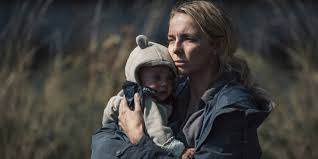
Director Mahalia Belo’s film The End We Start From (2023), is available on Disney+, Netflix, and Prime, depending on region. It is adapted from the novel of the same name and takes place in contemporary Britain where a series of prolonged rain storms flood the major towns and cities. This causes a mass exodus of people to head for higher ground and occupy government-run shelters. Society eventually descends into a survivalist dystopia, with widespread food shortages, violence, distrust, and a displaced population scavenging for resources. Among the societal turmoil a young couple (Jodie Comer and Joel Fry, referred to as Woman and R, respectively) and their newborn baby daughter Zeb attempt to survive.
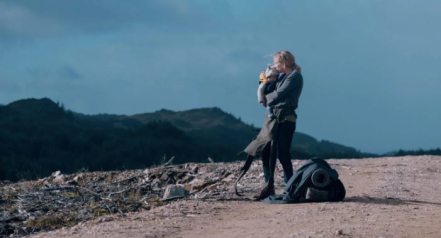
Image from The End We Start From (2024), produced by SunnyMarch, Hera Pictures, and BBC Film
While the ecological crisis that befalls the country is somewhat relegated to the background, it is worth looking at this narrative of survival through the lens of the ‘post-catastrophe’ framework that is laid out in my book Post-Catastrophe Film: Cinematic Visions in the Aftermath of Disaster (Intellect, 2026).
In the book I argue that post-catastrophe narratives, as a sub-genre, sit between the blockbuster disaster movies that commonly feature explosive computer-generated effects, and a muscular hero who leads a rescue mission (Armageddon, Deep Impact, San Andreas). In contrast, the post-apocalyptic film that takes place long after the disaster event and portrays the world as a barren wasteland with pockets of survivors eking out an existence (Mad Max, Hunger Games, The Road).
The typical narrative framework of the post-catastrophe film is laid out as follows.
- Pockets of society still function: Remnants of the “old life” remain, but the foundations are rapidly shifting.
- Technology still functions, but barely: Infrastructure—cars, phones, and the electrical grid—is operational but becoming increasingly unreliable.
- Refuge awaits: The plot is driven by the hope of a sanctuary organized away from the initial carnage.
- It is everyone for themselves: A “survival of the fittest” mentality begins to prevail among the survivors.
- Every person is “you”: Protagonists are ordinary citizens—not heroes—thrown into extraordinary circumstances.
- It is our world: The settings and societal structures are anchored in our present moment, not a distant future.
In the book I point towards recent films such as The Domestics (2018), How it Ends (2018), Cargo (2017), Awake (2021) Into the Forest (2015), and The Silence (2019) as examples of a post-catastrophe narrative framework.
What is striking about post-catastrophe films is their utter mundanity. The disaster event that occurs is often only shown as a prelude to the story, if it is shown at all. The event is not a meteorite slamming into the Earth, a supervolcano exploding, an alien invasion, or a global geostorm, it is often an unexplained power outage, a contagious virus, a societal reset conducted by a malevolent government, or a weather event. It hardly matters what befalls the world. The narrative’s only concern is what occurs in the immediate aftermath of the catastrophe to a small number of survivors.
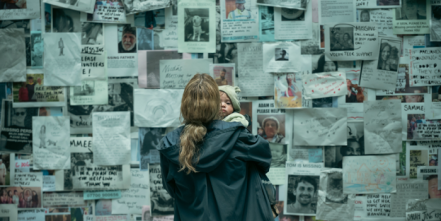
Image from The End We Start From (2024), produced by SunnyMarch, Hera Pictures, and BBC Film
The protagonists in post-catastrophe films are not extraordinary people as often seen in disaster movies and post-apocalyptic films. They are ordinary members of society who must overcome tremendous odds in order to survive the massive upheaval. They have no special powers, or extraordinary knowledge. They are, in essence, like you and me.
In effect, and quite fittingly for this critique, post-catastrophe films show the end in which those that survive must start from in order to persevere towards a livable and potentially worthwhile post-apocalyptic future.
The End We Start From fits nicely within the post-catastrophe framework. The scenario that befalls the country is a prolonged rainstorm. To wait out the deluge, the young family travels to R’s parents’ secluded cottage where there is ample food and supplies. This is acceptable to them for a few months, but as the rains continue, and supplies run low, R and his parents travel to a food distribution facility. The stampede for the meagre rations is so violent that R’s mother is killed in the crush. A distraught R and his father return to the house. R’s father shoots himself with a shotgun in the woods.
Unable to sustain themselves and with the rains not letting up, the family travel to a government shelter. Due to restrictions, R cannot accompany his wife and daughter and so leaves them. This outcome is actually for the family’s own good. The violence witnessed and the unknowable future has made R scared and paranoid and he can no longer take care of himself and his family.
In the shelter, Woman meets a young mother in a similar situation. They hear rumors about a remote Scottish island community that is taking in those that can reach the North coast. When the shelter is attacked by raiders, the two women, with their babies in tow, flee and travel across the country towards the coast.
When they reach the coastline, a scouting boat collects them and takes them to the island sanctuary. What they find is a self-sustaining community. Yet, the islanders have closed themselves off from the rest of the country and do not want to go back and participate in any rebuilding project once the rains have subsided. They have concluded that the rains may very well stop at some point soon, but society as it once was will never return, that a kind of savagery has developed. With continued climate disruption, this storm will likely be the first of many more.
Disillusioned with the island folk’s doomerist outlook, Woman and Zeb leave the island and return to London. She finds the city drowned and only traversable by boats that sweep between the buildings. Yet, the rains have now stopped and a government-led clean-up operation has begun. Woman returns to her waterlogged London apartment and finds R waiting there for her.
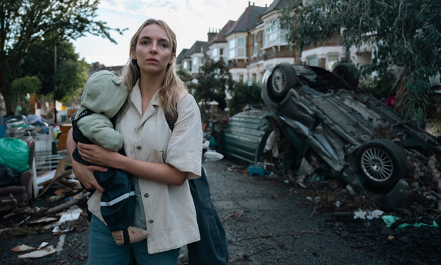
Image from The End We Start From (2024), produced by SunnyMarch, Hera Pictures, and BBC Film.
The End We Start From ticks all the boxes in the post-catastrophe framework laid out above. It is a narrative told from an ordinary person’s perspective, regarding an unremarkable natural event that sets the protagonists on a journey towards a rumoured refuge. A rudimentary social structure remains, though clearly it is crumbling towards a survivalist mentality as the situation worsens. Some technology, such as cars and radios, still function. The landscapes, in this case predominantly the countryside locales of England and Scotland are very much set within our own world. We can place ourselves in the same position as the protagonists. Their approach to survival is just as muddled, fearful, and reactive as ours would be faced with similar circumstances.
Why are these post-catastrophe narratives important to us now, and what do they say about our current multicrisis? By removing the spectacular effects and excitement of the disaster movie and the otherworldly environs of the futuristic post-apocalyptic film, these films give us a very real glimpse into our own collapsing world. The disaster events are plausible, the reactions to them relatable, the surroundings in which they occur recognisable. The narratives do not offer a solution, or reset, that so often occurs in disaster films. They force the viewer to linger in the moment of post-societal collapse and ask questions about their own actions, or inactions should a similar situation occur to them. The narratives compel the viewer to consider the possibilities of what comes next, what kind of future materializes from this timeline.
Film is entertainment, but it can also educate. Through the ‘reality effect’ of its narrative and environment it can plant seeds of change within the audience and offer an understanding of how a crisis can emerge from the most mundane of circumstances. The civilizational polycrisis we currently face needs to be communicated and understood. Film, along with other art forms and other tools of education, can offer that in abundance. The depressing environs of post-catastrophe narratives in particular show us a world we should avoid at all costs. How we avoid it is up to us.