By Jack Clarke
“I think belonging is really about participating, I suppose, having a stake in the place that you are in, right?” – Ali Al-Jamri on poetry, film, and finding home between Bahrain and Lancashire.
I was wasting away in bed eating crisps and doomscrolling when a post about a screening at the Ahmed Iqbal Ullah RACE Centre cut through like a flare – The Legend of the Looms, by poet and artist Ali Al-Jamri.
I’d been to the Centre before, so the title snagged. I messaged Al-Jamri for a screener, hit play, and got walloped by ghosts with impeccable timing. The poem moves like a loom shuttle: back-and-forth, argument and embrace, cloth and afterlife. I put two and two together, and having already guest-curated a few exhibitions at Bury Art Museum, one of those proud-but-undersung civic galleries that still feels built for the people, not the press release, I had a hunch this film belonged there.
Who gets to weave the story…..?
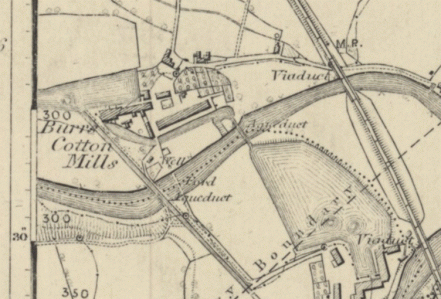
Bury wears mills in its muscle memory. Soft water perfect for finishing. Cotton landing at Liverpool and rippling inland, fields flipping to terraces, and the Peel family kick-starting the local boom with a calico works at Brooksbottom in 1773.
By 1818 there were seven cotton mills beating time to the Irwell and the Roch. The skyline still won’t let you forget: Peel Tower on Holcombe Hill, a 128-foot reminder that industry once shouted from the moors. Meanwhile, the town built a place to argue about it all in public: Bury Art Museum, born from paper magnate Thomas Wrigley’s 1897 gift, housed in a purpose-built gallery opened in October 1901 by architects Woodhouse & Willoughby, with the town museum added downstairs in 1907. A civic machine for showing what’s made, and who gets to make it – the key question for cultural democracy.
And really, that’s the question, isn’t it? What happens to places like Bury Art Museum when the cultural weather tilts toward the megastructures, the glittering gravitational pulls of Factory International, HOME, all the big-city noise in Manchester. How do we keep hold of the small engines of curiosity, the spaces where you can still smell the floor polish and argue about poetry next to a glass case of Roman coins?
….we do, together, right here!
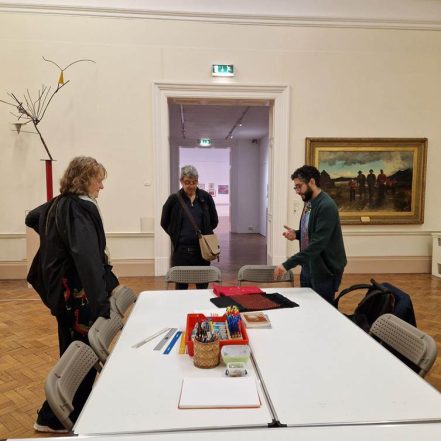
That’s where Ali and I found ourselves, somewhere between ghosts and graft, caffeine and conviction, talking at Cuckoo in Prestwich about radical film, what it means to be British, and whether Greater Manchester art is a scene or a siege. A few messages later, I pushed to bring The Legend of the Looms home to a local audience. So this isn’t just a screening; it’s a loop being tied. Bahrain to Rossendale to Bury: threads crossing mills, family rooms, dialects, and the stubborn afterlives of labour. The film asks who gets to weave the story; the venue answers: we do, together, right here.
I sat down with Ali Al-Jamri to talk about ghosts, cloth, and the futures we’re still making.
Jack Clarke: You’ve worked across poetry, film and performance, all forms that live somewhere between language and image. When you’re creating something new, what tends to come first for you: the words, the rhythm, or the picture?
Ali Al-Jamri: I think for me it’s the emotion, and I always start with poetry. When I think of Arabic, my other language, in Arabic the word for poetry is “شعر” (shi’r), which comes from the same word for emotion, and so poetry and emotion are one thing. The desire to express a particular emotion, comes before the rest. And then it’s figuring out what is the right way to express that emotion.
There are a lot of emotions in The Legend of the Looms. One of them, perhaps, is nostalgia. And that’s expressed through the rhythms of this poem, which draws on rhythms of both Lancashire English dialect poetry and Baharna Arabic dialect poetry, and so rhythm was a big part of that.
The film features your own family in Bahrain and draws on places like Rossendale – it feels both intimate and historical. How did making something so close to home change the way you think about memory and inheritance in your work?
Yeah, it was a really wonderful feeling to be able to go and film in my home village, and on the streets where I grew up, and on the streets with the weavers who, you know, 100 years ago, everyone in the village was a weaver or was in some way related to the weaving industry, and now there’s not that many weavers actually left.
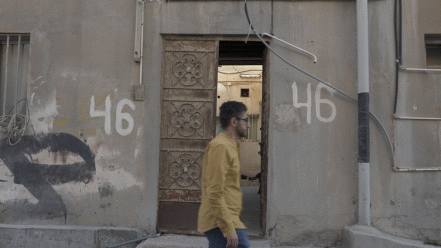
And so to go and to work with them and to really try to think, and live their lives as I had to to then tell the story that the film tells, took a lot of kind of getting to grips with that family legacy which we have maybe started to lose and started to forget, and which we want to try and hold on to.
But then equally, it made me have to search for the same thing in the English side of the story, and to find those senses of connection and those family links within England where I don’t necessarily have those. And so it was a very big learning process for me on both sides.
The Legend of the Looms is described as a “filmed poem of ghosts, cloth and survival.” That’s a powerful idea, poetry as something woven. When you were on set, how did you approach translating poetry into moving image, and what did you learn about collaboration through that process?
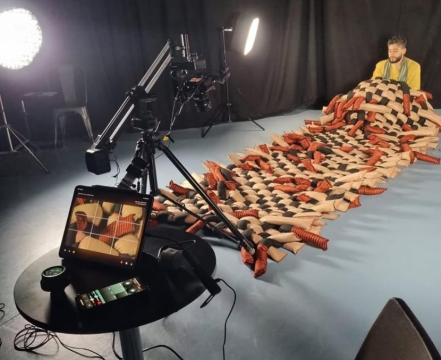
I think firstly, because it was written as a narrative poem, there were a lot of parts that were quite stage-directiony, if that’s a word, and so recognising that such a line, for example, “on his high throne the Lancaster weaver said,” I don’t need that, because I’ve got the medium of film to show him on his high throne and show him saying it. So there was a part of it which was understanding that.
And then there is another element of maybe identifying the patterns and the symbols that I’d used and reinterpreting them for a visual medium. So recognising that early on, the Bahraini weaver tells three stories of three unfortunate souls, and trying to find a way to symbolically show those three stories, each building one on the other. That was a really interesting process, because I think once I’d figured out those symbols, that helped me understand how the rest of the film would be made and what imagery we would be using for the rest of the film.
It was a constant give and take, and we did edit some of the words as well to better reflect the film that we would be making over time.
When you’re translating poetry into moving image, there’s always the question of what might be gained or lost in that process. Having gone through this with The Legend of the Looms, what did you discover about the relationship between poetry, film, and collaboration?
It’s easier now that I’ve done it on what felt to me like a big project. And when I started it, I couldn’t really imagine it as a filmed piece. And it was a big collaboration, and those collaborations were an important part of creating it. I couldn’t have made it without Ricardo Viela, who is my film director and co-producer. I couldn’t have made it without Patryk Krol, my composer, and my curator with the Arab British Centre, Jessica El Mal. All of them were very vital in bringing that creative vision to life.
But to start with, you know, my experience had always been as a writer, and so to move into the visual, there was a really big learning gap for me. I think ultimately they work really well together, because when I think about poetry, it has always been a performance art. Back before the written word was a thing, we already had poetry, and poetry was made to be performed, and it was made to be heard.
And I think film is our way today, it’s a very modern way—but it is still a form of performance and sharing that is maybe truer to the origins of poetry in some ways than a written text is. And so actually performing it in that way has been a really exciting way to be connected with what I think poetry is.
Showing this piece in Bury, a town shaped by the same mills and machines that echo through your film, adds another layer. What does it mean to bring The Legend of the Looms into a place with such deep textile roots, and how do you think audiences here might see themselves reflected in it?
You know, every time I’ve shown the film, there’s always people who come up to me afterwards and tell me a story that has come to them because of the film, like a family history of textile workers, or of some link in some way to this story.
And parts of it were shot in South Lancashire and in Rossendale, in the Rossendale Valley, and some of it was shot over at Peel Tower. So these are landmarks which residents of Bury and South Lancashire will recognise, and there is a feeling of locality, I hope people that this is speaking about that which is familiar to us here in the Bury area, but in a new way.
The film speaks about survival, resistance and imagination, all still urgent themes today. What do you hope people carry with them after watching it, especially those from working-class or diasporic communities trying to tell their own stories through art?
You know, I’m very conscious about globalisation and that impact on us culturally. I grew up in the ’90s with all of those Disney films, and people in America and in Europe and other parts of the world, grew up with the same films. And on one level that can seem incredible, but on another level, isn’t it kind of sad that millions and millions of people had essentially consumed all of the same media?
I think that makes us lose something, and it makes us lose our own particular culture that is tied to the local areas that we grew up in. And so for me, there’s a really big link there with dialect. We’re always constantly aware of losing our dialects and constantly aware of older generations in our communities and in our families who have stronger dialects than we do , whereas we are kind of slowly seeming to resemble each other, and not necessarily in a positive way.
So for me, that’s been a really big part of this, actually re-establishing the links to the local in order to think about what it is that makes us us, and what makes us almost uniquely us. But “unique” is a word that makes it sound like we exist apart from each other. We exist amongst each other and with each other. Finding that thing that is emblematic of our specific communities has been important to me.
And it’s not an easy thing to reject and consciously act against that kind of globalised culture and try to find the local culture, and actually engross ourselves in it and enjoy it and feel pleasure in it and express it ourselves. But I think by doing that, it helps us keep hold of our roots and of our identity as people from particular places in a particular context.
The film brings together different histories and geographies, but also seems to bridge communities. How has making The Legend of the Looms shaped the way you think about belonging and what it means to build connection through art?
It’s interesting because it’s become a much more topical thing, perhaps, than when I first came up with the project, this idea of what does it mean to be British? And fundamentally, the poem, the film, is about the encounter of a Lancashire weaver and a Bahraini weaver, and their immediate rivalry, then the respect, and then friendship that happens between them, all in the space of this ghostly story.
And in order for me to have written that, I really had to embody what it meant to be of Lancashire, and I had to embody what it meant to be of Bahrain. And the Bahrain part came easier, in a way, because I am Bahraini, and my parents are Bahraini. On the other hand, I’ve spent most of my life in England, I was born in England, and so I have a relationship with this country.
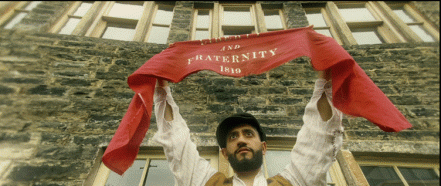
And it helped me understand that I think belonging is really about participation and having a stake in the place that you are in, right? And you can be an English person in England, or indeed an Arab person in an Arab country, with very little stake in your own community and in your own land. And equally, you can be someone from a different part of the world, in a new part of the world, yet be putting all of your stakes into that land and being part of it.
And I think that’s really what belonging ultimately is about, and in a way, writing this helped lead me to this idea and to this thought.
A lot of your work, and this film especially, feels rooted in the idea that culture shouldn’t just belong to institutions, but to the people who live it. When you think about cultural democracy, what does that mean to you in practice? Is it about access, authorship, or something deeper, about who gets to define what culture even is?
There is a big problem, isn’t there, in terms of arts funding and who’s getting the money, and how little money there is going around and equally, what we can create, especially on maybe smaller budgets as well.
And again, what we should be doing as artists, I think, is being true to our cultures and that doesn’t mean, you can only write about this because you’re from this particular culture and you can’t necessarily write about that, but it’s about being true to those communities that we are from and finding ways to reflect those communities.
And so to do that truly, you also have to really understand your community, you have to go and speak with your community. If there is a particular thing that is at the core of your community and you’re not speaking to that, that’s where inauthenticity can occur.
So I think there is something there around just actually being true not just to ourselves, so to speak, but to our people and our communities around us.
This film sits in dialogue with both Bahrain and the North of England, two places bound by threads of empire, labour, and survival. When you look at The Legend of the Looms through that lens, what does it say to you about Britishness today? Do you see Britishness as something to reclaim, to resist, or to reimagine entirely?
I feel like when I was growing up, I was British and it really wasn’t an issue or a conversation. It was kind of just taken for granted.
I wonder if I was 18, 19 today, that kind of age where you’re just coming into your personal identity and figuring things out for yourself, how I would feel. I feel like I would have a lot more pressure to accept or reject Britishness than I do now, as someone whose own personal identity questions didn’t need to include this fight over what Britishness even means.
I think that’s still an ongoing question. But as someone who was born here and continues to live here, of course I have a stake in what it means to be from here. This film is part of that conversation.