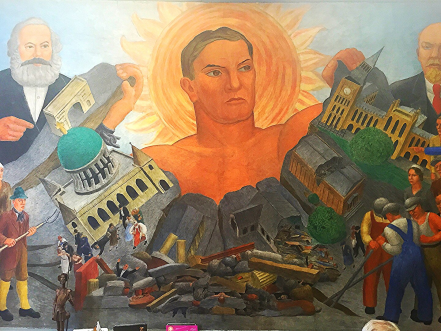
The Worker of the Future Overthrowing the Chaos of Capitalism (1935) fresco by Viscount Jack Hastings at the Marx Memorial Library and Workers’ School in London. Photo by Ben Sutherland via Wikipedia Commons, Creative Commons License 2.0.
By Geoff Bottoms
Many years ago during a particularly severe winter in the Yorkshire Dales, a shepherd went out to look for his sheep. He never returned. Search parties were sent out and eventually discovered the man’s dead body beneath many feet of snow. The villagers were naturally stunned by the man’s death but they were also puzzled. The man had been found clasping the third finger of his left hand. No-one could explain this until the old schoolmistress recalled a lesson she used to teach the children; she would make them recite the line “The Lord is my Shepherd” and at each word she would point to a finger of her hand beginning with the thumb. As the third finger corresponded to the word “my” it was obvious that as the man lay dying he was affirming his faith that God was his shepherd and therefore had nothing to fear.
In the tenth chapter of St John’s Gospel Jesus refers to himself as the Good Shepherd. Again we come across one of his “I am” sayings, signifying his divine mission, which would resonate with the disciples as the priests, prophets and kings had failed regularly in their responsibilities to such an extent that God had often taken back the flock into his personal care. Now they were entrusted to Jesus, whose mission following his resurrection from the dead, would eventually extend beyond his own people to embrace the whole of humanity. Yet the words of Jesus must have come as something of a shock when he said, “And other sheep I have, which are not of this fold; them also I must bring, and they shall hear my voice; and there shall be one fold, and one shepherd”.
Of course sheep are not pampered and coddled, shampooed and deodorised. They are smelly, frisky, freedom-loving and get themselves into all sorts of difficult and often life-threatening situations. Archbishop Desmond Tutu puts it so well when speaking about the parable of the lost sheep: “It is no lovely lamb that the Good Shepherd seeks and finds. No, it is this awful troublesome creature and the Good Shepherd is prepared to leave ninety-nine perfectly well-behaved sheep to go and find not a fluffy little lamb but that troublesome old ram which breaks through a wire fence and gets its fleece torn, and maybe it smells to high heaven since it will have fallen into a ditch of dirty water.”
We must remember that in the ancient world the shepherd’s livelihood depended on his flock for their fate was his. If they starved, he would starve; if they were attacked by thieves he would be attacked too. Consequently it was the most natural thing for a shepherd to risk his life in defence of his flock. Sometimes he had to do more than risk his life – he had to lay it down. By comparison a hireling came into the job not as a calling but as a means of making money so that if thieves or wolves attacked the sheep he would make a fast exit to save his own skin. There were many false shepherds throughout Israel’s history yet here was Jesus who so identified himself with his flock that he allowed himself to suffer death for their sake so that they would never be stolen from his love.
This image of the Good Shepherd who laid down his life for his sheep is so powerful that the earliest representation of the risen Christ is to be found in the catacombs or underground cemeteries in Rome where he is depicted as a young man carrying a sheep on his shoulders. Such is the intimacy between him and humanity that we need to discern his voice in a noisy and turbulent world and follow his call in the knowledge that he seeks our liberation from all that oppresses us. This is the nature of eternal life and it begins here and now rather than with the promise of jam tomorrow.
Of course we are not just sheep that follow but also sharers with Jesus in his mission to get involved with the smells and the mess of this world in order to create the world that brings everyone within the embrace of God’s universal and unconditional love. In today’s polarised world this has its cost, especially as we exercise God’s “preferential option for the poor.”
There’s a lot of talk today about “woke-ness.” While it was originally coined in the 1930s by African-Americans meaning being “alert to racial prejudice and discrimination” it has been hijacked by those engaging in a so-called “culture war” for their own ideological and political ends. Yet if by ‘woke’ we mean ending racism and inequality, treating immigrants and refugees as brothers and sisters to whom we have responsibilities, confronting our historical links with slavery which has shaped our country and our world and repairing the harms of the past, caring for our planet in the face of vested interests, and striving for a world where everyone has an equal chance and is free to reach their full potential then followers of Christ can legitimately claim to be “woke” in the truest sense.
Yet what is it about our world that leads to tyrants flourishing, half the world dying of trivial and serious diseases for lack of medicines that the other half take for granted, and people being trafficked, enslaved and abused because human wickedness sees them as a means of making money? What is it that has conspired throughout human history to make people want to starve or kill each other to gain their land, their wealth and resources, their prestige? What is it about power that means people who have achieved it never want to part with it? What is it about world economics that consistently means that the rich become richer and the poor become poorer in consequence? What is it about human nature that means that we seek comfort in our time even when we know that we are creating an environment in which our descendants will struggle to maintain basic human life?
The answer lies not only in the complicated nature of our humanity but in a system rooted in exploitation, oppression and violence that serves the vested interests of the few rather than the many. The future is either socialism or barbarism, as Rosa Luxemburg once succinctly put it. But this involves being involved in the historic class struggle to overthrow the capitalist order and usher in a new dawn for humanity, where in the words of Karl Marx, “the free development of each is the condition for the free development of all.”
There is a fresco by Viscount Jack Hastings at the Marx Memorial Library and Workers’ School in London captioned The Worker of the Future Overthrowing the Chaos of Capitalism dating from 1935 that captures this message perfectly. It appears at the top of this article.
Like Jesus the Good Shepherd who cares for his flock, the movement that follows in his footsteps is a community of people who care about the world in which they live and especially the vulnerable and marginalised. They may have their false shepherds, their unhappy divisions, and the baggage of theirr damaged humanity, yet the dream of Christ is that there should be one flock with him as its Good Shepherd.
As agents of his Kingdom of right relationships, those of us who are called to work with him to spread the Good News of his gratuitous love have a particular responsibility to ally with progressive movements everywhere in our shared struggle to bring a new world into being. Then we can truly proclaim that Christ is risen! He is risen indeed! And so are we! Alleluia!