By Alan Morrison
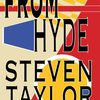
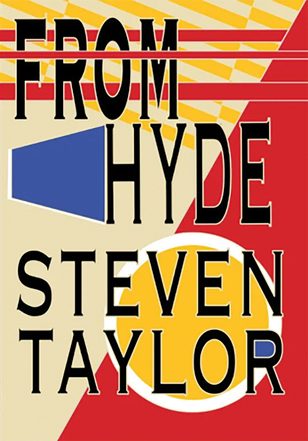
The first thing that strikes one about From Hyde by Steven Taylor is the striking graphic art cover design by poet and book designer Pascale Gouverneur, which riffs a little on Russian Constructivist art with its random abstract coloured geometric shapes, and also has a certain Mod (not say Modernist) aesthetic. Taylor is an appreciator of Constructivism of the likes of El Lissitzky so this might have had some bearing on Gouverneur’s design choices.
From Hyde is a book-length poem composed mostly in sentence case and a mixture of fairly short staccato lines, longer lines, and prose poetry, it forms as a lyrical social document-cum- Bildungsroman which also serves as a biography of its eponymous Tameside town where the poet grew up. There are echoes of Basil Bunting’s autobiographical book-length poem Brigflatts (1966), and Taylor references that work as an influence—along with Wallace Stevens—in the About the author at the back of the book (a poem in itself). The title might also be taken as a reference to a scriptural trope in the popular time-flipped/70s nostalgia police procedural series Life on Mars (2006-7).
Taylor’s stream-of-consciousness forms several different narratives that interweave with one another, and the trope ‘each length measured for a purpose,/ marked, and cut accordingly’, printed in bold type, punctuates the main text every couple of pages. It serves as a metaphorical anchor for the text as a whole, and also possibly references the cut-up approach to the poem’s structure and presentation. But primarily it is a leitmotif referencing the occupation of the poet’s father who worked as a textile cutter, and also that of his mother, who was a machinist (stitcher).
There are many aphorismic serendipities throughout this long work: ‘I’ve got a Granddad in the graveyard/ Purposefully neglected. He wore a belt/ Of blackened leather, punctured/ In order to be tightened. Loosened// Our life expectancy was worse than Dacca’s’; ‘My abilities deemed attention-seeking/ like the bulbous nose on a drunk’, and the powerful ‘Poetry is a serious matter/ Ownership is everything. There is power in land’.
Taylor’s great grandfather on his father’s side, Garibaldi, worked as a hatter, ultimately succumbing to the perennial occupational disease of the trade, ‘madness’ induced by the use of mercury. The hatting trade was once thriving in the Tameside district: ‘How hats were made partly from steam,/ Like doves or justice, a weekly wage/ Conjured from vacant space by a magician’. There is a poignant vignette on the poet’s great grandfather on his mother’s side, who was ‘an amiable soul/ Who put himself in uniform/ To avoid the dole’.
Taylor makes the distinction between his own radical Marxism and the relatively moderate Reformist measures proposed by some of the speakers at Peterloo in 1819: ‘Stephens cared nothing for universal suffrage/ But he could move a crowd …// Reform was the watchword/ Improvement not rebellion’. Taylor is critical of moderate progressivism elsewhere: ‘Gradualism was incontestable.// Christians vote Conservative./ It was in their nature. Labour/ Siphons off the anger of the others’. Here Taylor polemicises on the moral contradiction of church-going Tories, and associated social Darwinism, whilst also taking a swipe at Fabianism. Later time shifts to the most revolutionary year of the 19th century: ‘1848 was brilliant/ For pen and ink// A revolt in Paris/ An uprising in Vienna/ The Communist Manifesto/ Revolutions in Venice, Berlin, Milan and Parma’. Karl Marx is often a point of reference: ‘The Providence was built before/ The first volume of Das Kapital appeared’. There is the sense of wearing one’s learning on one’s sleeve as is typical of autodidacts: ‘Currently, he’s working his way through/ Franz Oppenheimer:/ The Social Problem and Socialism’.
Taylor was a culture-thirsty youth chatting with friends in a Manchester coffee bar in his own Knowledge District of the mind: ‘Of the four, sat around the table/ In the Jester/ A coffee bar on Market Street/ Discussing Manchester United/ I’m the closest to a Marxist/ The other three/ Are social democrats’. Hyde was once a wellspring of industry: ‘The Comination Acts forbade/ The amalgamation of persons for political reform/ According to Pitt,/ Citing the intemperate language/ Of the Irish and the French/ Not even words should be permitted to unite’. Even Hyde’s damp atmosphere was industrially auspicious as it was ‘good for cotton made the thread much less brittle’.
There is an intricate darkness to From Hyde (‘The Lord is my shepherd/ He leadeth me into dark pastures’), a black back cloth, a shadow side. And there is the aural association of the very name Hyde reminding us of the morally debauched shadow persona of Dr Jekyll in Robert Louis Stevenson’s sublime psychological allegory whose very title has become antonomasial shorthand for split personality. It’s no surprise then that this work contains many references to true crime, particularly the horrendous Moors Murders of the Sixties committed in and around Manchester and in Hyde itself where Brady and Hindley lived at the time, and the medical felonies of Harold Shipman in the Eighties and Nineties which were uncovered whilst he worked at a surgery in Hyde.
Myra Hindley is referenced with the first-person plural possessive determiner, as is often used in the North normally when referring to a relative, but in this case referencing the fact that Hindley (and Brady) lived in Hyde at the Hattersley estate where some of the crimes were committed and so suggestive of a collective community consciousness of which she is a dark part with the hinge of her name, and is laid out like an anti-prayer: ‘Our Myra// Permanent/ Unfarmed. Harsh & Unpretty,/ Dark brown stone pushing through/ Dark brown earth under a creamy sky./ Trees that huddle together like cattle/ Come to the gate for milking. A/ Dissipating mist. That infamous damp/ Chill. Reservoirs. Saddleworth Moor’.
The closing lines of From Hyde serve as a valediction on the town: ‘We were built on by factory owners and landlords/ More concerned with maximising profits/ Than adding lively details, curlicues/ Of peculiar contrasts. Our mills and churches// Were pragmatic. Means to ends// Any art works accumulated from our labour/ By our masters, went with them when they left us// Moved southward to live among their equals/ We would be required/ To make our mark on life otherwise// Shipman, Brady, Hindley’. The implication being that those from working-class backgrounds who don’t manage to ‘make their mark’ in any positive sense can run the risk of ultimately expressing themselves in a destructive way, though the examples of those three notorious names that close the poem with a bitter, wintry emphasis—not dissimilar to the symbolic colophon of the three main protagonists’ moorland graves huddled together at the close of Wuthering Heights—are extreme examples.
Taylor’s work also evokes that unmistakeable though difficult-to-define Brutalist alienation that has typified the tone of the cultural output of Greater Manchester throughout the late twentieth century. One thinks of the icy nihilism of Ian Curtis and Joy Division, and the compelling primitivist vibe of The Smiths, The Stone Roses and Happy Mondays. This is a gritty pop culture heritage which contrasts starkly with the antiquated blue-rinsed kitsch of Coronation Street. Manchester was of course home and painting subject of L.S. Lowry, and was the city on which Friedrich Engels’ based The Condition of the Working Class in England in 1844 and where he and Karl Marx wrote The Communist Manifesto. In the twenty twenties it is the birthplace of Andy Burnham’s “aspirational (i.e. capitalist-accommodating) socialism” known as “Manchesterism”.
But for the eponymous town in particular, with its mixture of rich industrial and cultural heritage but also of unfortunate associations with some of the worst crimes perpetrated in the mid-to-late 20th century, From Hyde is a distillation of the English—or at least North West English—subconscious. In chronicling this Northern town so forensically Steven Taylor has sculpted a poetic monument that casts a dark shadow in the disinfecting sunlight, an oral purgative, a catharsis of acceptance, a poem as memorial to the conflicting human drives of creativity and destructiveness, Thanatos and Eros, the death drive and the life (creative) drive. From Hyde is a significant long poem for our times.
From Hyde is published by erbacce-press (Liverpool) and can be ordered here
This is an abridged version of a longer review of this book recently published at The Recusant