

In this edition of Our Culture, Composer Ben Lunn discusses how working class people are often priced out of careers in classical music, how geography can make a difference and how ideology plays a part in what is composed. Alan McGuire then follows up with questions where Ben expands on certain points such as the opinion of classical music on the left in Britain today.
Art is limited by reality. Regardless of genius, universality of message, or intention, there are numerous limitations on artists throughout time. This could be due to technological limitations; Mozart never had the opportunity to write for a synth; this could be related to access to information; without encountering Gamelan, Debussy’s music would have been radically different; this could be due to economic issues; Holst could have written more music if he didn’t have to juggle performing and other responsibilities to make ends meet; or it could be political, what would have happened to music in England if Henry VIII didn’t split from Rome, or what would have happened to music in Scotland if they never unified with England and Wales?
All of these various factors, regardless of how much an artist directly engages with it, impact a composer. It could impact who they get to write for, where their music gets shared (if at all), or how much fame they could achieve in their lifetime. This ultimately means talent or genius alone cannot guarantee success. But it also means, the arts can only be as equitable as the society they are within. With all of this in mind, it is little surprise that only 13% of people working in the cultural sector are from working class backgrounds.
There have been many discussions about what could be done to improve the circumstance of working class people in classical music, however most of this focuses solely on access to opportunity and education. This without a doubt is vital but misses some of the bigger problems which are much more endemic.
Culture, as Gramsci pointedly describes, is a weapon of the ruling class whose complete monopoly of every facet of art and life that make their desires and wishes feel like common sense. Being aware of this fact is important, as it can give us understanding of how layers of our society and artistic sphere think, and can also show limitations, contradictions, or outright bias. Alongside this there are economic and geographical elements as well, which begins to paint a more thorough and complex picture.
Geography is arguably the easiest element to discuss. Essentially, if there aren’t jobs in an area, there are only so many people in that area who can work in that job. For Britain, due to devolution, there are three spheres of influences – namely England, Scotland, and Wales. In England, most work in classical music is centred around London, Manchester, and Birmingham, with other little elements in Leeds, Gateshead, and Bristol. So, practically speaking it is easier to be a working class composer in London than it is in Easington. Similarly, with access to music college education, this is all based in London, Manchester, Leeds, and Birmingham. This means for young musicians from the North-East or South-West have to move significantly if they wish to study in such a specialised environment, as opposed to a university.
Scotland is the next largest, however the financial gap between England and Scotland is quite marked, however Scottish Government funding is dedicated to approximately 5 million people as opposed to 50 million-odd in England. Scotland’s arts are predominantly based in Glasgow and Edinburgh, with minor elements in Aberdeen, Perth, and Inverness. Scotland’s only music college is in Glasgow. So young people in Scotland have to either move to Glasgow or to Manchester for their nearest music colleges.
Wales is in a similar situation to Scotland, where almost all cultural endeavours are situated within Cardiff (including Wales’ only music college). Though elements like the Eisteddfod travels around. Cornwall, as it stands is slowly, but surely, progressing closer to recognition as another nation within Britain. Though, artistically speaking, it simply does not have much in the way of infrastructure that is in any way comparable to Wales or Scotland. It should be mentioned here that there are many wonderful amateur ensembles up and down the country, however the issue for professional musicians is they aren’t likely to earn from playing with these ensembles; similarly, despite how positive it can be for composers to write for amateurs, very few have enough money to actually commission composers.
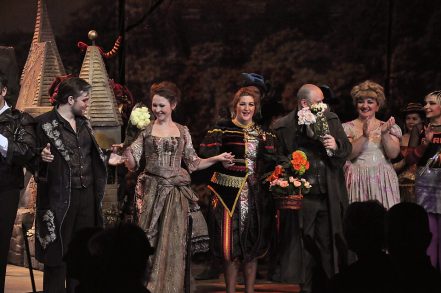
The Threepenny Opera
Economic elements, begin to be born from the geographical. Not every city needs to be the greatest hub of arts and culture – but this only works if travel between towns and cities is manageable and affordable. Someone living in Thurso, who wants to meet musicians to compose for in Glasgow, have a long and costly slog to get to Glasgow – and when such a meeting may be unpaid as it is a meeting to discuss potential work, it’s quick to see why certain regions of Britain are so under-represented within the arts. Other economic issues, surrounding low pay, limited performances, or limited streams, which limit how much return the composer gets in royalties, compound problems which makes working within the music sector financially harder.
The answer to these issues is very pragmatic. Namely, jobs need to be created across Britain, to ensure there aren’t numerous counties with little work for composers and musicians, improve royalties from streaming and concerts, and forcibly making organisations commission more work to avoid a situation where there are many orchestras who are performing historic and international superstars and not engaging with local artists.
The Divorce of Ideology and Class
The ideological level is much more complex as there is also a question of how the upper echelons of society view what is important in art, but also how they consider working class people should fit into it. This ultimately creates an incredible trap for composers and musicians, as it means composers and musicians have to create and perform music that does not reflect their lives, upbringings, or communities; or they have to act like a caricature of a working class individual, writing for brass bands, bemoaning the loss of industry, or twee uses of regional dialects.
Harrison Birtwistle is one great example of this, a working class composer who went onto be Britain’s most significant composer in the generation after Benjamin Britten. He is known internationally, and rightly so, because his music is unique in its power and energy which is hard to ignore even after decades have passed since his earliest works. However, the connections to working class roots are limited. His Grimethorpe Aria, which was commissioned by his friend Elgar Howarth for the Grimethorpe Brass Band is a remarkable piece, and a demonstration of Howarth’s bold intentions to elevate Brass Band music from marches and test pieces. It is one of my favourites works by Birtwistle, but it is clear the focus is more on the might of the mountain of coal than necessarily on the people mining it. That being said, if he tried to write a piece about the miners in Grimethorpe pit, would the work be as bold or would it have limited the imagination of what brass bands can do and make music about?
The Commission for Old and New Art has been a fascinating endeavour. They are an ensemble, predominantly based in Manchester and the North-West, and are wholly committed to performing music for working class audiences, having performed concerts for May Day celebrations and at The World Transformed (I was fortunate enough they performed my own string quartet at that concert). What makes them particularly remarkable is their commitment to performing works by composers who try to advance the political life of working class people, without diminishing on the intensity or quality of the art. This has included performances of Hanns Eisler and Ernst Hermann Meyer, as well as more contemporary composers like Jimena Maldonado. The work they do is excellent, however it is still too early to see how much of an impact they have had, as time will only tell what they can achieve.
Given that The Commission are a singular ensemble, they are model to be replicated in many ways, but without other regions having their own version they risk being a musical unicorn that are a miracle to those who can access them, but a myth for those out of reach.
Both examples are positive examples, but it does not break hegemony. Much like having a handful of women composers, does not mean classical music has transcended misogyny, a handful of working class composers alone do not remedy the issues we see within the art form.
What both examples show are strategies of how to battle within the current circumstances. Either by abandoning class concerns or accepting a relatively narrow connection. As has been witnessed by the response of the state against any form of solidarity with Palestine, speech is free until it crosses the line. This is also apparent within classical music. Though it is much more elaborate, as the art form is one of the more genteel spheres – so police aren’t going to carry off composers into vans for writing some notes, but a composer can be quietly blacklisted for life; the example of Alan Bush shows this has happened and can happen again.
Though, as Gramsci cleverly noted, this extreme level of force is only a last resort, as the state has more subtle methods to maintain its own interests. The most potent, and remarkably simple, is simply not referring to class, opting instead to discuss ‘socio-economic background’. Meaning the whole discussion around class is a weak and empty discussion. Treating working class people as pitiable, and in need of charity, but not truly human enough to warrant making their own art.
Beyond this, there are numerous discussions that crop up from time to time, which try to suggest class is no longer relevant in British society. Though they often point to facts, they stray wildly from the truth. Yes, we don’t have the former industrial base we used to have, and the trade union movement is almost the shadow of its former size, but that doesn’t mean the class conditions have truly changed. But with the purposeful change of tone to ‘socio-economic background’ we stop unifying people, and instead equate class solely to poverty, with no hint of dignity or identity.
Until we can remove this, and begin to see composers and musicians speaking about working class life with not just dignity, but with artistic licence which shows we can be truly human, and not just some plebeian entity that needs to educate ourselves out of our suffering, we cannot even truly begin to consider how working class artists can begin to overturn the current hegemony set before us. Until we have a dignified voice which can openly speak its name, working class composers and musicians are eternally trapped.
AM: You have clearly laid out the geographical and economic factors to accessing a career in classical music for working class people, but what are some of the broader issues that the working class face when it comes to engaging with classical music?
BL: There are many ideological questions and barriers, however ideology with the material reality is like putting the cart before the horse. However, the barriers that do exist are firstly the matter of education is a tricky one, as there are attempts to make music education more progressive generally; which is a positive development to a certain extent. However, the way in which composers are discussed implies that they tacitly accepted the world as it is – there is little discussion about the radical politics of Gustav Holst, or Aaron Copland; similarly when you look at the British composers in particular, you’ll quickly spot most composers from Britain discussed are rarely from industrial areas – often from the more genteel parts of the UK. So this creates a feedback loop of sorts, where composers from working class areas don’t see themselves in the history, so maybe don’t become composers, which means future generations from that area repeat the cycle.
Then as I mentioned in the article, there is a question of what topics can a composer compose a piece about? There is a lot of encouragement to write about the environment, which is important, but how many of these pieces critique the fundamental problems of society and how many mourn the loss of animals or countryside? The issue with this point is it is much harder to work out how blacklisting or silencing such topics happens as the journey to commissions can be a lot of smoke and mirrors already.
AM: How would more cultural democracy in classical music function and are there any examples from abroad, either past or present, where it is practised?
BL: There is a certain element that addressing economic factors will address a lot of these issues. If, for example, local councils had enough funding to have a local chamber orchestra (an ensemble of approximately 40 musicians), who had to showcase music by composers from the area the council represents that can begin to build a local infrastructure which sees the orchestra at service of the community (and bringing all the benefits access to music brings), but also means a composer can live and work in their hometown; within this dream we’d see a dramatic shift. Simply look at the roots into football in comparison to classical music. Despite all the flaws of football, and opportunities to jump from amateur youth things to the profession, there are at least clubs up and down the country and community clubs everywhere, whereas classical music has huge swathes of the country with no regional orchestra with a long-term presence.
Many parts of mainland Europe have positive elements in this shape, but they are also plagued by ideological issues, however all regions of Germany have their local orchestra, and opera, and so on which means that accessing art for the sake of it belonging to the nation is ingrained in society. Similarly, in places like Cuba and China music is present everywhere.
AM: If a truly left wing government were elected tomorrow, what practical policies could it implement to facilitate easier access to careers and participation in classical music for the working class?
BL: It’s not necessarily an issue of policies, but more one of culture. The left in general has very mixed feelings to classical music in Britain, and simply the idea that considering classical music can belong to all people in the country is seen as absurd, elitist, or simply seen as untrue (due to some innate flaw in the genre). Without addressing this, education always risks talking about it like a museum piece, or something you can learn about but your social betters get to do it, and then in the profession actually feeling a part of it while working class.
From there, we can think about educational, and routes from first picking up an instrument to making a life with it, or having access to it simply because it makes life richer. But while we have many on the left try and paint classical music as something innately anti-working class, or imperialist, we see people who’d rather campaign that we’d abandon entire art-forms than fight for bread and roses.
Read the rest of the editions from the Our Culture series:
Culture as Class Struggle: An Interview with Jenny Farrell
Our Culture: RIP British Working-Class Cinema (1935 – 2025) by Brett Gregory
Our Culture: The Uncomfortable Truth About Public Libraries
Our Culture: Breaking through the Class ceiling with bread and roses
Our Culture: Games and Class Struggle – with Scott Alsworth
Our Culture: Prize-winning Poetry Only Please! with Andy Croft
Our Culture: Democratising the BBC











.jpg)
