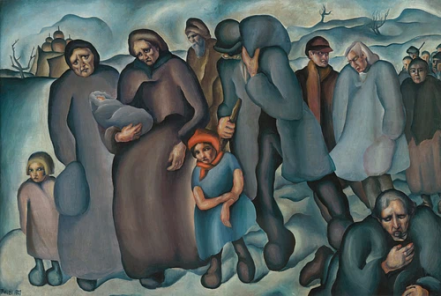
Refugees by Konštantín Bauer
By Omar Sabbagh
How should we view the past? How do we do justice to the stories of the vanquished? How might the horrors of late capitalism be redeemed? Let us consider Walter Benjamin’s thinking on the subject.
In ‘Convolute N’ of his uncompleted, posthumously gathered and published, The Arcades Project, the section on the ‘Theory of Knowledge, Theory of Progress’, Walter Benjamin develops his ideas about the representation of the past in ways that are congruent with his ‘Theses on the Philosophy of History’. For Benjamin the truth of history was to be found in moments of illuminative awakening, like those we find in Proust, where the continuum of time that makes up history is exploded. He states:
It is not that what is past casts its light on what is present, or what is present its light on what is past; rather, image is that wherein what has been comes together in a flash with the now to form a constellation. In other words, image is dialectics at a standstill. For while the relation of the present to the past is a purely temporal, continuous one, the relation of what-has-been to the now is dialectical: is not progression but image, suddenly emergent.
By dialectics at a standstill, or what he called alternately ‘dialectical images,’ Benjmain is putting a searing question to a continuous, linear notion of history and how we think of history. His notion is a modernist one, a notion that prioritizes the significance of the ‘epiphany’ or ‘ex-stasis’ – a sense of how discontinuity can serve to enrich and illuminate any fixed line of continuity, or continuous narrative.
The liberatory apotheosis of this view is like for Benjamin the effect of ‘splitting the atom’ of continuous history, which by the sign of its very set, established continuity, is clearly only the (univocal) victors’ stories. Each negative from the past, thus, each lost wish, desire, hope, dream, each part of the past that has been elided by a victor’s continuous narrative, is to be redeemed in his mildly mystical model. It is given an emergent, awakened voice, until all of history is redeemed, and we have in effect utopia on earth, or if you like, however figuratively, the ‘messianic kingdom.’ All the what ifs actualized as it were, as having been.
This is of course an extreme and emphatic stance, never achievable in empirical human history, but does to my mind remain a highly valuable regulative ideal to strive towards, as we keep on with the effort at rendering history the history of history; for ‘humanity’ is and remains a project, not a concept I don’t think to be used referentially. If you look at our world today, where might proves right, there is little to correspond ‘out there,’ to such a normative concept or conception of humanity. The world we live and live in remains to a significant extent, barbaric, animalistic. And it’s precisely because of this last point that Benjamin’s theorizing stays apposite, urgent advice. To illustrate….
No Hitler, no Stalin, no Holocaust, no Israel
In the Autumn of 2003 the renowned literary critic Edward W. Said died. That winter, in the wake of his passing, a friend and comrade of Said’s, Tariq Ali, published an obituary article on him in New Left Review – a chunk of memoir in commemoration. In it, Ali reports having once asked Said if the date “1917” meant anything to him – its main meaning for Ali being the Bolshevik revolution. Said, we are told, replied that yes, it did: “the Balfour Declaration.” Without claiming a status on a par with either of these writers and thinkers, I would like to intervene (so to speak) here. The pivotal date (or, as is implicit from what follows, oneof any number ofthem) in the twentieth century for me is the winter of 1918-1919.
Many, many years ago I read J.P. Nettl’s two-volume biography of Rosa Luxemburg. Towards the end of the second volume he writes of Luxemburg’s assassination, on the cusp of a potential Communist revolution in a war-torn, disintegrated Germany. What struck me as intimated by this scholar’s tale was the tenuousness of Luxemburg’s last days; the tenuousness of the fate of that shattered Germany. Kautsky and other German Marxists had fought and planned for revolution for decades. That winter of 1918-19 revolution was a very real and imminent possibility. At the last minute, Kautsky and his cohorts, on realizing the extent of their potential majority in a bourgeois parliament, hesitated, and succumbed to what we might think of as home comforts. This meant, in effect, the sacrificing of the “Spartacist” extremists, Luxemburg and Liebknecht. They were swiftly disposed of.
But just imagine. Had what was eminently possible happened, had there been a Communist revolution, not in a backward peasant economy like Russia, but in the centre of the world-system, where, unlike Russia, the objective and material levels of development might not have necessitated draconian and oppressive political moves – then the whole of the twentieth century would have been totally different. No Hitler, presumably, no Stalin. No holocaust. No holocaust, no Israel, or at least, no Israel in its current form. And so on…
An art we can all practice
In other words, Benjamin’s thinking is a vital source of inspiration, a living one, because the past for him is still living, still in a state of becoming, rather than ‘having been.’ To think of the past not as an established line but more artistically, where the present targets the negatives and with imagination realises them, is the only really progressive way of thinking about and approaching history. For, trivially, if the past had to be the way it was, then by the facile notion of cause and effect, the present must be the way it is. Which means the future, too, is overdetermined. And you don’t have to be a great writer of historical fiction to benefit from Benjamin’s wisdom. You don’t have to be Proust either.
Thinking of history and the past the way Benjamin does is an art we can all practice. Just as a skilled writer sacrifices humdrum chronology and tries, by his or her feats of omission and commission, to represent a story that discloses not, say, what the main protagonist had for breakfast, lunch and dinner every day, but the meaning in the pattern of experience, so each of one of us can act and practice a cognate art by never forgetting to keep trying to do justice to all the elisions of the stories of the vanquished, the conquered. Not necessarily till ‘Kingdom come,’ but to the best of our abilities.
I want to close by considering this seemingly hopeful stance in a little more detail. Because the sense of hope in Benjamin’s thinking about the state of the world in which he lived was caught in a paradox. He needed the notion of totality, which he calls ‘redemption,’ but by his conceptual use of said regulative ideal, he reveals a totality that is not one – a world in shreds, a hopeless world. The disharmonies of the twentieth century capitalist world can only be grasped under the light of an ideal, and without that ideal, political commitment to work towards a better world would be impeded. At the end of his surviving protégé, Theodor W. Adorno’s Minima Moralia, in the closing aphoristic section titled, ‘Finale,’ Adorno writes (clearly an epigone of Benjamin here):
The only philosophy which can be responsibly practised in the face of despair is the attempt to contemplate all things as they would present themselves from the standpoint of redemption. Knowledge has no light but that shed on the world by redemption: all else is reconstruction, mere technique. Perspectives must be fashioned that displace and estrange the world, reveal it to be, with its rifts and crevices, as indigent and distorted as it will appear one day in the messianic light.
And here is an extract from one of the sections of Benajmin’s beautifully-wrought One-Way Street:
Our feeling, dazzled, flutters like a flock of birds in the woman’s radiance. And as birds seek refuge in the leafy recesses of a tree, feelings escape into the shaded wrinkles, the awkward movements and inconspicuous blemishes of the body we love, where they can lie low in safety. And no passer-by would guess that it is just here, in what is defective and censurable, that the fleeting darts of adoration nestle.
Whether in Adorno’s philosophical register or Benjamin’s lyrical, personal one, the common idea is that it is only in the light of the end – God, redemption, love-and-beloved, or what have you – that we can achieve an ‘objective’ view of the state of our fallen world. Indeed, in his Hegel: Three Studies, Adorno speaks of the truth of Hegel to the twentieth-century world of late capitalism, as revealing that the whole, the system, the totality, was an ‘antagonistic totality.’ That the notion of the whole was true, but only by way of a thoroughgoing recognition of its very lack of closure or harmony or ‘wholeness.’ The truth of things only true as the untruth of things. Indeed, the parallel to Benjamin’s notion that every document of culture was a document of barbarism, in Adorno, comes by way of his famous dictum from Negative Dialectics, that there was a straight line through ‘civilization’, of barbarism from the slingshot to the atom bomb.
Both Benjamin and Adorno made use of notions of completion or redemption, but not in a directly religious sense. There was nothing naïve about their takes on the horrors of the modern capitalist world. Their use of such theological or indeed mystical figures was politicised. It is only in the light of (some very distant) perfection that we can really see, judge and criticise the horrible imperfections of the world we love, or would like one day to love.