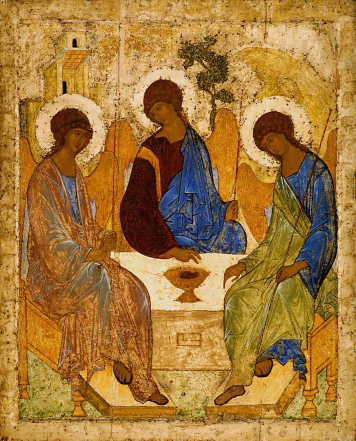
The Trinity, by Andrei Rublev
By Geoff Bottoms
In Genesis chapter 18 verses 1 – 8 God appears to Abraham as three men. Abraham and Sarah seem to see the divine in the presence of these three and they bow before them and call them “my lord” before offering them hospitality in the form of food and drink at the family table. This story inspired a piece of devotional religious art (above) by Russian iconographer Andrei Rublev in the fifteenth century entitled The Hospitality of Abraham, or simply The Trinity, which points beyond itself to the God who is both holy other yet ever present in our midst.
The icon shows the Holy One in the form of “a joyous threesome”, to quote the late Bishop Michael Ramsey, who are eating and drinking in an infinite hospitality between themselves. The gaze between the Three, understood as Father, Son and Holy Spirit, shows the deep respect between them as they all share from a common bowl yet the Spirit’s hand points toward the open and fourth place at the table as if inviting, offering, and clearing space for another guest.
At the front of the table there appears to be a small rectangular hole. Most people pass right over it but some art historians believe the remaining glue on the original icon indicates that there was perhaps once a mirror glued to the front of the table reflecting the face of the discerning observer who found themselves invited to sit at the divine table and consciously participate in the divine movement of loving and being loved.
Dynamic love relationships
All too often the Trinity is reduced to a quasi-mathematical formula epitomised by the Creed of St. Athanasius. Yet in order to gain some access on the mystery of the Trinity we have to think of it in terms of relationship. St. Augustine once described God as the Lover, the Beloved, and Love in which the Father as the Lover eternally pours out the fullness of his love and being on the Beloved Son, who returns it in full and equal measure because the Holy Spirit is that bond of Love between them.
In short, the Trinity is a family of love and we are invited to share in this dynamic celebration of love together with the whole of creation for love reaches out beyond itself to draw in the other. This is what Rublev’s icon is trying to express and it goes to the heart of all our worship which is directed to the Father through the Son in the power of the Holy Spirit.
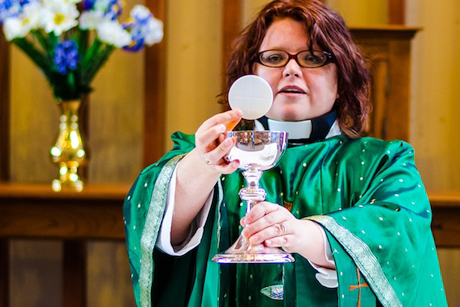
Of course this cosmic dimension to all our worship reaches its sublime expression in the Eucharist, when we are lifted into the divine liturgy of heaven, as the redeemed offer their sacrifice of thanksgiving in union with the Lamb slain for us from the foundation of the world. The words of the Sanctus in the Eucharistic Prayer unite heaven and earth in one great paean of praise, as we are embraced in the life and love of the Trinity, that has been described as a divine dance reflecting the flow of giving and receiving that lies at the heart of reality.
This now brings us to the social and political implications of the doctrine of the Holy Trinity so clearly spelt out by the Broad Church priest, theologian and Christian Socialist F. D. Maurice. For him this meant the recognition of the love of the Triune God expressed in the order of creation and in the law of brotherhood derived from that order. In his words:
Since the Triune God is the creator of the human race, the likeness of his eternal charity dwells in the human race, and the Trinity in Unity is the source of human fellowship in those who repent of their self-centred isolationism and discover the true principle of their being.
Today we would speak more in terms of the common good so that all our actions both as individuals and as a society come to recognise the interdependence of all things not only on a local or national level but also on a global and cosmic scale. As Karl Marx once put it:
It is not the consciousness of men that determines their being, but, on the contrary, their social being that determines their consciousness.
If we are created in the image and likeness of God the Holy Trinity, who created us as social beings, then we are made for communion with him and with each other so that we reflect the inner dynamic of his life and reality in our relationships with others and with the whole of creation. Returning to Rublev’s icon we are not the only one’s at the table.
So the Trinity reminds us that “no man is an island” and that we are our “brother’s keeper”. This is the message of hope which our faith has to offer a dark and dangerous world that is more intent on erecting walls and fences rather than building tunnels and bridges. As Rowan Williams reminds us when we see the stranger as the other, rather than the one with whom we can have a mutual life-giving experience:
God is the unimaginable, loving intelligence, from whose everlasting action comes everything, and whose everlasting, loving intelligent action is both focused utterly on you and me, and on every other being that is made. And the meaning of life is that I and you should so grow together in our wonder and delight at each other, and our willingness to serve each other, that eventually we will grow into a fullness of conscious joy and love in relation to God, which nothing can ever take away.