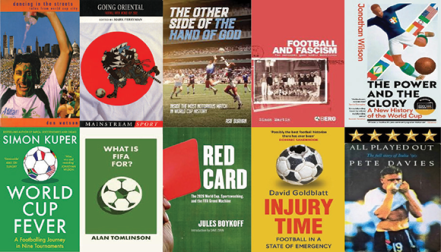
Philosophy Football’s Mark Perryman recommends ten reads that reveal the tournament at its best and worst.
After three weeks, the World Cup finally gets down to the serious business. The starting 48 teams have been whittled down to the last 16. Win or go home.
Yet the ‘serious business’ of a World Cup has, from the very beginning in Uruguay in 1930, always stretched far beyond the touchline. It is the only truly global sporting event. Even the Olympics don’t come close when it comes to mobilising the passions, partisanship and shared sense of community of a worldwide fan base.
Uniquely combining popular nationalism with popular internationalism, it is something politicians and activists alike have always struggled to comprehend. The joyfulness of the tournament survives more often than not in spite of, not because of, FIFA, the multinational sponsors or the political leadership of the host nation.
The World Cup, if we look carefully enough, shakes the world.
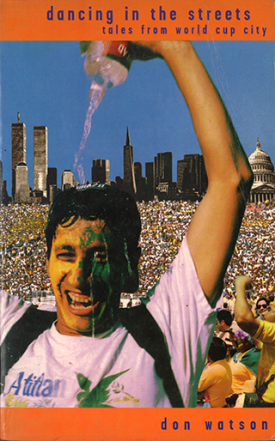
Dancing in the Streets: Tales from a World Cup City
Don Watson
The last time the USA hosted a World Cup, it did so on its own, and England had failed to qualify. All the joy of Italia ’90 and England’s barnstorming run to the semi-finals came to naught under Graham Taylor’s mishap-strewn management. Meanwhile, 1966 World Cup winner Jack Charlton, snobbishly overlooked as England manager because he didn’t quite fit what the FA thought the holder of the post should look like, sound like or behave like, took the Republic of Ireland to their second successive tournament, USA ’94.
Don Watson, previously best known as a music writer on the 1980s must-read weekly New Musical Express, turned his hand to football to write a book that not only captures the unique experience of following your nation to a World Cup, for Scotland 2026, read Ireland 1994, but also how this hopelessly and joyfully intersects with the globalism of both the host nation and the fellow World Cup competing nations. Of course, we can get a flavour of this through the media, but nothing compares with the experience itself.
With Dancing in the Streets, Don captures this brilliantly and, along the way, both coins and develops the term “World Cup City”. My dog-eared copy helped convince me I had to be there the next time. France ’98.
Available second-hand from AbeBooks.
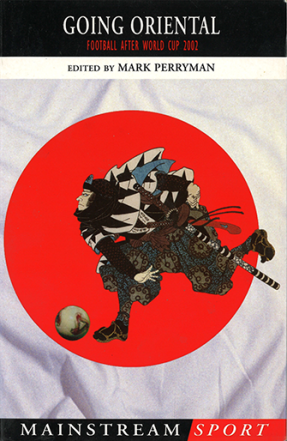
Going Oriental: Football after World Cup 2002
Mark Perryman
And you could say I, just like hundreds of thousands of other England fans, promptly caught the World Cup travelling bug. That bug was given an injection of full-blown footballing global internationalism by Japan 2002. Unlike France ’98, this was a country few travelling England fans had visited before and knew next to nothing about, including me.
So how to do a book? Japanese and South Korean contributors to fill in the blanks. My favourite football writers. England fans reporting on their own experiences. Political and cultural writers providing the broader context.
England went out at the quarter-final stage, so there was no happy ending on the pitch. But thanks to this brilliant range of contributors, with Going Oriental I did my best to provide one off it.
Available second-hand from World of Books.
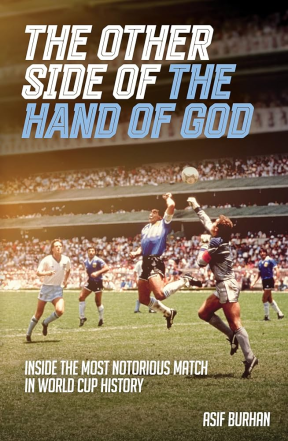
The Other Side of the Hand of God: Inside the Most Notorious Match in World Cup History
Asif Burhan
Are World Cups all sweetness and light? No, of course not. Any World Cup is made up of a complexity of rivalries, some the product of a history off the pitch, some down to events on it, most a potent mix of both.
Mexico ’86 was preceded by the small, or rather the big, matter of the 1982 Falklands/Malvinas War, an episode that, on both sides, has become hopelessly confused with events on the pitch ever since. For the Spain ’82 World Cup, FIFA fixed the draw so that, unless the two teams made the final, they couldn’t meet. Sorted, or so they thought.
Asif Burhan, whom I first met as a fellow travelling England fan, in his debut book The Other Side of the Hand of God tells in fascinating detail how the football and this short war became hopelessly mingled. Argentina, their armed forces having suffered a humiliating defeat off the pitch, were only able to win on it through bare-faced cheating. What’s to like? Not much.
Asif helps us to understand this moment in two nations’ shared football history. Yet it can’t be divorced from the contrary fact that all but the most embittered England fans would gladly, if a little grudgingly, recognise. Notwithstanding his ‘Hand of God’, Maradona remains one of the world’s footballing greats.
Available from Pitch Publishing.
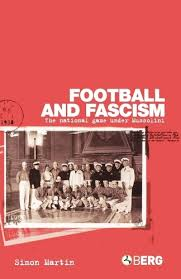
Football and Fascism: The National Game under Mussolini
Simon Martin
Sport and fascism? Oh, you mean Berlin 1936, the Nazi Olympics, the Olympic movement’s cohabitation with Hitler, his infamous walkout when Jesse Owens’s winning four gold medals humiliated Adolf’s fervent belief in the racial superiority of the white Aryan. A familiar enough episode for most sports fans.
Yet Mussolini’s connection with Italian football is, in many ways, much more significant. The inaugural World Cup was held in Uruguay in 1930. The second, Italy 1934, took place at the height of Mussolini’s power, and Italy won the competition, becoming the first European nation to do so. Then, at France ’38, they became the first team to win the World Cup away from home.
Mussolini unashamedly exploited these victories for their propaganda value, both at home and abroad. But more than that, Italian football was reorganised under his leadership. He created the modern national league, Serie A. Sounds familiar? In Rome, Turin, Bologna and Como, clubs’ stadiums were rebuilt, featuring Mussolini’s name in their title, a statue in his honour, or both. This was a regime that absolutely understood, and exploited, the power of football to promote fascism.
Simon Martin’s book reveals a history that football would rather forget. It is an account that leaves the reader thankful that Trump, apart from no doubt showing up to spoil the World Cup Final, has shown little interest in football. This tournament, despite his worst efforts elsewhere, has instead shown the power of football to unite in joy rather than divide through hate, or worse.
Available second-hand from World of Books.
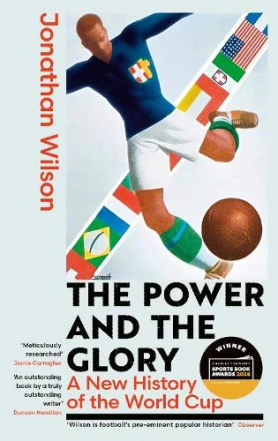
The Power and the Glory: A New History of the World Cup
Jonathan Wilson
For dedicated followers of the World Cup of a certain vintage, the late Brian Glanville’s History of the World Cup has always been a must-read. First published in 1973, updated editions appeared in 1974, 1980, 1984, 1993, 1997, 2002, 2005, 2006, 2014 and 2018. Brian passed away in 2025.
Jonathan Wilson is perfectly placed to continue this there-or-thereabouts quadrennial tradition. A learned writer on the evolution of football tactics, a historian of the game and, as founding editor of The Blizzard, steeped in football as culture, The Power and the Glory showcases Jonathan’s rich mix of talents to chronicle the cultural reach of every World Cup. Can’t wait for the updated 2030 edition. Yes, please.
Available from Abacus Books.
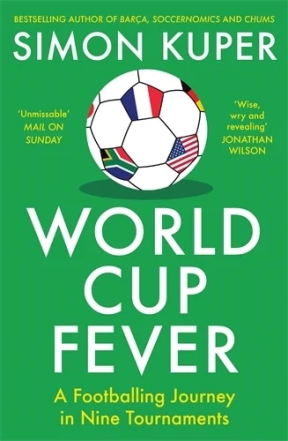
World Cup Fever: A Footballing Journey in Nine Tournaments
Simon Kuper
Simon Kuper made his debut as an author in 1994 with Football Against the Enemy. It won the hugely prestigious William Hill Sports Book of the Year. A kind of Fever Pitch, published two years earlier in 1992, gone global, or, if you prefer, on tour. I don’t mean this in a derivative way. Rather, Simon, like Nick, entirely understood how football’s meaning is located in the deep-seated attachments, and sometimes antagonisms, it ignites. He’s subsequently explored this through books on Ajax and Barcelona and expanded his reach to explain, with Stefan Szymanski, Soccernomics and, further afield, the English class and political system rooted in Oxbridge.
Simon combines all this in World Cup Fever, made all the more special by his own travelling tales from the World Cups of 1990 to 2022. Four of these I’ve been to: 1998 to 2010. At one, England v Argentina in Sapporo in 2002, I shared a pre-match lunch with Simon, I think. By then he was travelling with media accreditation. But Simon, whose first World Cup was Italia ’90, when he went as an escapee student, absolutely gets what a unique experience the tournament is for fans.
FIFA, governments and sponsors do their worst to police, monetise and ruin the experience, but all my experience of France, Japan, Germany and South Africa tells me they never entirely succeed. Fans from every competing nation, along with the hosts, have the time of their lives in spite of it all.
Warning: after reading this book, the irresistible inclination will be to want to join in next time. Start saving now!
Available from Profile Books.
What Is FIFA For?
Alan Tomlinson
I’ve probably learnt more about the politics of sport from Alan Tomlinson than from any other author. As a critical thinker, he is simply peerless. Most, including me, would answer the question, “What is FIFA for?” with two words. Eff all. Fair enough. An explosion of anger at FIFA’s purposeful ineptitude is entirely justified.
Alan’s short book perfectly captures the deep-rooted reason why so much of what FIFA does is wrong: clientelism, which inevitably breeds a relentless drive for revenue generation at any cost in order to fund the patronage and corrupt practices on which it depends. But at the same time, football is by some considerable distance the most global of sports. It functions as such thanks to FIFA, so credit, where credit is due, must also be given. Alan balances a powerful critique of FIFA with an appreciative understanding of its much understated role.
Available from Bristol University Press.
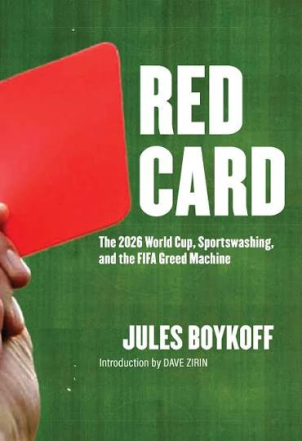
Red Card: The 2026 World Cup, Sportswashing and the FIFA Greed Machine
Jules Boykoff
Jules Boykoff’s critique of World Cup 2026 is unashamedly agitational, an adjective I use entirely positively. A former international footballer, academic and campaigner, the anger leaps off the page, driving the reader from one murky episode of World Cup sportswashing to the next. If there were a ‘Man of the Match’ award for sportswashing, there is little doubt Jules would dishonour Infantino with it. Job done.
But the difficulty remains: once the games kick off, the joy of the spectacle takes over. The answer Jules provides is much like a match:
“We’re living a pick-a-side moment in history when one must choose democracy or authoritarianism. If someone refuses to choose, then in reality, they have chosen. To that battle, I say game on.”
Off the pitch, in the age of Trump, or indeed Farage, such a binary opposition is understandable. But with football, the lines are blurred. The global carnival of joy that a World Cup, at its best, becomes is genuine. It’s not ‘false consciousness’, but rather a welcome break from all the world throws at us the rest of the time. How to make that connection critical as well as joyful? The answer lies in a quote Jules opens his book with from Stuart Hall, the political theorist, not the disgraced former TV commentator:
“Politics does not reflect majorities, it constructs them.”
1-0 to Hegemony United.
Available from OR Books.
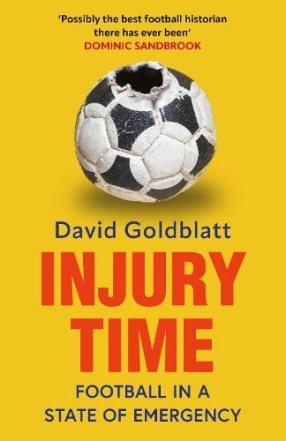
Injury Time: Football in a State of Emergency
David Goldblatt
Of course, World Cup 2026 doesn’t stand in (un)splendid isolation. The kind of critique Alan Tomlinson and Jules Boykoff offer of FIFA and the tournament will, come mid-August, be just as necessary to apply to the domestic game. There’s no one better to provide precisely that than David Goldblatt.
David excels as a writer by combining a counter-history of football that identifies an alternative present to the one we’ve been lumbered with, while at the same time providing a detailed understanding of the system that has produced the state football is in.
His most extraordinary achievement? None of this leaves the reader depressed. Instead, it leaves them intellectually armed with the belief that another football is possible, if right now implausible.
Injury Time ranges far and wide. Choose to dip into individual chapters for insights into how football frames Europe, economics, racism, national identity and the climate crisis. Or reverse the process: how Brexit, the decline of authority, nationalism, Covid and the changing geography of club ownership frame football. Either way, or through a mix of both, once World Cup 2026 is over this is a book that will focus minds, and hopes, ahead of the 2026-27 season. That’s if England haven’t won the trophy. In that eventuality, all critical thought might need to take a gloriously earned rest.
Available from Mudlark.
All Played Out: The Full Story of Italia ’90
Pete Davies
For my Five Gold Star choice of a book to make sense of World Cup 2026, I’ve gone all the way back to Italia ’90. In one beautifully crafted sentence, author Pete Davies summed up precisely the meaning of that, this, any World Cup.
“Planet Football. It’s a place where the simple dreams of boys kicking a ball between coats on the ground are force-nurtured, under floodlights and cameras, to the most mutant and enormous dimensions.”
With one amendment: “and girls”. (As Pete’s next book, I Lost My Heart to the Belles: The Story of the Doncaster Belles, remains the best book ever written on women’s football, the aberration is forgiven.)
Pete’s book was his first on football. A novelist, he came to Italia ’90 afresh and left it bewitched. Italy. Bobby Robson. Gazzamania. Lineker. Missed penalties. He gloriously captures the lot. It is no criticism to note that, swiftly following the success of the tournament, ‘Planet Football’ became ‘Mod£rn Football’. In 1992, both the Premier League and the Champions League (plus its rich runners-up) were founded. The rest is history.
But before all that, All Played Out describes a World Cup at its very best. When I set out to edit a collection, The Ingerland Factor: Home Truths from Football, about the first World Cup I travelled to, France ’98, I was chuffed to bits that Pete agreed to contribute a chapter. And again for my World Cup 2002 collection. Never mind my own modest efforts, those two chapters by Pete are the finest achievement of any of my football books.
If you haven’t read it, grab yourself a copy of All Played Out and you’ll understand why.
Available second-hand from AbeBooks.
Note: No links in this review are to Amazon. If you can avoid boosting the obscene wealth of tax-dodging billionaires, please do.
Mark Perryman is the co-founder of the self-styled ‘sporting outfitters of intellectual distinction’ AKA Philosophy Football