Photo credit: Stephen Brash
By Geoff Bottoms
Why can’t women be priests? It’s a good question whose time has come, and in many parts of the universal Church it has already been answered. While women have been ordained as ministers in Christian communities that stand outside the historic three-fold Order of Bishops, Priests and Deacons since the nineteenth century, it is only in the last century that they have been ordained in churches that claim to stand within this line of Apostolic Succession.
Yet women have played vital, foundational leadership roles in the early Christian movement as apostles, deacons, prophets, and house church leaders, before the institutionalisation of the Church restricted their authority. Biblical texts, archaeological findings, and early Christian art confirm that women were active ministers rather than passive observers.
Before dedicated church buildings existed, Christians met in private homes. Wealthy women like Chloe, Lydia, and Nympha acted as homeowners, financial patrons, and spiritual overseers of these communities.
In Romans 16:1-2, Paul introduces Phoebe using the title diakonos (deacon/minister), the same word used for male leaders. She was a prominent patron who delivered and officially interpreted Paul’s letter to the Romans. Junia the Apostle, named in Romans 16:7 as “prominent among the apostles,” was a highly regarded early missionary, while Priscilla was a prominent teacher and missionary who, alongside her husband Aquila, co-founded house churches.
Meanwhile Mary Magdalene was revered in early tradition as the “Apostle to the Apostles,” and is celebrated as “Equal to the Apostles” by the Easter Orthodox Church, because she was commissioned by Jesus as his first witness to announce the resurrection to the male disciples.
In early Christian art, Roman catacombs, such as the Catacomb of Priscilla, feature ancient frescoes depicting women in the orans (praying) posture, which some scholars interpret as leading Eucharistic celebrations. Tombstones and church mosaics from the 1st through to the 4th centuries bear inscriptions dedicated to women using titles like presbytera (elder/priest) and episkopa (bishop).
As Christianity transitioned from an informal, persecuted underground movement to the official religion of the Roman Empire in the 4th century, it adopted the patriarchal structures of Roman civic life. Church councils gradually passed canons explicitly banning women from the altar, ordinations, and public teaching, effectively erasing their formal leadership roles.
From a Marxist perspective, the restriction of women from the priesthood is viewed as the consequence of this archaic patriarchal structure, that uses the argument of divine justification to exclude women from authority and perpetuate their subordinate role in a class-based society.
Yet it is interesting to note that although Friedrich Engels, who collaborated with Marx, viewed religion as part of the ideological superstructure that supports the ruling class and its power structures, while acting as an ideological tool to maintain male dominance, he also acknowledged the revolutionary, proto-communist potential of early Christianity in his work On the History of Early Christianity.
In her prominent essay Always at the Table published in The Tablet, Catholic theologian and author Margaret Hebblethwaite harks back to this early Christianity and argues that a wider circle of disciples—specifically including women—shared the Last Supper with Jesus, challenging the traditional belief that only the twelve male Apostles were present. She highlights the crucial linguistic difference between Apostoloi (the sent ones/the Twelve) and Mathetai (the learners/disciples). While the Synoptic Gospels notes Jesus sat down with the Twelve, the preparation and scope of the meal involved a broader group of followers.
Historically, a traditional Jewish Passover (Seder) is a domestic, family event. Hebblethwaite notes it is “unthinkable” that the women who travelled with Jesus from Galilee and financially provided for Him (such as Mary Magdalene, Joanna, and Susanna) would be excluded from a major festive family meal.
In her lectures and columns for The Tablet and various theological conferences, Hebblethwaite highlights that the Church historically recognised a priestly dimension in Mary. At the foot of the Cross, her act of letting go, enduring, and sacrificing her son has often been interpreted in tradition as a form of priestly offering. She has previously noted that as recently as 1906, the Vatican even granted an indulgence for saying a prayer to “Mary, Virgin Priest”.
Hebblethwaite’s exploration of Mary’s priestly traits is closely intertwined with her advocacy for a female religious imaginary and rethinking of the role of women in the Church. She frequently points out the historical paradoxes within Roman Catholicism, noting that while the institutional Church officially bars women from the ministerial priesthood, its own rich mystical and liturgical history has frequently relied on heavily Marian and feminine symbols to explain what a priest actually does—such as bringing Christ into the world.
Women priests in the Church of England
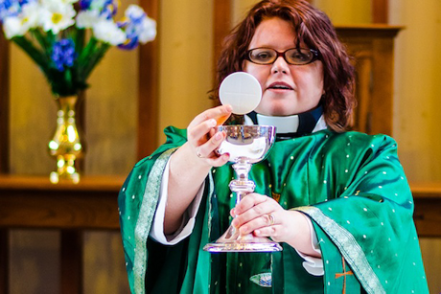
Returning to the practice of ordaining women in churches that follow the Apostolic Three Fold Order in the present era, Florence Li Tim-Oi was the first woman ordained as an Anglican priest on January 25, 1944, in China. She was ordained by Bishop Ronald Hall in response to the shortage of priests, which was a pioneering move in the Anglican Communion.
Yet it was fifty years later that Angela Berners-Wilson became the first woman ordained to the priesthood in the Church of England on March 12, 1994. Then the first female bishop in the Church of England was Libby Lane, consecrated in 2015, while on 25th March 2026, Sarah Mullally was installed as the first female Archbishop of Canterbury having previously served as the Bishop of London.
This has not been without controversy as certain parts of the Church of the England and the Anglican Communion on the whole have experienced divisions within their ranks, leading to alternative episcopal oversight for those who cannot accept the ordination of women, and even outright hostility, abuse and death threats against women priests and bishops, who continue to experience discrimination.
When it comes to the Roman Catholic Church, the Women’s Ordination Conference (WOC) is the world’s oldest and largest national organisation dedicated solely to advocating for the ordination of women as deacons, priests, and bishops. Founded in 1975, this grassroots-driven movement leverages bold activism, public dialogue, and prayerful witness to challenge the all-male priesthood and promote gender equity and systemic reform in church governance.
WOC regularly maintains an international presence through its partnership with Women’s Ordination Worldwide (WOW), a global ecumenical network fighting the same barriers across multiple continents. WOC frequently responds to Vatican policy updates, such as issuing sharp public critiques against late-2025 Vatican commission rulings that continued to reject female deacons.
Women priests in the Catholic Church
Meanwhile the Roman Catholic Women Priests (RCWP) initiative is a renewal movement within the Roman Catholic Church. Its goal is to achieve full equality for all within the Church as a matter of justice and faithfulness to the Gospel, and advocates for a new model of inclusive priestly ministry in the church. As such it stands within the prophetic tradition of obedience to the Holy Spirit who calls all people to discipleship.
The movement dissents from what it calls myths or misconceptions about women’s role in the Catholic Church and about the exclusion of women from holy orders. It mentions the case of Ludmila Javorová, a Czech woman who worked in the underground church during the Cold War and said she was secretly ordained as a priest, as an instance of female ordination in the modern era.
The Women’s Ordination Conference and Roman Catholic Women Priests are distinct but deeply interconnected entities within the global movement advocating for gender equality and the ordination of women in the Roman Catholic Church. While the WOC serves as an advocacy, political lobbying, and consciousness-raising organisation, RCWP acts as the practical application of the movement by actively preparing and ordaining women.
Roman Catholic Women Priests began with the ordination of seven women on the Danube River in 2002 by Rómulo Antonio Braschi, a Catholic bishop within the Apostolic Succession and in communion with the Pope, with the assistance of at least two other unnamed bishops. From its birth on the Danube River, it has evolved into two streams in Western and Eastern Europe, two in Western and Eastern Canada, and two in the United States comprising RCWP USA and the Association of Roman Catholic Women Priests (ARCWP), and two in Latin America comprising RCWP/USA and ARCWP.
The specific charism of the Association of Roman Catholic Women Priests within the broader global Roman Catholic Women Priests initiative is to live the Gospel message of equality and justice for all, including women in the church and in society now. It works in solidarity with the poor, exploited, and marginalised for structural and transformative justice in partnership with all believers. Its vision is to act as a community of equals in decision-making both as an organisation and within our faith communities and advocates for the renewal of Jesus’ vision as found in the Gospel for the church and for the world.
As a result there are now women priests in Germany, Austria, France, Spain, Scotland, Canada, the United States, South and Central America, South Africa and Asia. In 2024, there were 263 ordained members and approximately 300 in the worldwide movement, all of whom have been excommunicated by the Vatican.
Pope John Paul II definitively closed the debate on the ordination of women to the Roman Catholic priesthood with his 1994 Apostolic Letter, Ordinatio Sacerdotalis. In the document’s most critical passage, John Paul II declared that “the Church has no authority whatsoever to confer priestly ordination on women and that this judgment is to be definitively held by all the Church’s faithful”. This has been upheld by both the late Pope Francis and Pope Leo.
Yet despite official teaching, surveys have indicated that significant numbers of Catholics in various countries support ordaining women, with studies showing high support levels (e.g., 64% in the U.S.). As far back as the National Pastoral Congress in Liverpool in 1980, where the issue of women’s leadership in the Church including ordination to the diaconate was discussed, to the present synodal process initiated by the late Pope Francis, women’s ordination has risen up the agenda when consulting the laity, in an attempt to democratise the Church.
John Wijngaards was a Dutch Catholic scripture scholar and a former priest who advocated for the ordination of women. He argued that the demand stems directly from the equality of men and women in Christ’s universal priesthood, acquired through baptism, and
derives from the nature of the Church as the People of God in which women as much as men are full and equal members. It is implied in women’s full participation in the whole sacramental order and is testified to in the sense of faith carried by Catholics who instinctively know that it is not God or Christ who bans women from the priesthood.
Addressing the First International Conference of Women’s Ordination Worldwide in Dublin in 2001, he concluded with these words:
The Catholic Church will eventually ordain women as priests. How long we will have to wait for this will depend on a number of factors..but the Holy Spirit should not be underestimated. It has already shown the way in other Christian Churches…..
The Catholic Church has gone through crises before. Often the struggles and agonies of its committed members led to revolutionary changes that went even beyond people’s hopes and visions. The Spirit wrests new beginnings from suffering and defeat….
For our campaign is not just our own, it is the never-ending struggle of the Holy Spirit herself who, in the words of St. Paul, groans in us as we, first-fruits of the Spirit, groan inwardly waiting for our full identities to be set free. And we can be full of hope.”
The title of the Conference was “Women Priests – Now is the Time.”
Meanwhile the German Bishops’ Conference continues to advocate for expanding sacramental roles for women. In February 2026 it elected Bishop Heiner Wilmer as its next president for a six-year term. He is a staunch proponent of the controversial reformist Synodal Way, openly supporting expanded roles for women and other progressive reforms concerning priestly celibacy, greater involvement of the laity, and the blessing of same sex couples. These proposals were rejected by the Vatican as recently as June 2026. Then in July 2026, Bishop Christian Würtz was appointed to the Diocese of Eichstätt by Pope Leo. He too has called for a re-examination of the possibility of women priests.