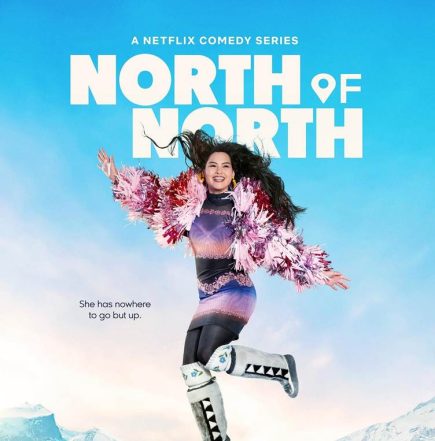
North of North
By Dennis Broe
The Canadian Broadcasting Company and Netflix’ North of North is an extremely entertaining fable of life in the contested Arctic with a beguiling Inuit star, Anna Lambe, who is now a breakout actress and is also starring opposite Brad Pitt in Heart of the Beast.
The series, which has just released its second season, revolves around the Inuit woman Siaja who, in order to make something more of herself, leaves her husband Ting, regarded by the other women as the town hunk, but who only wants her to be mother to his children.
His selfishness is illustrated when on a seal hunt, he guns the boat, not knowing he has knocked Siaja into the Arctic Ocean – then when she is fished out of the water, scolding her for ruining his hunt. “I blew up my whole life” is Siaja’s cry as she joins a barely functioning community centre and attempts to enliven the place through a series of misadventures that ultimately prove to be successful.
There is a strong relationship, both accepting and antagonistic, between Siaja and her mother. She has her own problems both with Siaja’s father who returns to their far north settlement, and with a missing sister who has been taken from her.
Siaja is frequently comforted in her journey, as in the season two opener, by a shaman female elder and by Nuliajuk, a goddess whose domain is sea animals and who appears to her when situations are direst. The mythical Ice Cove is actually Lambe’s home town of Iqaluit in the Nunavut region, where the show is shot and the show is created by indigenous veteran showrunners Stacey Aglok MacDonald and Altehea Arnaqua-Baril, using a cast primarily drawn from the region.
One of the production companies is Aboriginal Peoples’ Television Network which produced among others Little Bird about the kidnapping and relocation of native children in Canada, a theme taken up with the story of Siaja’s sister, Reservation Dogs about four teens on relocated native land in Oklahoma trying to make in to California and Tribal, a police detective series with Jessica Matten’s cop having to frequently prick the colonial bubble of her Anglo partner.

Tribal on the Aborgine Network
So what could go wrong? Nothing really, the show is delightful. But it’s limited in its depiction of Inuit life – especially in the problems both geopolitical and more everyday that are haunting the Arctic and threatening the very existence of its inhabitants. These are problems that cannot be subsumed entirely into a story of female liberation, and when they are it makes that liberation sound just a little hollow.
Although that is of course perfect for a Netflix homogenisation which is spreading across the world and now engulfing over 50 countries. The rhetoric on these series is all about “the local.” The reality is “the local” generally functions as flava and is fitted into a few “liberal” patterns, such as individual female liberation without the collective, that also fits nicely into a global Western hegemony.
So what is elided? The Arctic is an ecological battlefield in the process of being militarised even as it deteriorates because of global warming. Inuit territory, including Nunavut from where Siaja comes, holds an estimated 25 percent of the planet’s undiscovered hydrocarbon reserves.
This is not to mention that the melting of what Canada calls The Northwest Passage – with the country’s territorial claim based on its Inuit inhabitants – decreases the time it takes to ship these precious metals from the Canadian Arctic to Asian industrial markets by about 15 days, compared to shipping through the Panama Canal.
This is causing a shipping battle between the U.S., which claims Greenland, denies Canada’s claim to a territorial Northwest Passage, and proposes an “open” sea lane controlled and patrolled by the U.S.
The Arctic is warming two to four times faster than anywhere else on the planet, making it easier to extract minerals and fostering shipping routes that disrupt traditional Inuit hunting grounds. The result is an increased chance of oil spills and leaks on these ships, broken ice trails that endanger local hunters who rely on the frozen paths to hunt, and underwater noise that disrupts marine mammals – seals, walruses and polar bears – threatening to make Ting’s hunt a thing of the past, as well as railway lines for transporting the ores that disrupt caribou migration.
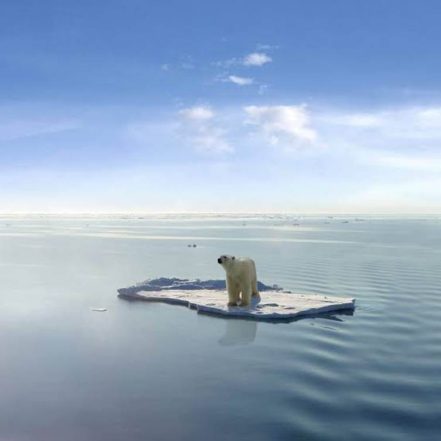
Ecological disaster in the Arctic: The end of polar bears?
The series does deal with the new influx of Arctic tourism that goes along with the rise in shipping, as Siaja in the second season pilot attempts to ingratiate herself and the community centre with this influx, by putting on an Inuit show, that incidentally indicates a dramatic rise in budget for season two. The tension though in the episode is not about tourism cheapening Inuit culture but about how, in her personal drive to prove herself, Siaja can captivate these visitors.
What the show refuses to go near is the rapid militarisation of the Arctic as it becomes a pawn in a U.S. and NATO hegemonic power grab. The NATO seven members of the Arctic Council, which previously had, along with Russia whose coastline constitutes the majority of land in the Arctic region, been dedicated to peaceful and scientific pursuits in the Arctic as a no-go zone for global conflict, instead cut Russia off from the Council, thus turning what had been a civilian ecological council into a security bloc.
The power grab in the Arctic, turning it into another of the world’s choke points, is easy to understand given the current lack of Western contol of the Strait of Hormuz and now the Red Sea, thus potentially locking out or greatly increasing the price of West Asian energy exports. Beijing and Moscow in response are laying the groundwork for their own Polar Silk Road, as an alternative to supply the rest of the world with energy sources such as liquid natural gas.
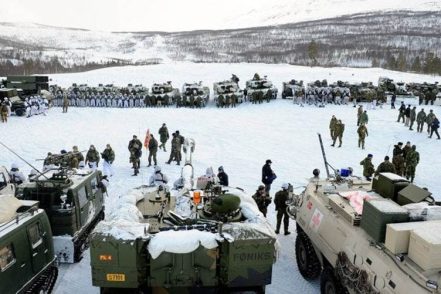
NATO militarisation of the Arctic
The Inuit challenges in maintaining their independence then are increasing as their native hunting lands becomes the world’s next energy mining and shipping hotspot. Rather than Inuit unity, gained by a hard-fought acceptance by Ting of Siaja’s own independence but then a coming together of both to face the problems of their people whether in a relationship or not, the show proposes instead that part of Siaja’s fulfilment is her back and forth courting of the Southern Canadian Cree Kuuk.
Siaja’s personal battle for emancipation, in the context of the problems facing her people which this emancipation ignores, begins ultimately to look less like a triumph and more like a cloying tantrum. It illustrates the increasing inadequacy of liberal identity politics which most often is employed not to confront the actual challenges of an increasingly bellicose global order, but to divide the challengers.