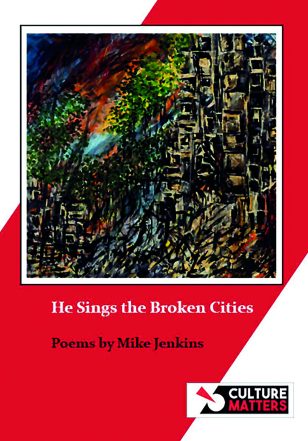
The book is available here
By Patrick Jones
I first came across Mike Jenkins’ work in 1993 when I arrived back in the UK after living in America. I remember reading a poem and interview in The Western Mail about working class writing which I loved and somehow I managed to find his address and sent him a few poems not expecting a reply but a few weeks later a handwritten envelope arrived with some words of advice from Mike. It steadied my hand and gave me confidence to keep going. So, over 30 years later it is a profound honour to write this.
If Mike lived 300 years ago he would be travelling around the towns and villages reading his poetry in grimy taverns of the village square to the downtrodden and ignored ranting against injustices and bearing witness to his times. Without any royal patronage I hasten to add!
So here we are in 2025, the year of the apocalypse or so it seems and this collection dares to tread where many poets fear to go. Shunning the cosy classrooms of Universities and the cheese and wine award ceremonies in glitzy bars these poems aim to speak to the ordinary person, the citizen not subject ; to rattle, ruffle, poke and provoke- he stakes his claim then holds up society to a mirror and asks ‘what do you think of this then?’ We cannot look away. The poems jolt us into action.
As Paulo Freire said, “Washing one’s hands of the conflict between the powerful and the powerless means to side with the powerful, not to be neutral. ”
This collection, like much of Mike’s work, is a witnessing, a document for future generations. Sometimes we cannot be neutral. We have to ask ourselves what it is we stand for? We believe? We dream of? We avoid?
He has the ability to create a startling poetic image and then hit you with a statement that illuminates reality in such a visceral manner. It is this fusion that makes his poetry rather unique. This work aims to connect and reach deep into the reader, not content with merely skimming the surface with erudite Greek references or plodding platitudes or making the long list for some award. These words are a direct hit to the amygdala.
An urgent plea to the world
The first section documents the Israeli occupation of Palestine and the ongoing genocide in Gaza. He is one of only a few Welsh poets to put their head above the parapet; these poems deliver an urgent plea to the world. Wake up! Speak! Do something!
Comprising the poems Prison Gaza to Famine Figures, he dissects the Israeli genocide in Gaza after October 7th 2023. The juxtaposition of numbers in A Sign should be plastered on every billboard. The poet Charles Reznikoff said that his legal studies led him to the insight that poetry should be like the evidence given by a witness in a criminal trial. In his 1976 work Holocaust he writes:
‘The women begged for their lives:
they were young, they were ready to work.
They were ordered to rise and run
and the SS men drew their revolvers and shot all five;
and then kept pushing the bodies with their feet
to see if they were still alive’
Nearly 50 years on, another ethnic cleansing is documented in Jenkins’ Let Them Eat Bullets! With the poet acting as witness:
‘shot down like deer in woods
or moorland pheasants
seen as so much meat,
as trophies for the Occupation
sucked into snares, traps
with bait of food packs
Let them eat bullets!’
In the poem which gives the collection its title, Samir Sings, the human voice of hope reaches out to a deaf world. Here is poetry as protest born from noticing. The 24/7 news cycle can make us numb to the suffering of others. We swipe, we click on repeat. But poetry makes us stop and think and possibly, feel. Like the disappeared doctor, Hussam Abu Safiya, long forgotten by the media, the poem stands as testament to the person. Marking out what happened, these poems leave an imprint in our neural pathways, begging us to ‘Remember, Cofiwch’.
In Dabke we are offered a glimmer of hope which then fades to dust ending with the devastating lines ‘the music silenced by gunfire’.
Palm reaching references the horrific (and once again, avoidable) disaster in Aberfan, and details the connections and consequences of man-made devastation in Gaza, where poppies and olive trees fuse.
‘Writing poetry after Auschwitz is barbaric’ wrote Theodor Adorno. He argued that after the Holocaust, a certain form of artistic expression is inadequate to connect with or describe the reality of the world. Poetry, through metaphor, could not express the reality of the industrialization of the murder of millions of people. It feels like Jenkins takes up that challenge, as he ends the section with From Gaza to Auschwitz, proving once again that these words are unafraid to speak their truth.
It is the poetry of speaking out – the politics of No in search of a Yes, whilst avoiding the pitfalls of propaganda. It is as if he is saying it is barbaric not to write, after watching what has happened and is happening in Gaza.
A platform for the underdog and the silenced
The second section explores rebellion and protest across the world and at home in Cymru, through various stories of under-represented individuals. The poems reclaim the narrative from the oppressor, the colonizer and the perpetrator, giving a platform to the underdog and silenced.
This is not mere historical nostalgia but a desire to provoke debate and connect the dying dots of resonance to now. ‘What can we learn from then?’ he appeals to the reader. I always find myself dipping into history books after reading many of Mike’s poems, to research a name or moment in time.
The third sequence turns its fierce gaze inwards to the poet’s homeland. Some are written in Cymraeg – a bold and brave statement for a mostly English language wordsmith. His love of language is contagious, as we savour the yelped syllables and digest new melodies.
There are echoes of R.S. Thomas, Mogg Williams and most notably Idris Davies, another Valleys poet whose work wore the scars of his hometown streets and hills. Trickle Down and The Cave is Empty are as if the Rhymney wanderer had suddenly time travelled into 2025, armed with his pencil and notebook to speak of his land.
A howl of defiance
The collection culminates with Jenkins’ signature ‘dialect’ poems that capture the tongues of the lost, the ignored, the misunderstood and deluded. Akin to a literary Lowry painting, he carves out a moving and sometimes humorous tapestry of spirits that carry us home.
Ending with more personal testimonies to lost poets and comrades, he reminds us that life is fleeting and to hold on to the goodness around us and concludes this breathtaking, soulshaking, news-unfaking, revolution-making witnessing of soul and society with a howl of defiance in Cymru Rising, which ends with the lines: ‘one day they will come’….and maybe they already have.
As iconic Palestinian poet Mahmoud Darwish wrote: ‘We are afflicted by an incurable malady – hope’
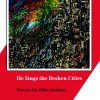
He Sings the Broken Cities by Mike Jenkins is available here.