The Diggers
By Professor Gregor Gall
As an A-level history student studying the seventeenth century at a grammar school in Buckinghamshire, my teacher was none too pleased when I brought up the issue of The Diggers by asking a question about their place in the English Revolution. This was after having come across a brief mention in Tony Benn’s Arguments for Socialism (1980) book. Not much good came out of that inquiry.
However, just a year or so later, Billy Bragg’s Between the Wars (EP) (1985) contained the song The World Turned Upside Down. It reached No. 15 in the UK singles chart. I got an awfully lot more from that on what The Diggers stood for.
By producing an electronic guitar version that was harder and harsher than the original song by acoustic guitar playing and left-wing folk singer, Leon Rosselson, in 1975, Bragg popularised the song for my generation. Rosselson had taken the title and subject matter from Christopher Hill’s book of 1972.
Hill was a major Marxist historian and, along with other Communist Party members, founded the Communist Party Historians Group in 1946. The group popularised the ‘history from below’ approach (which is now also known as ‘the people’s history’ approach), and for Hill that meant the better-known Levellers especially in the English Revolution of the 1640s. Unknown to me at the time, it was this which was behind my question to my history teacher, and which so irked and angered him.
But after having researched and written some ten book length studies on said revolution, Hill turned his focus specifically towards the issue of the radical ideas in the 1640s, producing The World Turned Upside Down: Radical Ideas During the English Revolution. Among the groups he studied in the book were The Seekers, The Ranters, The Quakers, The Levellers, and, of course, The Diggers.
Creating a common treasury for all
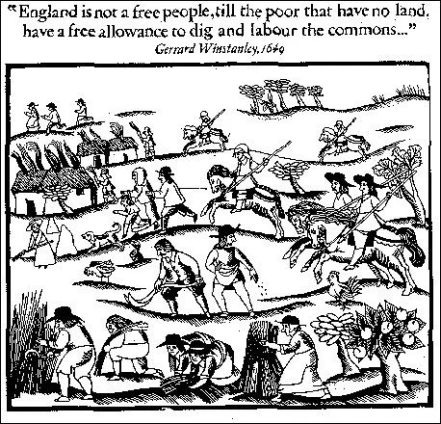
Why Rosselson chose to focus especially upon The Diggers is not known but it may have had something to do with The Diggers, who were known as The True Levellers, being the more radical, if not revolutionary, of the groups. They sought to create what is called agrarian socialism or communistic utopia by ‘levelling’ the land.
This meant creating communes to not reform the existing social order but, rather, establish a new kind of egalitarian social order. The lyrics of the song refer to one such attempt at St George’s Hill, Weybridge, near Cobham, Surrey, where the fences and walls of enclosed lands of the landlords were torn down. After being violently evicted from St George’s Hill, the Diggers formed new communes elsewhere but met the same fate elsewhere.
The lyrics present a powerful story of a historical event, with a clear progression through a beginning, middle and end to tell this tale. This is no pedestrian protest song because it talks of creating a new society – being for something, rather than just against something.
Read the lyrics as you listen to Billy Bragg sing them:
The World Turned Upside Down
In 1649
To St. George’s Hill
A ragged band they called the Diggers
Came to show the people’s will
They defied the landlords
They defied the laws
They were the dispossessed
Reclaiming what was theirs
‘We come in peace,’ they said
‘To dig and sow
We come to work the lands in common
And to make the waste grounds grow
This earth divided
We will make whole
So it will be
A common treasury for all
The sin of property
We do disdain
No man has any right to buy and sell
The earth for private gain
By theft and murder
They took the land
Now everywhere the walls
Spring up at their command
They make the laws
To chain us well
The clergy dazzle us with heaven
Or they damn us into hell
We will not worship
The God they serve
The God of greed who feeds the rich
While poor men starve
We work, we eat together
We need no swords
We will not bow to the masters
Or pay rent to the lords
We are free men
Though we are poor
You Diggers all stand up for glory
Stand up now’
From the men of property
The orders came
They sent the hired men and troopers
To wipe out the Diggers’ claim
Tear down their cottages
Destroy their corn
They were dispersed
But still the vision lingers on
‘You poor, take courage
You rich, take care
This Earth was made a common treasury
For everyone to share
All things in common
All people one
We come in peace’
The orders came to cut them down
Given this was a pre-capitalist, feudal agrarian revolt when we now live in a capitalist, industrial (or even post-industrial) society, how can it be conceived as an artefact of communist counterculture?
The answer is that the desires expressed in the lyrics through The Diggers are those that concern compassion for fellow humans and then for humankind at large. These transcend any historical epoch. In other words, the lyrics envisage a new society based upon need and not greed, and based on common ownership of resources (and not private appropriation). The agency here is the exploited and oppressed, who have seen that there is reason in revolt. Collectivism – and not individualism – is the hallmark here. But so too is that the revolt of the exploited and oppressed will be met by coercion and ideology from the exploiters and oppressors.
Communists are duty bound to produce their own communist cultural artefacts – songs, novels, poems, comics etc. that envisage a new society and stimulate the imagination, as well as providing arguments to help spread the creed of communism.
The Culture Matters website is a great vehicle for creative and critical pieces that criticise existing society and imagine new ways of doing things. Poems, short stories, visual art, videogames can all help – songs especially are a short and more appealing way to do this.
Notes
[1] Others like Dick Gaughan on his album Handful of Earth (1981), The Barracudas on their album Endeavour to Persevere (1984) and Attila the Stockbroker with Barnstormer on The Siege of Shoreham album (1996) have also covered the song.
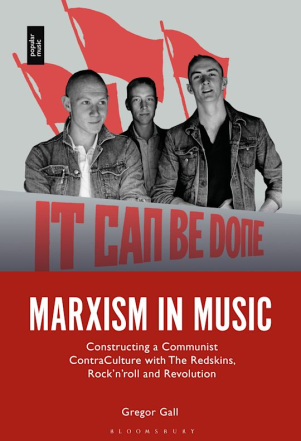
[2] The arguments about what a communist contra-culture is and what role it can play are fully laid out in my Marxism in Music: Constructing a Communist Contra-Culture with The Redskins, Rock’n’roll and Revolution (Bloomsbury, 2026). You can read a review of the book here. Until the 31st January 2027, there is a 35% discount code available – MARXISM35 – on the hardback book, so £52 (with free postage within UK). Use the code here