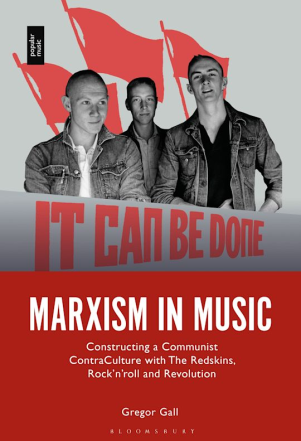
The book is available here – until the 31 January 2027, there is a 35% discount code available – MARXISM35 – on the hardback book, so £52 (with free postage within UK).
By Keith Flett
The Redskins started in 1981 and played their last ever gig in Munich on 14th September 1986. To have seen them live, as I did, you would need to be at least in your mid-50s now.
Their records, singles and one album, Neither Washington or Moscow, mixed rock with soul in a combination, the Supremes and the Clash as they put it, that remains striking. YouTube has plenty of clips for the curious.
Indeed for those not familiar those clips are essential listening, before approaching Gregor Gall’s detailed analysis of what an attempt at communist counterculture did or did not achieve forty years ago now.
The context of the book is framed by the earlier Rock Against Racism, and the slightly later if overlapping Red Wedge, both of course aiming and trying successfully to situate a left politics in the popular cultural sphere.
The difference is that the Redskins and other bands Gall looks at, such as Easterhouse, were aiming, perhaps, to produce a specifically Marxist or communist music rather than something that was broadly left-wing but without a political project specifically associated with it.
Gall also rightly contrasts the efforts of the British left to build such projects with other countries such as France and Germany. Eric Hobsbawm spent some time reviewing the cultural practices of the French and Italian Communist parties, while E P Thompson argued that while other countries did certain things the British left did not, that was because it was focused, because it had to be, on anti-imperialism, ‘so bloody much to oppose’ as he put it.
The Durham Miners’ Gala and the Tolpuddle Martyrs’ Festival, both held in July, are the key cultural events of the British labour movement. May Day marches are held on or around the day itself, but don’t match the scale of those held elsewhere around the globe.
Gall argues that the cultural traditions of the CPGB were less than inspiring, particularly when judged against the criteria of a communist counterculture. There was literature, and Eric Hobsbawm wrote on jazz for the New Statesman, but in terms of mainstream impact it was at best limited. However, he does note rightly that the Party still does more in the cultural field than the rest of a wider left, and notes the contribution made by Culture Matters.
As he points out, the membership of the CPGB peaked at 50,000 in the 1940s and declined subsequently, and this doesn’t bear comparison with the size of Communist Parties in France and Italy. Size does matter here, because with it came the ability to finance cultural activities and the people to run them.
Moving to the period of the 1980s, Gall notes that while two members of the Redskins were SWP members and had no particular differences with the Party’s politics, it was itself not fully engaged with what the Redskins project was.
Economism on the left
Gall has a double perspective on this. Firstly, he argues that both the CPGB and the SWP were characterised by ‘economism’ that is a focus on day-to-day workers struggles. That can hardly be questioned, but it would be surprising if as parties of the left they were not. He counterposes to this the Gramscian terms of the war of position and the war of movement. That is, the left must not just be involved in struggle but seek to build an hegemony of ideas and perspectives. Clearly a countercommunist culture can help to achieve that.
It can be agreed that neither the CPGB or the SWP or others did achieve that. If we are looking specifically at the 1980s, it might be argued that neither had the numbers or resources to do it, even assuming this was their aim. Gall says that the SWP was lukewarm at best to the Redskins project, although during the 1984/5 Miners’ Strike, the moment of their peak impact, the correlation between the gigs (often free) they played and the drive to support the miners was in my experience a close one.
Looking at the Redskins and Easterhouse, he notes that their record labels and promoters did not inhibit their aim of promoting left politics. Rather they saw this as a key selling point. Unfortunately, sales were not as high as they no doubt would have liked!
He points out that the reasons for the split-up of both bands were not particularly political differences, but differences between band members about the direction of the music.
Focusing on the Redskins, he circulated a questionnaire to those who were familiar with their music, he argues that they were not just preaching to the converted but genuinely attracted new people to socialist ideas with the music and lyrics. Gregor Gall spoke at a socialist history seminar at the Institute of Historical Research that I convene in September 2026, and several of those attending confirmed that point.
The political moment of the 1980s created the possibility of at least developing the kind of communist counterculture that Gall sees as key to the advance of the left. Progress was made but as often not sufficient progress. He is downbeat about whether this moment can come again currently. He points out that membership of left-wing organisations is considerably lower now than it was in the 1980s. A note of caution about how accurate such numbers are, either then or now, might be needed however!
He touches on – but does not pursue – whether there are other ways of developing support for left ideas that don’t build a communist counterculture. For example, Tom Robinson’s Glad to be Gay or the Specials’ Free Nelson Mandela were both big commercial hits, getting significant publicity. Of course, that is very different from organising and developing a left-wing culture in a more than transient moment.
Overall, this is a fascinating and well researched book that repays reading for anyone who was there in the 1980s or is familiar with the music now, and also for those involved in projects to build communist countercultures today.
But don’t forget to check out the Redskins music on You Tube while you are reading the book!