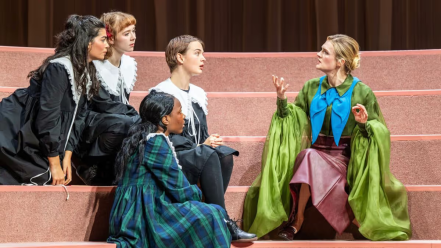
Gayle Rankin plays Miss Brodie
By David McKinstry
David Harrower’s radical reinterpretation of a much-loved Scottish classic, The Prime of Miss Jean Brodie, is remarkable for its subtle yet stark political undertones. The tweed and twee of earlier productions have been replaced with a bohemian, avant-garde feel that gives Spark’s story a dark political and psychological edge. Harrower has updated and sharpened the script, drawing heavily on the historical context of the growth of fascism during the 1930s. In doing so, he gives the play a modern, foreboding resonance and an implicit warning from history.
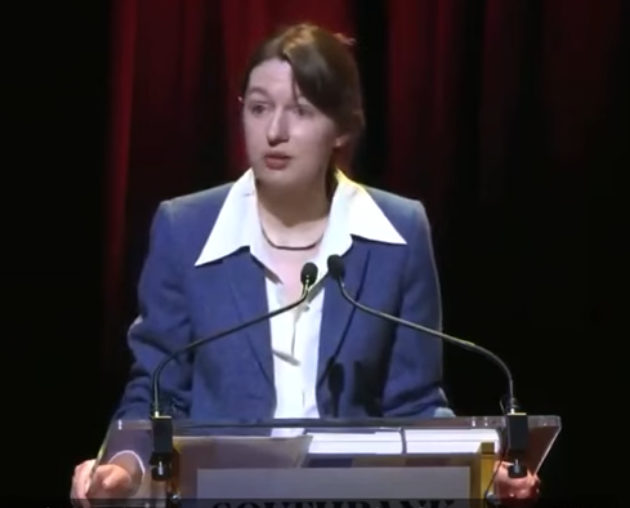
Gayle Rankin, as Brodie, is a magnetic monstrosity who captures the hearts and souls of “her girls” and her male colleagues. Her sharply cut clothing is matched by her razor-sharp tongue. Rankin delivers her lines with such impeccable comic timing that the audience laughs, albeit guiltily, as she charismatically manipulates and subjugates her pupils. Her sinisterly captivating portrayal of Brodie is brilliantly counterbalanced by Maureen Beattie as Miss Mackay, the dour yet honourable Presbyterian schoolmistress.
Through Brodie and Mackay, the director subtly reminds the audience that, in the 1930s, many succumbed to the dark charisma of fascism rather than the seemingly dull decency of democracy. It is a lesson we are having to relearn today.
This adaptation also gives a voice to “her girls” and explores the consequences of their unquestioning loyalty to “The Brodie Set”. Their teacher demands that they become free thinkers, but only on her terms. Her favourite, Sandy Stranger (Bobby Rainsbury), is exalted as potential intellectual giant. Yet poor, doomed Mary MacGregor (Tallulah Grieve) is deemed dull and treated as a doormat, the butt of countless jokes and the target of her classmates’ ridicule.
Brodie’s girls are perfectly pitched by the entire cast. Through their light, carefully observed stage interactions, we see them move from subservience towards becoming questioning young adults, increasingly aware of their subtly domineering teacher. By giving the girls a voice, this adaptation shines a light on the importance of teachers in shaping young lives.
This production paints such a vivid portrait of a complex character while, with nuanced brushstrokes, sketching a much wider political landscape of the growth of fascism in the 1930s. Through its writing, direction and outstanding performances, the National Theatre of Scotland adaptation of The Prime of Miss Jean Brodie is theatre at its best.
The Prime of Miss Jean Brodie, by Muriel Spark, adapted by David Harrower, directed by Vicky Featherstone, at the Citizens Theatre, Glasgow till 7 November 2026.