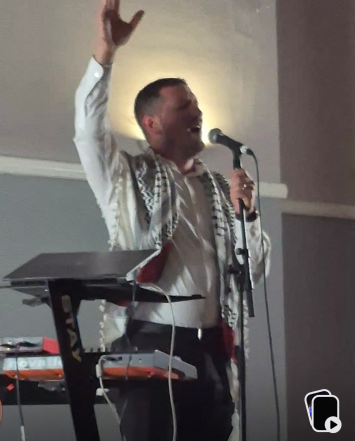
Zaid Hilal performing in Glasgow
Lizzie Eldridge reviews Zaid Hilal’s performance at Blythswood Hall, Glasgow
‘The true struggle is with the duende‘ – Federico García Lorca
As soon as the concert began, the sound of Zaid Hilal’s voice along with his presence filled the space with duende. It was magical, shivering, immediate and tangible.
Duende is a Spanish word that can’t be translated into English, but it’s at the heart of flamenco. It’s best described as a spirit, an energy, a force, and an overwhelming emotion that emanates from the compulsion, a vital need, to express that which must be expressed, that which must be released, that which, in the act of articulation, brings into being that which it evokes.
You know when you are in the presence of duende. It isn’t intellectual. It doesn’t require analysis. You feel it and you are instantly drenched in its agonising beauty.
Zaid Hilal is duende. There is no ego with this remarkable musician. He opens his mouth into sound and the air is alive with duende. He releases its energy through his body. He embodies its essence in his very being. He sustains this essence in his playful and deeply humane storytelling.
And his stories are of Palestine. His stories are the Palestinian experience. His stories are the country of Palestine, its earth, its struggle. The stories, the storyteller and the musician are one.
At the start of the evening, Zaid sang the now famous lullaby, Together for Palestine, bringing us all together within our shared world of resistance and solidarity. The ache, the sadness and the hope combined as this familiar song bathed the space in a cry of empathy and unshakable validation of why we were there, shoulder to shoulder, in this place and in this time.
Zaid then took us back to 1936 – the year my own father was born and the year in which the Spanish writer, Federico García Lorca, who wrote, lived and breathed the duende, was murdered by the fascists at the beginning of the Spanish Civil War.
In 1936 Palestine, 3 young men were executed by the British army for daring to resist the colonialist occupation. Zaid told their story with compassion and humour, speaking of how each one wanted to be first to be hung. Zaid’s subsequent song preserved their legacy, eliding the present and the past.
This timelessness is crucial to the duende, resonating with ancient truths, age-old mysteries, and the ongoing human struggle against oppression. Duende comes up from the earth through the soles of the feet, surging into being with a raw vitality, an instinctive authenticity, an impulsive response to our universal human condition.
“All that has dark sounds has duende,” says Manuel Torre, a celebrated Flamenco singer in early twentieth-century Spain. Duende pivots on the knife-edge of death. It dances and swoons with death. It calls up the life force and the death force at the self-same time, and this is its urgency and its integrity. Duende evokes laughter and tears. Duende is the agony and the ecstasy.
Zaid’s entire performance was this. His music carried us through joy and through grief, all the while with the steady, unstoppable rhythm of resistance, a rhythm which pulses through Zaid’s very being.
In one of his stories, he spoke of the journey he made from his hometown, Bethlehem, to Jordan, when he was leaving Palestine to come on tour in the UK. He told us this journey would normally take about an hour but some days, it takes much more. His journey took 7 hours because of the numerous Israeli checkpoints.
“You never know,” Zaid smiled. “Maybe the Israeli soldier’s girlfriend is giving him a hard time and he’s in a bad mood.”
Despite decades of brutal occupation, despite decades of vicious apartheid, despite the horrors of the ongoing genocide, Zaid humanised the people responsible for inhumane atrocities. In the briefest of moments, Zaid refused the Israeli’s despicable dehumanisation of the Palestinian people by gracing his oppressors with human attributes. This is resilience in its most resilient form.
On the lengthy bus journey to Jordan, Zaid met fellow passengers from various refugee camps. Instead of complaining, they shared stories, told jokes and they sang, conjuring up echoes of Brecht’s haunting lines:
In the dark times Will there also be singing? Yes, there will be singing. About the dark times.
Yet the joy of resistance – and Zaid effuses joy – means that the darkness can never engulf the human refusal to allow it to do so. The act of making art – through music, words, painting, dance, visual media – is itself a refusal of the darkness, an act of retaining the human and the impulse of humanity, an act of defiance against the forces of death, wilfully attempting to extinguish life.
There are many examples of this in Gaza, from children playing football to artists continuing to paint no matter how insufferable their circumstances. 18-year-old artist, Marah Khaled al’Za’anin, has transformed her tent in Gaza City into an art gallery, turning the confines of displacement into a place of creativity which depicts the harsh realities of life within a genocide.
Similarly, 80-year-old Mohammad Zamlout has turned his tent in Al-Bureij refugee camp into an artist’s studio, “treating every canvas as another chance to hold onto life.” Despite losing his 3 sons in the genocide, Mohammad documents the intense suffering of the Palestinians in a testament to the heartbreaking realities of living under continual bombardment, eternal displacement and unbearable loss.
As Lorca knew all too well:
Poetry exists in all things, the ugly and the beautiful, even the repugnant; the difficult thing is to know how to discover it, to awaken the deep lakes of the soul.
Zaid’s music and presence immersed us in the deep lakes of the soul. Zaid’s music and presence created the will to go on. Zaid’s music and presence was the life force incarnate, the vibrant and enchanting embodiment of the human spirit in its fullest glory.
The deep lakes of the soul are the territory of the duende, where the duende trembles, takes shape and bursts into life. It’s no surprise that Zaid embodies duende in abundance as the intertwined nature of Arab and Spanish culture is many centuries old.
The Arabs ruled Spain from 711 to 1492, a period of Muslim governance known as Al-Andalus (hence Andalusia). This was a time when Muslims, Christians and Jews lived side by side, just as they did in Palestine before the British mandate interrupted this co-existence and the Israeli occupation first began its ongoing genocide.
An important part, too, of Spanish culture was, and is, the gitanos or flamencos – the Andalusian gypsies – and the source of this music is the zajal (sung Arabic lyric poetry). Even during Franco’s fascist dictatorship, andalucismo (Andalusian cultural nationalism) grew steadily and with it an appreciation of the rich interrelationship between Spanish, Arab and Islamic culture.
As Lorca observes in his Theory and Play of the Duende:
“In all Arab music, dance, song or elegy, the arrival of duende is greeted with vigorous cries of ‘Allah! Allah!’ so close to the ‘Olé!’ of the bullfight, and who knows whether they are not the same?”
Last year, I visited Granada for the first time and the symbiotic interconnection between Spanish and Arabic culture is the living and breathing reality of this city. It whispers this reality through every wall, every stone, every hillside. It celebrates this reality through its very existence.
On my final night there, I stood opposite the Alhambra – a celebrated monument of medieval Islamic architecture which, fittingly, also combines elements from the Spanish Renaissance. I stood in the Jewish Quarter of Granada and I watched a flamenco band perform.
Last week in Glasgow, saturated in the shimmering beauty of Zaid’s music, I was drenched in the duende again.
For more details about Zaid Hilal’s UK tour and his music, see here.