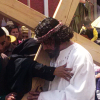
Jesus on the Cross, from the interior of Grazia Chapel. Lars Hammar, CC by SA 2.0
On Good Friday, Violet White argues that our response to the repeated crises of our times should be guided by the pattern of the Cross – that of sacrificial love – rather than co-opting it as Body Art in celebration of illegal and immoral Wars.
This is a moment of truth.
We have been hurtling towards the exposure of catastrophe for so long. And here it comes in the form of the knock-on tsunami of the unprovoked US/Israeli War on Iran.
When Truth Dies
The following poem was written in 2015, and at the time many people viewed it as remote and fantastical.
Shooting the Messenger
In a miasma of malign intent, we are driving, each in our own lane,
into a pile-up that will throw us limb for limb together in the end.
No-one is going to escape, whether caught in the tail wind or feeding
the furore. We’re careering along in a holocaust of integrity, a striving
for vicious self-aggrandisement, a top dog best hit first strike annihilation-
by-wit. Any honest broker should watch their back, any witness bringing
evidence to the public discourse prepare for excommunication. There is no
relation between what is said and what is repeated, what is brought and
what is received, what is done and what is reported; deceit is the default,
both easier and self-pleasingly tricksier. A parody of clever shoots trigger
word concepts straight from the hip, yes or no ticks only. And you can’t reason
with the one who trains a gun at your head when you’re flagging Armageddon.
When I wrote this, I had in mind that ‘Armageddon’ was not an outcome to desire, whereas the US Secretary of War is now making it obvious he wants to do all he can to hasten the day. The War on Iran is, in his view, Donald Trump’s contribution to that.
The greatest consequence of Lies is War
This catastrophe has been snowballing for decades of course. The erosion of integrity in governance and media, which some might consider a passive and non-affective issue of taste, has always been ominous and predictive.
When truth is openly sidelined for a pick-and-mix choice of narrative – explicitly selecting and pushing stories useful to the powerful – and a cultural thrust elevating competitiveness as the single acceptable currency of communication and presentation is dominant, the values that inspire our greatest humanity are systematically trashed at all levels. Creativity is crushed and Art, Philosophy, Religion etc are only permitted space where they can be monetised or instrumentalised by the powerful.
Society is dumbed-down ad nauseum, with the majority of citizens confined in ever more limiting and isolating spaces at the disposal of the ruling classes. This fragmentation is the death of society’s vibrancy and commonality.
With a corresponding and exponential increase in wealth- (and thus power-) inequality through the demolition of equitable structures, the contempt for working-class voices and concerns is palpable and it is disastrous for everyone. The set-back in such democracy as we were once building has taken us down a clear path towards societal collapse.
It has been said that ‘the first casualty of War is Truth’; it could also be said that ‘the greatest consequence of Lies is War’. And here we are once more, with the ever-present threat of it taking a Dr Strangelove Nuclear turn in a now treaty-denuded world, and with severe economic consequences already so far baked-in, even if it all miraculously stops (or pauses) today,
For too long the ‘wretched of the earth’ have suffered the consequences of rampant evil visited upon them from our neck of the woods. Now it seems we are going to get a greater taste of those consequences. As people of faith in enemy territory, this moment calls us again to reclaim our heritage, our life story, and to witness to the vibrancy of life-affirming truth in whichever way we are called. How, then, should we respond to the urgent question posed in the book of Hebrews:
How shall we escape if we neglect so great a salvation? Hebrews 2.1
For what could be more relevant in a time of catastrophe than salvation?
Rooted in both the transcendent reality and the reality of the present moment
This is a work which, critically, should root us both in transcendent reality and in the reality of the present moment.
Good Friday is the perfect time for this. The time in the Christian Calendar when the battle between good and evil reaches its defining moment in the crucifixion of Jesus. When, we are told:
Having drawn the sting of all the powers ranged against us, Christ exposed them, shattered, empty and defeated. Disarming the principalities and powers that were ranged against us, he made a public example of them in the Cross. Colossians 2.15
Or as one translation puts it:
He stripped the tyrants of their sham authority at the Cross and marched them naked through the streets. Colossians 2.15 (The Message)
Easter: Our Redemption Story
We know – the evidence is all around us – that the world is occupied by evil and there is an overriding and ongoing conflict between good and evil. Whilst acknowledging that victory is assured, and evil cannot ultimately triumph, we nevertheless stand in an in-between time, engaged in warfare to that assured end, on active service in the battle to wrest the earth and all its resources from the usurper.
There are times when we celebrate the true reign of God in the sure knowledge that we are gathered up into that victory, times when we rejoice that God comes to judge the world with righteousness and the peoples with equity, to the joy of all creation:
Let the sea resound, and all that fills it,
the world, and all who dwell in it.
Let the rivers clap their hands,
let the mountains sing together for joy
before the LORD,
for He comes to judge the earth.
He will judge the world with righteousness
and the peoples with equity.
– Psalm 98. 8,9.
And there are times when, albeit reliant upon the truth of this victory, we are nevertheless deeply embedded in the struggle of the transition.
The season we call ‘Easter’ ‘is when we follow in Christ’s footsteps in our spiritual imagination – to recognise and reaffirm these joint realities. The journey of Lent and on to Good Friday drills us in the warfare, the suffering and grief, as well as the reality and exposure of evil. It reminds us again of the great and abiding consolation we have in Jesus; in his overwhelming love and solidarity with us in our struggle. Easter Sunday calls us to rejoice in the resurrection; our shared victory over the oppressive forces defeated on the cross; the joy of liberation. Together they make up our redemption story:
God purposed that through the Son all things should be reconciled back to himself, whether on earth or in heaven, as through him, the Father made peace by means of the blood of his cross. Colossians 1.20
And God shall wipe away all tears from their eyes; and there shall be no more death, neither sorrow, nor crying, neither shall there be any more pain: for the old order of things are passed away. Rev 21. 4
In his days shall the righteous flourish; and the abundance of peace so long as the moon endures. Psalm 72. 7
And they shall not hurt nor destroy… for the earth shall be full of the knowledge of the Lord, as the waters cover the sea. Isaiah 11. 9
The fellowship of his sufferings
But here’s the thing: you don’t get one without the other. The road to Easter Sunday, to glory, to redemption, freedom and triumph is through the struggle of Good Friday, the sacrifice which is offered for that victory, and which, if we are able to view it through the eyes of Jesus, will cause us to rejoice for the promised glory that is set before us and embedded in our hearts in the Spirit.
He… put the Spirit in our hearts as a pledge of what is to come. 2 Cor 1.22
Let us fix our eyes on Jesus, the author and perfector of our faith, who for the Joy set before him, endured the cross, scorning its shame, and sat down at the right hand of the throne of God. Hebrews 12.2
A hollow triumphalism – such as seems to be driving this war on Iran – is the antithesis of faith and, indeed, of reality. For we know that:
the whole creation groans and travails in the pain of labour.And we ourselves also, which have the firstfruits of the Spirit, even we ourselves likewise groan in labour, waiting for the promised redemption.. Romans 8. 22,23.
The ‘labour’ here is as the labour of childbirth – so the sense is that we are participants in the birthing of this new era – our world’s promised land; this is not a passive ‘waiting’ and nor is it – we can encourage ourselves – a fruitless endeavour. We are giving birth.
In this transition time, we are called to share the fellowship of Christ’s sufferings in conformity to his sacrificial and redemptive death:
I want to know Christ, the power of his resurrection, and the fellowship of his sufferings, being conformed to him in his death Philippians 3.10
and Paul speaks of his own experience of this also in the letter to the church at Colossae:
Even now I rejoice in the midst of my sufferings on your behalf. And in my own person I am making up whatever is still lacking and remains to be completed on our part of Christ’s afflictions Colossians 1.24.
These verses remind us that if we are to participate in the glorious fellowship of the Trinity, we must share the concerns of God’s heart and the passion of Christ, we must be a people who grieve; a people who deeply feel the immense suffering of a world in thrall to evil and over-shadowed by death, ruled by those who delight in oppression,.
We must share his sufferings if we are to share his glorious inheritance. Romans 8.17
For those of us who live in the relative – though increasingly fragile and volatile – affluence of the dominant culture in our world, the idea that we might take on such sacrificial love voluntarily is somewhat alien. In extremis, sacrifice – even to death – is far more often felt as a calling, and embraced.
On Good Friday, when we consider the Cross and what it speaks to, we remember we live in a world always in varying degrees of tragedy and extremis, (some of which we are likely to become more personally acquainted with imminently).
Self-Immolation: Greater Love?
In extremis, some have followed in Jesus’ footsteps, witnessing to the truth of evil ‘even unto death’. Self-immolation is a form of witness which we commonly associate with eastern cultures and it is generally strange to western imaginations. Given our historic embrace of Christianity and its pivotal event, it’s hard to see why – although there are of course many reasons why the death of Christ is exceptional.
But our culture is apt to view self-immolation as a form of madness, a destructive waste of a life and tragically pointless. People often look for a history of mental health problems to explain it.
It’s worth reminding ourselves at this point therefore that those around Jesus also thought he was mad, and desperately tried to restrain him from his calling to the Cross; he was misunderstood not just by the authorities, but by his most intimate family and friends as well.
I imagine part of what conditions the western response is simply our lack of really grasping how devastating is the earthly reality of evil and oppression.
There have been at least two self-immolations in the Gaza genocide, and it was Aaron Bushnell’s action on 24th Feb 2024 that made it really click into place for me. An earlier incident had been hushed up – seemingly the woman had not been able to get her framing of it out to the public – but Aaron made sure his message was loud and clear – he livestreamed himself explaining what he was doing and why – so there was no chance the authorities could suppress it. It felt both shocking and vital. In order to mine the real meaning of the act I immediately started writing a poem – and when I got two-thirds of the way into it I felt I did understand:
He wanted you to know
just how much they mattered
This much, he said…
Far from being a denigration of human life, Aaron’s act was a public elevation – to the highest level within his power – of the precious lives that were being so casually and vilely desecrated. And later there was footage of people in Gaza expressing gratitude for Aaron’s solidarity. The poem is here on this site; ‘A Message From Aaron on Day 142, Joe’ and is written in the form of a letter to Joe Biden, the then US President.
Another poem – written in 2009 – also looks at a self-immolation responding to US imperial war; this time the horrors of the Vietnam War. Norman Morrison, a Quaker, set himself alight in front of the office window of US Secretary of Defense, Robert McNamara, at the Pentagon on 2nd Nov 1965. His wife wrote a book about the aftermath for her and their children and the poem addresses them, rather than Norman. They later went to Vietnam and were amazed by the gratitude expressed in response to Norman’s action, the widespread awareness of it, and the warmth of their welcome.
Love’s Fallout
Wrapped into the vortex of the action,
you too were set apart; a sacrament
within a careless land, never without
the weight of understanding
And biding your time
amongst toyers with trinkets,
you laid your treasure deep,
putting by bitter herbs
for a flavour further on
and further in; your mouths
forever unsuited
from glycaemic sweetnesses
On the other side of the world
bread fell from the heavens
out of that fire’s assumption;
a sweet savour alien to those skies,
those times. They said that
hearts leapt in those flames,
fused a peculiar hope
as grief affirmed coalesced
It was bringing it back home.
Incarnate. One loss. One flesh.
A people unknown become kin.
Living your life in grafted skin.
It’s hard to conclude from even the little we know that the witness of these two men was meaningless. These actions spread around the world, and the US Secretary of Defense had an involuntary front row view of Norman Morrison sacrificing himself in witness to the barbarity of the war he, Robert McNamara, was primarily responsible for. And at the least we have evidence that the people suffering from these imperial slaughters deeply felt the solidarity of the witness. The manner of it is also a form of intense identification with the victims these two men were grieving, who were, of course, not just killed, but often burned to death.
This is certainly an extreme calling, and very few will be called to take this path. But, for those few, I think it must be considered proportionate. Where we still lack vital awareness of the horror of evil, an acceptance of this action – albeit rare – can help rebalance our perspective.
A present day ‘cloud of witnesses’
We have seen Palestinians make immense sacrifices over the last two and a half years; the health workers, paramedics, civil defence/rescue workers and journalists, many of them very young, not only operating in the most dangerous circumstances possible, but actually refusing to stop their work despite being explicitly stated targets for assassination by the Israelis in their ongoing genocide. And those who take up arms in asymmetric resistance against the overwhelming power of colonisers and invaders know too that they are putting their lives on the line.
But when people live on the edge, sacrifice calls every single day. And these people understand the cost to the soul of evading that call. They believe too that their ‘labour is not in vain’, and seem to have remarkable patience and endurance in waiting for the longed-for outcome, often even in the awareness that it will not be in their lifetime. As our scriptures exhort us, so they behave:
Therefore, beloved, be steadfast, immovable, always abounding in the work of the Lord, knowing that your labour is not in vain in the Lord. I Cor 15.58
Wait patiently as the farmer waits through the early and late rains for the harvesting of the precious fruits of the earth. James 5. 7
Beyond those who offer themselves for their own people and land or kin, we have seen the self-sacrifice of foreign medics and aid workers voluntarily going back into Gaza throughout the genocide amid the intentional bombardment of hospitals and targeting of aid workers. Taking into themselves the shattering horror and grief and harm of such unrestrained evil unleashed upon all ages, including babies and children.
And even here in Britain we have seen people take a sacrificial path to confront this terrible evil; many of them young, some vulnerable through disability or elderly.
And this, again, has been at considerable personal cost as, shamefully, our government actually stands with the perpetrators of the genocide and persecutes those who oppose it. They have been treated as terrorists, relentlessly harassed, held on remand awaiting trial for periods far in excess of the rules; they have been arrested and rearrested in completely unnecessary dawn raids, then released, pending charge, on conditions constraining their activities which prevail for months despite ending in no charge at all.
All of these people have confronted and challenged the demonic forces operating in the genocide; they have borne witness to the catastrophe of the most heinous and terrifying evil; they have been the truth incarnate amongst the foul miasma of deranged lies.
And, indeed, their labour has not been in vain. They have participated in one of the greatest exposures of evil ever. Public understanding has been transformed all over the world. They have all helped to shred any credibility the Israeli occupation ever had. They have helped to expose the foul alliances our governments ruthlessly maintain. And they have done their part in bringing Empire to this pivotal point of demise. Which is breathtaking in its significance for the whole world.
The redemptive pattern of the prophetic
We are called to be a prophetic body; a people who incarnate God’s Justice and speak God’s mind into the depravity of our present situation. But the starting point of this – as we see from the biblical prophets – is grief and lamentation; mourning and weeping. Only out of this brokenness and identification with the sorrow and agony of oppression can we declaim. This is Good Friday. And if we too are to make a difference, to play our part, whatever that is, we must be conformed to it. This is the pattern of redemptive activity revealed to us in the Cross. And this is a universal principle; to truly overthrow evil you must walk right through it, grieving it, yet remaining undeterred and undeflected, exposing it for what it is. You can be sure that very few of these sacrificial people would have taken action had they not first entered into the shared grief.
The US ‘Secretary of War’ and the illegal war against Iran
Bearing this in mind, and in stark contrast with their sacrificial love, nothing could be more tragically vacuous in its triumphalism than the pronouncements from Pete Hegseth, the US Secretary of Defense, (who has renamed himself the ‘Secretary of War’ and the department he heads the ‘Dept of War’) in his ‘updates’ on the perfidious war of aggression being waged by the world’s superpower – the United States, with genocidal Israel, against Iran. Here’s a few extracts from Pete Hegseth’s speeches:
We have a President of the United States who when he sends his war fighters out to fight he unties their hands to.. destroy the enemy as viciously as possible from moment one…
..we see ourselves as part of this negotiation as well – we negotiate with bombs
No stupid rules of engagement, no politically correct wars
Death and destruction from the skies all day long… this was never meant to be a fair fight, and it is not a fair fight; we’re punching them while they’re down, which is exactly as it should be
They are toast… America is winning decisively, devastatingly and without mercy
Peace through strength
As most Christians – and probably most people in general – will understand, these statements are the inverse of biblical values and antithetical to the gospel, with perhaps the last one being the most telling, since we are repeatedly told throughout the entire Bible not to rely on our own strength.
Paul reports that when he prayed for a particular affliction, some weakness of his own to be taken away, God answered him with an assurance that a state of felt weakness is not a bad state, and in fact is particularly beneficial in the context of trust in God:
And he said to me: “My grace is sufficient for you, for my power is made perfect in weakness” Therefore I will boast all the more gladly of my weaknesses, so that the power of Christ may rest upon me. 2 Cor 12. 9
The US Secretary of War is an avowed Christian Nationalist and Christian Zionist, who, vis a vis the latter, believes – along with religious Israeli Zionists – in the building of a third Jewish Temple on the site now occupied by Al Aqsa Mosque. This would of course be anathema for Muslims, but also for Christians who believe that Jesus, the Messiah, is the fulfilment of the Jewish Temple, and whose coming ends the Temple period altogether.
Pete Hegseth’s views on the illegal joint US/Israeli war against Iran – which Netanyahu gleefully announced fulfils his most desired 40 year long dream – can be gleaned from a report sent by a Christian NCO (who disagrees with these views) in one of the units potentially being deployed in this war. As reported here by Jonathan Larsen, the report says:
I am an NCO in our unit. This morning our commander opened up the combat readiness status briefing by urging us to not be “afraid” as to what is happening with our combat operations in Iran right now. He urged us to tell our troops that this was “all part of God’s divine plan” and he specifically referenced numerous citations out of the Book of Revelation referring to Armageddon and the imminent return of Jesus Christ. He said that “President Trump has been anointed by Jesus to light the signal fire in Iran to cause Armageddon and mark his return to Earth
In a recent White House service, Hegseth prayed the following concerning the illegal war:
Behold now the wicked who rise against your justice and the peace of the righteous; snap the rod of the oppressor, frustrate the wicked plans and break the teeth of the ungodly, By the blast of your anger let the evil perish.. for their day has come; the time of their punishment, Pour out your wrath upon those who plot vain things and blow them away like chaff before the wind.
He requested:
..overwhelming violence of action against those who deserve no mercy – let Justice be executed swiftly and without remorse that evil may be driven back
The Pope responds
The Pope, clearly alluding to these professed prayers, used part of his address last Sunday – Palm Sunday – the day we remember Jesus riding into Jerusalem, not on a battle-charger but on a donkey as the Prince of Peace – to counter the whole idea of them, being far more outspoken than is usual for the office, saying:
Jesus is the King of Peace, who rejects war, whom no one can use to justify war… He does not listen to the prayers of those who wage war, but rejects them.
And, quoting from Isaiah 1.15:
Even though you make many prayers, I will not listen: your hands are full of blood.
Countering all the rhetoric about enemies and infidels in a strongly antiwar address, Pope Leo pointed out that Jesus desired to bring the world to the Father’s arms and to tear down every barrier that keeps us from God and our neighbour.
He spoke of those who ‘stir up violence’ in contrast to Christ, who offers himself to embrace humanity. He lamented with people crying out to God with the:
painful groans of all those who are oppressed by violence and are victims of war. Christ, King of Peace, cries out again from His cross: God is love! Have mercy! Lay down your weapons! Remember that you are brothers and sisters!”
It’s not very hard to debunk Pete Hegseth’s projection of ‘Christianity’ and the idea that the immoral war against Iran is a form of religious crusade to ignite the ‘end-times’. But beyond this, my immediate reaction to Pete’s prayers was to think that the Secretary of War should probably be far more careful what he prays for…
The point of no return?
In our times, it seems to me that we hit a point of no return with the Genocide in Gaza. Long patience by many (not least perhaps, God) has been extended to the oppressive regime of Western hegemony; there has been ample time to turn back and repent. But the prevailing order has become further and further entrenched in evil, setting themselves ever more determinedly and blatantly against God’s just rule of righteousness and casting aside all restraint:
The kings of the earth take their stand
and the rulers gather together,
against the LORD
“Let us free ourselves from their rule, they say:
Let us cast aside all restraint” Psalm 2. 2,3
We see this most obviously in the speech, attitudes and actions of the United States and Israel, but, if you scratch the surface of allied governments, including our own and those in Europe, it’s patently obvious that venality, lies, and trust in the power of force are their absolute hallmarks – and that – throughout this century at the very least – governments have become ever more confirmed in the cynical hubris of their self-claimed autonomy and exemption from boundaries like law and truth. Integrity is rare indeed and dishonesty rampant.
And this is not confined to any one party – notably and justifiably they are frequently understood collectively as a ‘UniParty’ whereby no real choice is offered to citizens who wish to see change for the better. This is the corruption of governance across the board.
The current regime in the United States is the very public face of this hubris taken to its terrifying yet inevitable conclusion, as everyone can now see. But the material and political support for Israel’s genocide of the Palestinian people, the wholesale trashing of International Law, the refusal to condemn injustice and rather to actually conspire in it and even persecute citizens who do protest it – amongst much else – makes it clear enough that the same self-aggrandising evils are endemic across the whole hegemonic order – the current Empire.
Answer the call
And it feels as though this is coming to a head; as though the hideous never-ending imperial rampage across the globe is finally hitting the buffers in their latest war of choice against Iran. The Empire is losing its position. (And the trees of the field – not least the precious and cherished Olive Trees in Palestine which the occupiers have massacred in tens of thousands – shall clap their hands..).
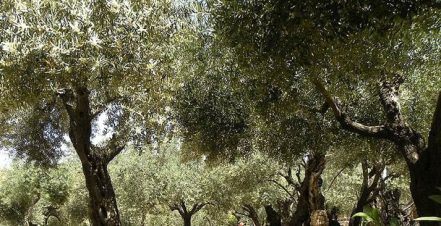
Olive Trees, Garden of Gethsemane. Ian W Scott. CC by SA 2.0
Doubtless there are many toils and snares ahead in this – and it’s a path we’ve never trod before. In this pivotal moment, as Empire loses ground, we must not. When we hear our call, let us, like Isaiah, respond ‘Here am I; send me’.
Then I heard the voice of the Lord saying,
“Whom shall I send? And who will go for us?”
And I said, “Here am I. Send me!” Isaiah 6. 8