By Nick Moss
Denni Turp’s collection opens with a quote from Rosa Luxemburg: “The most revolutionary thing one can do is always to proclaim loudly what is happening.” What’s happening, as Fran Lock says in her introduction, is that the power relations that underpin the dynamic caught in the “staple of comic language” – the Actress and the Bishop – are unpicked to examine the class and gender assumptions that underlie the comic veneer. As Lock explains it, “Even as Turp exposes the grossly unequal power relations that limit the lives of working-class women, she uses the space of the text to subvert them.”
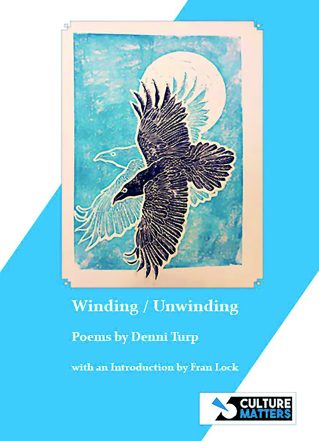
There are three essential characters in the poems in Winding / Unwinding:- the Actress, who stands as representative of working-class women throughout; the Bishop, a generalised figure of patriarchal authority and Church-borne misogyny, as well as a specific individual bringing the dynamics of gender oppression into specific situations; and the Crow. Fran Lock contends in the introduction that “Through the Crow, Turp brings subtly into frame the imaginative yoking of animality and womanhood transmitted through art and culture via the charged woman-as -animal metaphor.” This may be so, but I think the Crow also stands in the book as a symbol of possibility, of metamorphosis, even when the Actress has reached a point of surrender.
The Actress’s intention is to hack away at the layers of dupery and dissimulation that constitute the “linguistic commonplace” as Lock says, that covers over the real nature of her relations to the Bishop(s) in the poems. She tells us that “Dissembling has never been my forte” in Not Really a Hall of Mirrors, and at the start we do not know whether she will be advantaged or disadvantaged by this, although we can suspect the outcome.
Prospects defines how the Actress has been confined by the expectations of others, and the violence of others, has had to make the best of it, learn the rules:
The Actress never met a bishop
so the opportunity to say sweet FA to one
was rather more than merely rare.
The sneering stare from folk supposedly
so godly far too often came her way
despite their secret gropes and hidden
longings for her flesh, their jealousies.
She tucked awareness neatly into boxes,
kept it plain and out of sight, accepted
being bent beneath the weight of labels
burdened with self-blame, had al her lines
word perfect, learnt to play their game.
The opening line “The Actress never met a bishop” is a barbed and effective one. If the bishops stand in, let’s say, for what Althusser called Ideological State Apparatuses (the purportedly apolitical aspects of civil society wherein the “imaginary relationship of individuals to their real conditions of existence” is forged (from Louis Althusser, Ideology and Ideological State Apparatuses in Lenin and Philosophy pp 121-176, Monthly Review Press 1971) then the bishops are everywhere and nowhere; invisible yet all-too-real. We survive within the nexus of class and gender oppressions by learning “to play their game.” What’s at stake, then, is how well the Actress can play the game, and what happens if she refuses to do so.
In She wonders what the bailiffs might have cost, Turp examines ways in which bodies are schooled to play the game. That might be through elocution lessons (deemed too expensive by her mother, so the chance to “change my voice to suit my role” is denied and language becomes a marker, a step on the ladder which has RP English at the top of it ) or it might be through ballroom dancing lessons, “the next best thing…and anyway, all she could afford.”
Working-class culture
There is a sense in which the physicality of working-class culture – the centrality of the body in dance and sport – is both a strength and a weakness. Our bodies can be sites of grace and skill, but we are always/already within a culture based on language, on the correct use of language and the right form of speech, so only a few of us can use our bodies to fly out of the cage. Ballroom dancing is no match for the “special voice.”
At university, the Actress notes, contemptuously, “All those damn bishops…with their name dropping/ their nicely networked contacts” and:
…with that usual line – When I was at Oxford.
Oh, you need to hear that sound, that first
awe-syllable that starts it off,
the way they drag it out.
She thinks of telling them of another scenario, of working in a condom factory, but holds back as “they move on with another power play.” And there’s the snare – right there – you can mock the “awe-syllable” and think they’re the biggest bunch of Bishoprics you’ve ever met; but alone, you’re still out-ranked by the awes and the power-plays.
Although freedom can be located somewhere, elsewhere, for a time. In After the Festival it’s glimpsed in the “opportunist” prancing of magpies, pigeons and crows: “A one-clawed pigeon stumps along a sideways line and pecks.” In The Actress out in rural middle England, the Actress marvels at “the enclosing sweep of gardens” but “walks into a churchyard, only birds/for company and few enough of them. / Bees scout and bustle in the banks of lavender / She notices the occasional butterfly or two- / a Holly Blue, a Peacock here and there to catch the sun.”
There may only be temporary lulls in the forever war that is intended to make you feel worthless and diminished, but a country walk can provide a rejuvenating armistice , and a joyful sense of trespass into a space not meant for you, even if you need to “make a record / to prove it’s real, not just a stupid dream.”
In the next poem, Next Move, the Actress considers why “you don’t get old lady performance poets/for some reason.” Then “She looks for the bishop/and just catches his smirk.” Sometimes the bishops can be close at hand, in the home, playing by the rules themselves. And the rules say that if someone else wants to not follow the rules you tell them they’re being daft. And just that almost-timid mockery (a mockery celebrating in fact its own timidity) can be enough to undermine you, to cut you off at the knees.
The Crows, meanwhile, “their dark heads tap-tap tapping/new gaps into the gable had woken her up at five.” The crows won’t let you rest. The crows want to dismantle the domestic.
Trapped in oppressive relationships
The core of the book is Glosa: In So Many Places, which quotes Elizabeth Bishop’s The Armadillo and shares with Bishop a careful attention to the natural world. The poem is a sublime meditation on the “shifts of season”, with the Crow visiting to insist the Actress “Breathe deep. Just let it go.” But with this surrender to the rhythms of the everyday comes despair:
And so she knows that far too little changes,
only nature understands the details of the need
for growing, the links between the energies
of life that flood the land and sea and sky.
I think I’m losing hope, she tells the bishop.
And this is a clear-sighted realisation of where we are now. Still trapped within the relations of oppression that undermine our every attempt to bring about meaningful change. Stunned into despair at environmental destruction (“the gorse retracts its shine, the bird song stops, / and still the fires spread without respite / climbing the mountain height.”) And driven to a Heideggerian quietude at our centrality to that.
In the face of nature afire, we renounce the agency we have fought so long to attain. Yet still the Crow cries “Open your wings, child” and “don’t stop dreaming”, to which the Actress responds “I’ve settled for just getting on and day to day. Best way, my darkly feathered friend. Best way.” Yet still the Actress rouses herself, “steps out once more onto the stage” and declares “I am reprobate chameleon scavenger plebeian / none of the things you think I am (or can you guess?) / I am far more of me (or less?)”
Winding / Unwinding contains 16 poems. It is a short book but a powerful, weighty, demanding one. These are, ultimately, poems that wrestle hard with the word and with the world for the right to define the “more or less” of who the Actress is, in a world that is defined by bishops, and by Bishops.
Denni Turp’s voice can at times have the blunt, awed force of RS Thomas in the poems’ descriptions of sensuous encounters with the natural world. At other times there is the curled-lip mordancy of Kim Addonizio. These, though, are just reference points to signal the presence of Denni Turp as a wholly original and challenging new voice.
Winding / Unwinding by Denni Turp, with an Introduction by Fran Lock, is available in print here and as an ebook here.