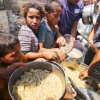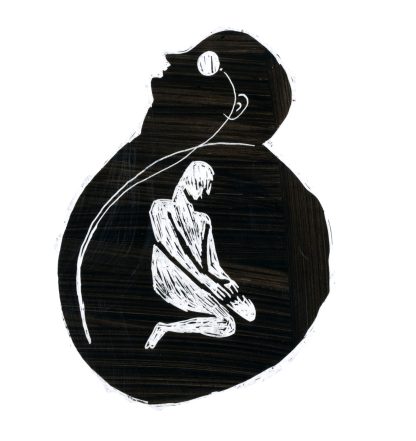
The Rich and the Poor, by Ignacia Ruiz
Jim Aitken reviews four new poetry books
Culture Matters have four poetry collections that all seem to have forms of struggle at their heart. These collections include Release the Sausages: Poems for Keir Starmer, edited by Andy Croft, Love is Stronger than Death: Mary Magdalene and the Insurrection of Jesus by Fran Lock, Words United by Michael Rosen and The Last Days of Alicante by Alan McGuire.
Each collection deals with the theme of struggle in varying ways and at different times. While Fran Lock takes us back two thousand years, Alan McGuire goes back to the Spanish Civil War as well as present day Spain. Michael Rosen delves into his ancestry and makes a devasting attack against the Israeli genocide in Gaza. Andy Croft edits no less than fifty poets, all willing not to contribute a poem in honour of the first year in power of the Labour Prime Minister, Sir Keir Starme KCB QC.
Love is Stronger than Death
Fran Lock’s collection is not only beautifully written, it is beautifully illustrated with woodcut drawings by Ignacia Ruiz. Her poems are a wonderful antidote and riposte to the present Christian nationalism we see in the US, and to the hotlines to God that so many far-right preachers and politicians seem to have today. She takes us back to source, as it were. She brings back to life the love that Jesus preached. It won over Mary of Magdalene, who became his most ardent follower.
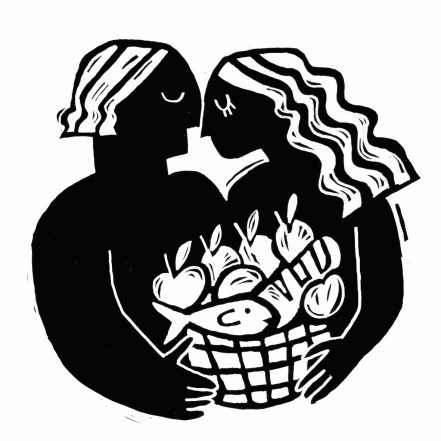
My Beloved, by Ignacia Ruiz
But Mary is a woman who is no lackey for a man. The love that Jesus has spoken of, and inspired in her, makes her realise that ‘love is justice.’ Not an empty kind of justice but one that ‘is a spectre haunting humankind.’ This love, she says, ‘is something stirring… nothing about it savours the grave, for this is as strong and stronger than death.’
The Christian core has obviously been blasphemed against in our age, and in previous times – twisted out of recognition by twisted emperors, kings and their lackey politicians. She rescues and recovers the revolutionary message that ended slavery in the ancient world. She berates ‘the manacles of money’ and the ‘tentacles of wealth.’ We must remember that three days after Jesus turned over the tables of the money men from the temple, he was crucified.
Lock actually recovers the original message of liberation which is at the core of the Gospel message. She sees in the once-marginalised figure of Mary Magdalene, a figure filled with the love Jesus showed her, someone who would challenge all the evils we see today under capitalism. Justice, like wealth and love, should be redistributive, shared by everyone.
Lock’s poem is also a reminder from a different age that struggle is necessary to challenge brute power. Her poem makes us wish a Mary Magdalene could come forth and challenge the brute ignorance and greed exemplified by Trump and his acolytes across the world today.
Release the Sausages!
Andy Croft’s anthology of empty pages attempts, in a deeply ironic way, to pay homage to the truly insightful socialist project that Sir Keir has unleashed on the UK since his election in 2024. He has, of course, done no such thing and is incapable of any shred of socialist action. The ‘change’ Starmer spoke of endlessly before the election has turned out to be as empty as he is himself. When in power his first instincts were to cut the winter fuel allowance, retain the two-child benefit cap, implement cuts to overseas aid, cuts to welfare and disability benefits, offer unqualified support for Israel’s genocide in Gaza and total capitulation to Trump.

One of the lengthier poems in Release the Sausages!
Croft has written in the Preface to the book: ’The only poetry (Keir Starmer) is known to have quoted in public is a line from a Philip Larkin poem in praise of the late Queen.’ This says much about a man who is simply carrying on Conservative politics. It could also be argued that his rightward move to over migration pulls the country further to the right. Farage is the only winner if you take him on in his natural territory. The book is without any poems whatsoever, to symbolise Starmer’s emptiness as a politician.
The title, of course, is meant to be as ridiculous as the man supposedly being written about. It is actually the words Starmer mistakenly used when he meant to say ‘release the hostages.’ His craven support of Israel and Trump seems to sum up how he is simply yet another dud reformist without any desire to reform anything.
Words United
Michael Rosen’s collection, by comparison, attacks Trump, Starmer and all the other supporters of genocide. Rosen loves words and the uses they can be put to. Though he deals with deeply serious material, he does so with a wonderful playfulness and wit. He picks up a comment from Netanyahu about ‘our ancestral lands’ and takes his reader on a tour of where he and his parents and grandparents grew up. He knows, of course, that Netanyahu means Israel but exposes the comment as an entirely bogus one.
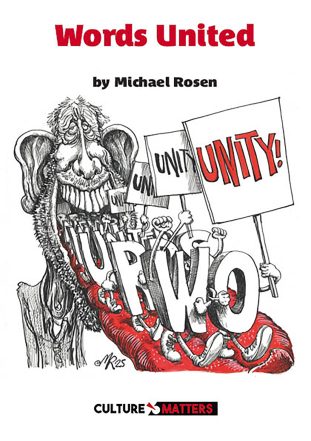
Similarly, the idea of the Promised Land is ridiculed in the poem of that name. An anonymous family turn up at the home of anonymous residents telling them that they have a right to their home. The family tell the residents to look at their papers and to look at the bit mentioned Promised Land. Asked who wrote these lines they are told,’ God wrote them, look/here come His tanks.’
Rosen also takes aim at the empty Starmer for his appalling ‘Island of Strangers’ comment that echoed Enoch Powell. He reminds Starmer how, during the time he had Covid and was hospitalised, ‘If ever you’re in need as I was / may you have an island of strangers / like I had.’
The Last Days of Alicante
Alan McGuire’s collection sees the poet absorbing another nation’s culture and history. While there are poems that simply enjoy the difference of place and custom, McGuire also sees evidence of the Spanish Civil War. He brings back to life a republican communist called Miguel Hernández Gilabert. He was also a poet and McGuire uses a quote from him to introduce his collection: ‘We’ve still so many things to talk about / my friend, my dearest friend.’
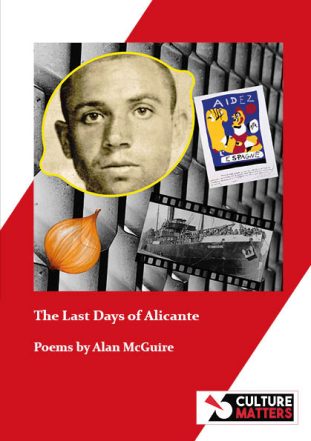
In a very real sense McGuire is writing and talking about the ‘many things’ the Spaniard spoke of and represented, and in so doing McGuire shows himself to be a dear friend. Alicante was the last stronghold of republican Spain to fall. McGuire visits gravesites and sees the remnants of a history that needs to have voice today. The Spain of mass tourism is built on the blood and sacrifice of people like Hernández who wanted a more socially equitable land.
In the poem (Not) Poetic Justice, McGuire sums up his own poetic project in the collection when he writes:
no open graves
ghosts still haunt
the present
from the past.
The ghost of Hernández and his comrades live again in these poems and photographs from the first poetry collection by McGuire. It is to be hoped it will not be his last.
All these books are available here.