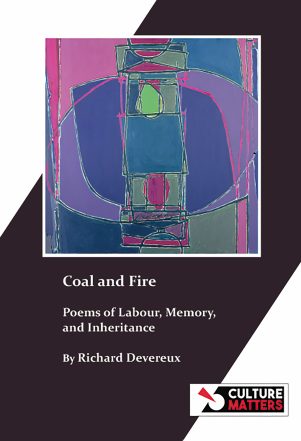
The book is available here
By Nick Moss
If part of the purpose of Culture Matters is to give voice to descriptions of the lived experience of working-class life, and of the endurance and solidarity and sometimes the fun and daftness of hard work, then with Richard Devereaux’s book and with Roger Cornish’s Mother Pit, that aim has been well met.
Cornish’s book was a document of a mining community edging from exuberance, through struggle to decline. Devereux covers similar terrain, but predominantly from a child’s perspective, in relation to visits to his grandparents in Wales, and growing up in the Black Country.
Cornish makes the point that “A man spends his life surrounded by work that nobody outside the pit ever sees”. Much the same could be said of the world of Richard Devereaux’s poetry – it maps out a world of steam trains, steel furnaces and power stations, and a childhood spent seeing the wastelands of industry as a vast playground.
My childhood was spent in similar landscapes – initially in the Potteries, with the noise of the winding engines of Chatterley Whitfield pit as soundtrack, then in Liverpool, with trips to St Helens to see family who lived under the lights of the Stanlow refinery. There was a particularity to how the industrialised topography manifested at local level – it felt future-facing but rooted, able to bear its history of technological and sociological change and carry it forward.
Growing up, it wasn’t that you were unaware of the smog, or the stench or the walking wounded, but it was just “how it was”. Until the industries that sustained it were wiped out – and all that was left was unemployment, addiction, suicidality and environmental disaster.
Richard Devereux maps all this superbly. He sends messages about how it was to live in the distinct worlds of his youth. He’s aided in this by Alan Morrison’s excellent foreword, which gives the poems a context, in the Coal poems, “the physical, spiritual and psychological legacy of coal mining” and in the Fire poems, “micro-social histories… finely-sculpted and richly descriptive.”
Devereux ‘s poems are quiet; they don’t yell or bludgeon. Like a Lowry painting, they simply show what was. In their book Lowry and the Painting of Modern Life (Tate Books 2013) TJ Clark and Anne M Wagner describe LS Lowry’s themes as being not only the industrial cities but the “physical fabric”, “the distinctive sense of place and space that grew up with them”, and this is essentially what Devereaux sets out to capture in his work.
In the poem Communion, Devereux shows mining life stripped of romance or illusion but yet rooted deeply in a sense of community, respect and care:
Coal paid his wage.
His children did not starve, but how he resented
days he saw no light—
no more than a mole.
Last hooter gone,
lamp handed in—
he wheezed on.
Once winter came,
the muffled old miners stood
side by side,
and sang— watched their number lowered
by one.
There is no minimising of hardship in these poems. But there is also a recognition that the particular strength of the miners as the most militant and organised section of the working class came from the fact that their work involved a threefold struggle – against the coalface as a source of danger, against the mine owners (and then the NCB) as cost-cutters and against the government as string -pullers and, ultimately executioners.
Work required a solidarity that was not only about how to conduct yourselves as workers above ground but as workers below, dependent on each other for safety and survival. Devereux shows us this not only in the poems that deal with the 1926 General Strike and the 1910 Chainmakers’ Strike, but also by focusing on a different kind of show of solidarity – the kind of daily solidarity that creates communities of militant unity, such as were able to support the miners throughout the 1984-85 strike:
On the bus on his way to his shift down the pit,
old Bryn’s old heart gave out and he fell down dead.
Quick, called Dai, the young Branch Sec.,
We’ll take him with us, boys,
we can’t leave Bryn behind on the number six.
Two of the best then draped the dead man’s arms around their shoulders.
Each held a hand so he wouldn’t slip off.
His feet, though, dragged behind.
They propped him up at the muster-point
and took him down, with them, in the cage, below.
And that is where they said he died.
This way, said Dai, the Board will have to pay
his widow compensation—
what’s due to a man who dies at the face.
And they sat with Bryn a while, then brought him up.
– Final Journey
Looking out for each other is ultimately the only way we survive.
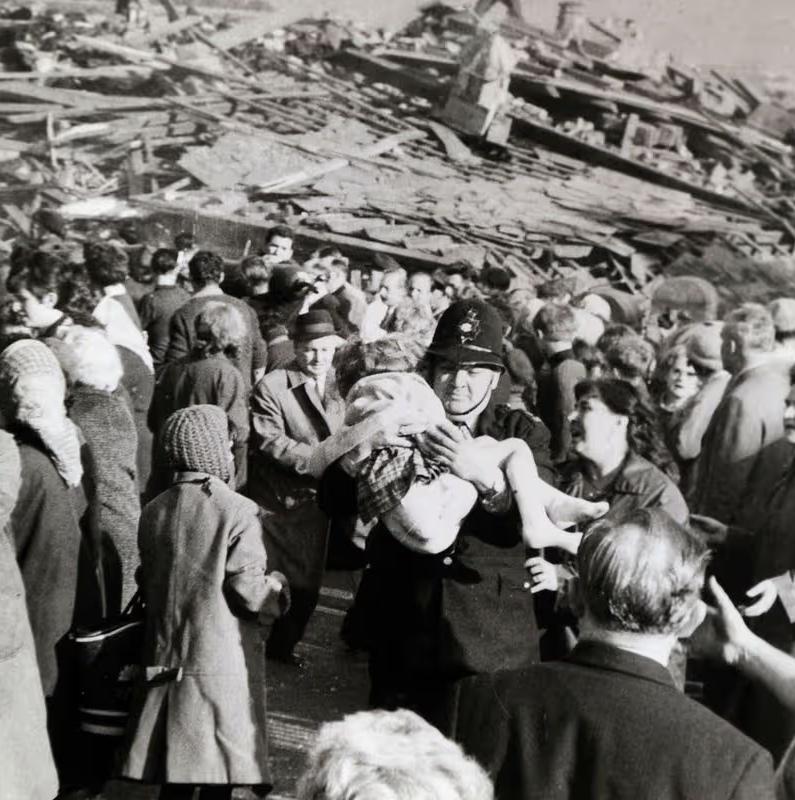
There are three poems here that deal with the Aberfan disaster. They are, each of them, as they should be, terrifying. Only Thunder sets a scene of classroom routine suddenly disturbed by the interruption of the seemingly inconceivable:
Friday 21st October 1966
then it starts
a low distant sound a rumble—
slightly louder now
everyone’s heard it
everyone’s listening now
looks criss-cross the classroom
from eye to eye
child to child
The poem Aberfan asks whether the atrocity that occurred really was so inconceivable – and we recognise immediately that Aberfan, like Hillsborough, like the Post Office scandal, like the infected blood scandal, was ultimately about whose lives matter, how much working-class lives are worth:
What was the NCB supposed to do?
Surely, in the public name,
do better than the old mineowners.
The managers at the NCB
should have placed no faith
in the legacy of private profit,
should have checked the tip was safe.
They’d been warned:
The tip’s not safe.
The truth of Aberfan though lies not only in failures and betrayals of the state, but in the bravery of the working people whose lives were ripped apart and had to act immediately as the horror rolled out before them:
In every pit for miles,
the sirens screamed,
the cages shot the men to the head,
night-shift boys knocked up from their beds,
every pick and shovel—grabbed
all, quick, onto lorries,
up, down and round the mountain bends… …
at Aberfan they could not speak.
What do you say to ten feet of slurry?
They dig, dig and dig for dear life
and as they dig
they sing Myfanwy.
They dig, dig, dig
and bring out from Pantglas Junior
all of the little girls and boys
one by one
to the mothers waiting, waiting, waiting
Devereux’s Aberfan trilogy of poems is brutally simple. It documents what happened, who was at fault, and who stepped up and stepped forward. It works effectively to memorialise respectfully those who died, but with an anger proper to the event.
I want though also to make a claim for Devereux as a lyric poet. There are aspects of his work that remind me of the great American lyric poet, Donald Justice. I don’t mean to say that there is a direct comparison – Justice wrote as a professional poet from the mid-60s through to his death in 2004.
What I want to suggest is that there are common themes and a common approach. Both write poems that are elegiac, that are focused on memory and loss. Devereux writes of miners “loading the trucks then shouldering them / laden with oaths, along the tracks”. He gives us portraits of the homelife of his Welsh grandparents:
When we took our seats
the room hummed
with our own warmth,
and the range purred—
its work done.
– Salem
He sketches “the stubborn glow of furnaces and the flicker of fireflies darting into the night sky from foundries and forges, as if from the Inferno” and “Furnace fires that lit the skies above Tipton, Smethwick, Wednesbury.” Devereaux captures the lost promise of British industry and how that manifests as an elegy for a landscape that was despoiled through relentless extraction, yet seemed mysterious and full of promise and adventure, if you were a kid growing up with it as your backyard. All of this puts me in mind of Justice, in, for example his Pantoum of the Great Depression:-
It was the ordinary pities and fears consumed us.
We gathered on porches; the moon rose; we were poor.
What audience would ever know our story?
Beyond our windows shone the actual world.
We gathered on porches; the moon rose; we were poor.
And time went by, drawn by slow horses.
Somewhere beyond our windows shone the world.
The Great Depression had entered our souls like fog.
It’s a matter of tone – not quite lament, nor a song of a kind of sublime surrender, more a rueful notation of what is. What’s important though is that Devereux is using the lyric form to document working-class life and the “places and spaces” (to quote Clark and Wagner again) within which that life takes place.
And why should that matter? Because we are told as a class that beauty does not belong to us – that nothing of our lives can be beautiful, that the light that falls on us is not the same light that falls on the streets of Mayfair. But if, among the slagheaps and the wildfires, the pneumoconiosis, the COPD and the asbestosis, we can still find something of beauty, then we have hope and something to fight for. We can strive for utopia within the ruins.
What’s special about Devereaux’s writing is that he captures all of this; the latent possibility of a better way of living so long as we as a class have some sense of our own power. That power calls to us through our history:
Chain masters paid starvation rates
To haggard wives with babes and ragged kids,
The women joined the Anti-Sweating League,
Downed ’ommer and tongs, linked arms and marched.
– The Chainmakers’ Strike, Cradley Heath, 1910
It also calls us through our struggles today to try to hold each other above the water, as we are hit by wave after wave of economic and ecological disaster.
Devereux is not simply providing a poetry of nostalgia. As Clark and Wagner wrote about Lowry “…the swamps and chimneys are those of Wigan 70 years ago but could as well be on the edges of Shenzhen or Sao Paulo…”. Clark writes elsewhere in the same book that “the life of the streets never stopped throwing up incident and energy.”
We should remember this when tempted to see Devereux’s beautiful and powerful poems through a sepia-tinted lens. Somewhere, there is always what Devereux calls “the sweet intoxication of teargas”; somewhere, someone is always standing up and having to say, as the Aberfan victim’s father does in this book:
We want it recorded
“Buried alive by the National Coal Board”
— can you write that down Sir—
these are the words we want on the Certificates.
We have to stand with them until the madness of Capital’s crazed gyrations is forced to a stop. These poems sketch out how we might remember to be towards each other, as a means of reaching that goal.
Coal and Fire: Poems of Labour, Memory and Inheritance, by Richard Devereux, is available here.