Love cools, friendship falls off, brothers divide; in cities, mutinies; in countries, discord; in palaces, treason; and the bond cracked ’twixt son and father…. We have seen the best of our time. Machinations, hollowness, treachery, and all ruinous disorders follow us disquietly to our graves… King Lear, Act 1, Scene 2
By David Betteridge
There was a conference in London at which, over the course of nearly a fortnight, the country’s future was debated in a root-and-branch manner, and with great passion. Egalitarian views were voiced, if not agreed, and, from a significant group of speakers, there was a proto-revolutionary call for a redistribution of wealth, notably of land. As is currently under way across the US and elsewhere – since an upsurge of protest last year against Trump and his abuse of power – there was a “No Kings” movement associated with this conference, feeding into it, and being strengthened by it.
I am referring to the Putney Debates of 1647, so called because they took place in St Mary’s Church, in Putney, London. Delegates elected from the New Model Army met there, with others, between 28th October of that year and 8th November, to review what they were fighting for, and fighting against, and how to proceed in their turning of the world upside down. This “turning upside down” was, of course, the English Civil War, or, according to Marxist analysis, the English Revolution.
Reading the transcripts of these Putney Debates, along with such associated publications as a series of pamphlets titled the Agreement of the People, we are struck by how resonant the Debates remain, even after 379 years of change. We find, for example, detailed proposals for extending the scope and frequency of elections, for freedom of expression, and for laws that are “equal, so they must be good, and not obviously destructive to the safety and well-being of the people.”
If the Putney debaters were to time-travel, and join us here in Britain today, they would be surprised to find that attempts had recently been made by Starmer’s government to cancel elections, not extend them, and also that to call genocide “genocide” can be deemed a thought-crime, that to exercise free speech in defence of freedom can be prosecuted as terrorism, and that to vote for measures designed to reduce child poverty can result in Labour MPs losing the party whip; and they would be dismayed to find that we are still living in a monarchy.
Constitutional historians might explain to these comrades-from-the-past that over the centuries our monarchy has been forced into a complicated symbiosis with Parliament and with other parts of the body politic, with Parliament having “the last word”, but they would see clear evidence, nonetheless, that the Crown is sedulously nurtured, promoted and protected, despite its frequent (and current) tarnishings, and that it serves to legitimise class divisions, much as it always has. There was one tendency in the Putney Debates, the Levellers, who were especially resolute in addressing the economic basis of class rule. Some of these revolutionaries, calling themselves the “True Levellers”, went beyond merely calling for this or calling for that. Famously, they employed a strategy that we now describe as direct action. Starting in April of 1649, they set to work clearing selected tracts of common land. Their purpose was to cultivate them, and, in due course, harvest them, living off the fruits of their labour in communities of friends and equals. In taking this action, first of all on St George’s Hill, in Surrey, then briefly on other sites, they earned the nickname of “Diggers”, and the name stuck.
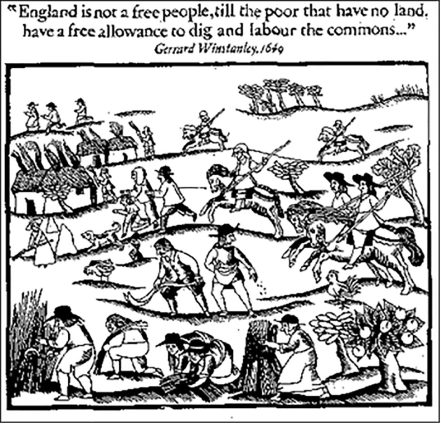
We can begin to get some sense of these Diggers’ thinking by reading their manifesto, The True Levellers Standard Advanced, the work of Gerrard Winstanley, one of their best-remembered leaders and their principal theoretician. In it, he places their direct action on St George’s Hill in a grand narrative of world history, going back to God’s will and Eden, “as it was first made.” Winstanley would be pleased to know that we present-day adherents of a republican and communist Left still honour their direct action of 1649, though less pleased, I guess, if we told him that St George’s Hill is now a gated housing development, home to an elite of super-rich:
… we begin to Digge upon George-Hill, to eate our Bread together by righteous labour, and sweat of our browes… And though that Earth in view of Flesh, be very barren, yet we should trust the Spirit for a blessing. And that not only this Common, or Heath should be taken in and Manured by the People, but all the Commons and waste Ground in England, and in the whole World, shall be taken in by the People in righteousness, not owning any Propriety; but taking the Earth to be a Common Treasury, as it was first made for all.
It was not long, of course, before this little parcel of “Common Treasury” came under attack. As in physics, so in politics, there is no action without reaction, in this case sustained thuggery, theft of tools, arson, vexatious litigation, fines, imprisonment, and even killing, instigated by local lords of the manor. So the brave new experiment on St George’s Hill had to be abandoned, and other attempts made in other locations were no more successful. Reaction won.
Undismayed, Winstanley went on in his campaigning for a root-and-branch renewal of political thinking. A pamphlet, The Law of Freedom, which he published in February 1652, outlines a theory and practice of communism still way beyond our reach, as beyond his. He would be pleased, however, were he to time-travel here, to see that the Society of Friends, of which he was an early member, still exists as a force for good in a dangerous world.

Who better to guide us into these ins and outs and ups and downs of the English Revolution than Alan Morrison? Not only has he made a long study of it, more importantly he has a deep sense of the perennial issues of religion and politics that fired it, understanding these issues in his heart as well as his head, because he lives them.
The Alderbank Wade is Morrison’s verse novel deriving its subject matter from the English Revolution. It is based on an earlier drafted prose novel which Morrison tells us in the Preface he laid aside in a pile of manuscripts in a drawer for nearly thirty years:
But after publishing my Republican-themed poetry collection Wolves Come Grovelling with Culture Matters in 2023, I once again felt the urge to revisit my old tale, only now I decided to rewrite it entirely (and from memory) in verse…
… and so The Alderbank Wade was born. Pretty quickly it attracted significant critical notice. Reviewers recognised Morrison’s novel in verse as showing especial skill in portraying division, and showing how division is fought out, not only between individuals and the classes and factions that they are part of, but also within individuals’ own lives. England’s civil war had many, many more battlefields than could ever be located on a map with a crossed-swords symbol. In Morrison’s own words, in the Preface:
What I try to show throughout is how each individual protagonist wrestles with divided loyalties and nuances and contradictions of their own minds as they navigate their way through those grievously divided times.
Now as then, then as now! Reading The Alderbank Wade, as well as providing us with a literary treat, demonstrates the sad fact that, in politics, fair can turn foul with horrible speed. It also demonstrates the crying need to know in our bones what to hold fast to, and whom to trust.
The first thing that struck me when I began to read The Alderbank Wade was just how much energy Morrison had packed into this novel in verse. It carries us forward, zestfully, with meaning hard on the heels of meaning, across the line-breaks and across the rhyming or half-rhyming couplets that are his chosen form. These meanings are conveyed in an idiolect that Morrison created specially for his first-person narrator, one Jared Amory, who in old age struggles to make sense of his life, intertwined as it was with that of a friend from childhood, Gideon Wade. It is a way of speaking that suggests someone from the past, but without resorting to thee and thou, or other archaisms.
Morrison as author and Amory a narrator seem to have become one, speaking in a living vernacular, strongly embedded in real life. This embeddedness stems in large part, I reckon, from the plentiful use of concrete nouns and transitive verbs, naming things and conveying actions in a picturesque fashion. See/hear for example how Jared’s and Gideon’s origins are sketched, in Part I of the novel:
We were both temperamental sons of austere men,
Gideon’s father a simple farmer & glass-eyed Anglican,
Mine, a solicitor’s scrivener & ruminating ‘Puritan’
Who chewed his Geneva Bible under a shady capotain
Black as his apparel…
… [we, with such] God-fearing fathers
Were each unsuited as sons: I would have rather
Been a poet than a mere apprentice scribe,
While Gid, always spouting his politics & diatribe
Would have made for a Parliament man had he been
Born better-heeled – but at least we could daydream…
What economy of diction! What bold strokes of description! Reading on, we see/hear that the narration of action is equally well achieved as description, as in a passage in Part VI where Jared tells of Gideon’s iconoclastic rampages against Laudian churches after his switch of allegiance from Crown to Parliament. Here he is, enjoying his rank of captain in the Ironsides:
… Ordering his Roundheads to leave no stone
Unturned, & so they tore down the reredos,
Smashed up the statues & idols, demolished
The altars, took axes to the wooden pulpits, slung
Out any popish gold.…
…loud & diabolic
& deafening the sound of their hammers & mallets
Smashing the statues & idols & ornaments
& their axes chopping up the splintering pulpits
& pews…
Even in passages where details of political and religious thinking need to be conveyed, Morrison’s/Amory’s style succeeds in making them real, because the style is in character. For example, also from Part VI:
…England, a Civil War? Was any of this laying out
A path to peace & godliness? (Gid would quote
From Matthew: I come not in peace but with a sword…
But did Christ not speak in symbol, in metaphor?}
What we have here are examples of more than good writing, I think. We have examples of a good historical imagination at work, doing what the philosopher-cum-historian R.G. Collingwood prescribed, that is to say reconstructing your chosen period of time with your chosen people in it, and doing so by re-enacting in your mind what they were thinking, and doing it from the closest of possible readings of your primary sources, editing nothing out and smuggling nothing in.
Usefully, in his Preface, Morrison tells us what those sources were. They included the same Seventeenth Century publications that I have already quoted (above), and more besides, with Gerrard Winstanley to the fore, plus, at an early stage in his “devouring” of evidence, a Sealed Knot “authentic recreation of the sights of the Civil War” as played out at the Battle of Torrington. Morrison also mentions having learned from such secondary sources as books by Christopher Hill, David Petegorsky, and F.D. Gow, and films about Winstanley and Oliver Cromwell.
Let us see/hear how Jared continues his narration, from the establishment of a Digger community in Alderbank – inspired, in the novel’s imagining, by the real-life community on St George’s Hill – and then, painfully, on to its tragic end. Weakened by disunity, and attacked by troops detailed to assert Cromwell’s rule, the big house that the Alderbank Diggers had for their HQ was blown up, and with it any hope of their utopian experiment continuing. Here are Jared’s elegiac words, from Part XVI of the novel:
When I woke cold & shivering it was green morning light
& down the hill before me Alderbank was anthracite:
Charred & smouldering, as were its grounds where once
Crops had grown now scorched to black protrusions,
& even parts of the corn fields surrounding the estate…
Were visibly singed, the smoke still rising from the ruins,
& my stomach plunged at what had become of Gideon…
…eerily, I began to hear faint murmurs
Of plaintive voices through the trees, dishevelled,
Exhausted, haunted tones…
The remainder of our community…
Regarding the preceding period of disunity that had weakened the community, John O’Donoghue points to a key element in the psycho-drama that was played out there, at the same time as the civil war was extending its trauma across the nation:
Amory and Wade start to drift apart: ‘It pained me how far our souls / Had rolled apart like two ends of a scroll…’ Amory starts to doubt his former friend: ‘I had a divided mind at a divided time…’ It is now that the community starts to fragment.
This image of the two ends of a scroll signifying division is a perfect one.

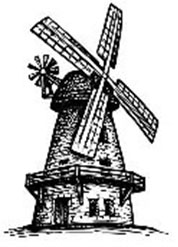
As well as the scroll, there is a second highly significant image at work in The Alderbank Wade. It first appears on page 1 and recurs again and again until page 120, which is the end of the novel. This is the image of the windmill, quite filmic in places, I thought, as I read my way through the increasingly dark narrative. Here is how a now elderly Jared bids farewell to us, and sums things up, in Part XVII, called “Epilogue”:
Having scaled the steep hill to the windmill I am much
Fatigued, hence why I have lain myself to
Rest awhile…
Some time must have passed, since now
It is sunset & the skies are bruising indigo from flaming
Salmon & soon there will be inky blues deepening…
Are those the wind-sails I hear swishing, or children’s
Whispers on the breeze…?
Morrison is good at endings. (I think, for example, of the “Benedictions” roll-call of the dead at the end of his Tan Raptures, a heart-breaking study of the many social murders committed by the application of Tory “welfare reforms”. The Diggers, by the way, have an honoured role in this fine book, published by Smokestack Books in 2017.) His ending for The Alderbank Wade not only rounds off this tale of conflicted and conflicting friendship in a beautiful way; it also leaves us pondering “the choices we made”, that is to say the choices that the characters in the novel made, and at the same time the choices that we, the readers, have made and will of necessity go on making, for good or ill, until we run out of them:
& as everything dims around me & the darkness
Gathers, Time stills with the creak of the wind-sails,
I see Gid again, the enigma, green-eyed in a glade
Of dwindling light before me, smiling again
& laughing in the wind – in the deepening shade
Of this windmill I reflect on the choices we made
& whether we were not all the Alderbank Wade…
The Alderbank Wade by Alan Morrison is available to order here