

Colbert and Grogu: Separated at Birth?
By Dennis Broe
Two recent media events in film and television are closer to non-events, though you wouldn’t know it from the publicity they received in mainstream outlets.
The New York Times wept over the cancelling of Steven Colbert’s Late Show which in terms of what’s replacing it is an unwelcome change. It represents more signs of the politically motivated conservative, Zionist heavy-handed approach of Larry Ellison and son David’s regime at Paramount, which owns CBS.
Colbert’s previous show on Comedy Central—a network which is by the way also now under the purview of the Ellisons—The Colbert Report was one of the funniest, most audacious shows on TV. Each episode Colbert, as an insufferable conservative, would mock the personas of Republican and far-right media “stars,” wallowing in their ignorance and refusal to see even an ounce of the truth.
Unfortunately, when he was promoted to, as they used to say in the Peter Principle “his level of incompetence” as CBS late night host, he first attempted to be “loony” without the politics. That didn’t work in terms of ratings and so he swung over to almost exclusively doing what in late night is called “topical” humor.
The problem is his so-called humor was not funny. It was instead a rigid sop to the Democratic Party, even as in the Biden and second Trump era we have seen that party sitting on the sidelines, refusing to actively contest Trump. The continually easy supposed pummeling of Trump was always accompanied by “respectful” treatment of the Hilary Clinton, Biden, and Harris failed campaigns and failed presidency with their equal failure to actively challenge Trump on issues of concern to working-class people.
Their limp flaccid resistance amounted to political enabling and made them complicit in Trump’s first and second rise. It was a pitiful sight where rather than exposing the emperor as having no clothes, what we got every night was a comedian with no jokes, simply pandering to his inside-the-bubble audience.
Believe it or not what’s replacing him, with Colbert eased out after offending the president, is worse, as CBS, once a symbol of excellence, now stands for the Cruddy Broadcasting System. What we’re getting in Colbert’s place is full-time entrepreneur, part-time talk show host Byron Allen’s Comics Unleashed. Allen is the textbook definition of bland. He has never met a political joke he likes and so one thing you can bet the comics on his show won’t be “unleashed” about is “topical” humor offending the Trump regime. And that is the point!
David Letterman, who held the spot before Colbert, made a momentary return to the acerbic Letterman who used to do battle every night with the NBC corporate General Electric philistine ownership. He called the changeover a “botched holdup,” referring to David Ellison as “The Ellison Twins,” recalling bottom layer TV like “The Olson Twins” and described alternating richest man in the world and Oracle AI owner Larry this way: “As best I understand it, he invented the slinky,” again implying there is something equally slinky about Ellison.
Letterman’s final comment on the changeover is close to Hamlet’s calling the changeover from his father to the usurper Claudius “Hyperion to a Satyr,” that is a sun god to a randy goat. Letterman updated Hamlet’s comparison this way: “This used to be my show. It’s like driving by your old neighborhood and realizing that where you used to live, they’re putting up an adult bookstore.”
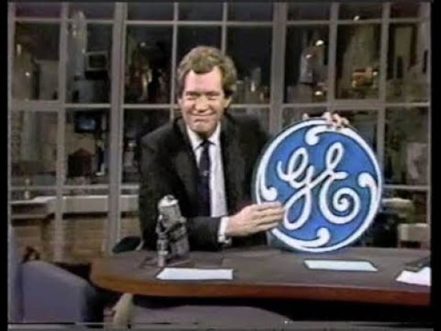
David Letterman doing battle with GE
It must be added also that there is a change in the terms of the Byron Allen takeover of the late- night slot. Allen, described by a colleague as having “deep relationships with advertisers, partners and sources of capital” was not hired by CBS. Instead, in the best neoliberal arrangement, he is renting the space from CBS and responsible for securing the advertising himself to make the show profitable. Clearly, this makes him even more beholden to those advertisers since there is no network to intervene between him and pure selling; one small step for comics, one giant leap off a cliff for network and late-night TV.
And it gets worse…..
The second major event is the release of the first summer blockbuster from the Star Wars franchise owned by Disney, The Mandalorian and Grogu, and it too in terms of popular entertainment is a degradation. In the original Star Wars in 1977, there was something at stake. The first three episodes were about the difficult and hard-fought transformation of an empire to a republic. So, there was at least something behind the series’ claim to being about freedom and democracy within its universe. Of course, flash forward and what we are watching every day in our current reality is the transformation of a democracy into an empire, one that is hardening every moment even as that empire is slipping away.
The first two television seasons of The Mandalorian had a thrust to them that went beyond the father and son bonding of the intergalactic spaghetti Western hero and his animatronic puppet, his would-be son with the power of the force, Grogu. The series was set in the time after the republic had come into being but was still being beset by various outposts of the fascist empire attempting to overthrow it. This gave yet again a kind of force to the series as in 2019 the first Trump administration, now leaving office, coalesced in attempts to retain power and take over the republic.
Each Star Wars film has previously situated itself in some place on the timeline around the empire and the republic, thus in a way raising the stakes for the films and rationalizing their full-length treatment. Not so this film. There is nothing at stake but a silly post Jabba-the-Hut story that goes nowhere and represents no real threat to the empire.
The film just alternates between meaningless and senseless battles of the helmeted warrior who professes to not like violence, the better to pre-sell the video game, and animatronic “cuteness” of the puppet which since it adds little to their relationship becomes itself nothing more than an advert for merch. In this degradation, since this is less a movie than two episodes of the TV series strung together, the film then is a perfect illustration of an empire posing as a republic but one that cannot halt its own decline.

The Mandalorian: preselling the video game
Both Colbert and The Mandalorian are examples of the way that decline is mirrored in mainstream entertainment. This seems to have given up on anything meaningful and resigned itself to bread and circuses – to torturing an already abused population whose leisure outlets betray them as well. Unfortunately in the Mandalorian’s terms, in our current entertainment media, “This is the way.”