By Keith Flett
Can a campaign from below, a democratic campaign on a social and cultural activity like beer drinking, have any effect? Yes, it can. The story this year of the revival of draught Bass, a 4.4% cask-only pale ale, is an astonishing one.
Bass of course has a long history. The red triangle, still in use, was first registered as a UK trademark in 1875, so famous that it appeared in Manet’s painting of the bar at the Folies Bergere as well as in several paintings by Picasso, although it’s not clear that he was a keen Bass drinker.
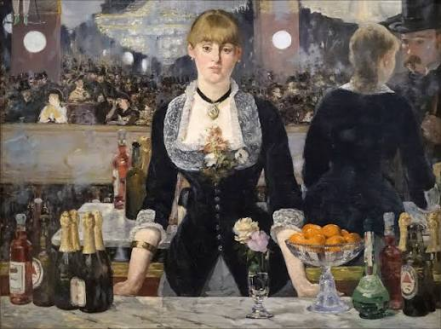
The bar at the Folies-Bergere, by Manet
In the Victorian era Bass was sold around the imperial globe, mainly of course in bottle. Brewed in Burton on Trent using the unique Burton Union system of brewing. It was notable for, to put it no higher, meaning that drinkers would have no need of laxatives.
Bass then was a classic British pale ale, if not the classic, with a worldwide reputation. I first drank it in the 1970s in Bass Charrington pubs in North London. Memory of taste is problematic. I do recall that it was not my favourite beer, and looking back, this was probably because (the style having been to the US and back in the intervening period) it was what is now called a West Coast pale. The West Coast of the US that is, not England. That meant for my then youthful palate I probably thought it rather bitter.
Things started to go badly wrong for Bass drinkers with 1989 Beer Orders. At the time these were thought to be a step forward. They restricted the number of pubs that breweries could own. That meant substantial numbers of pubs were sold off leading to the creation of what we now know as pub companies. Strangely what is probably the best known, though not the largest pubco, Wetherspoons was not a significant beneficiary. However the changes did allow Spoons to open pubs in retail premises.
It also meant that pubs by law could sell a guest beer, ideally local, alongside products from the big breweries. This worked well, so well in fact that the legal requirement was revoked in 2003.
All this spelt bad news for Bass. Bass Charrington who brewed Bass decided in 2000 to focus on being a pub company and got rid of their breweries. That meant that a major outlet for Bass disappeared. What had once been a common sight on pub bar tops became over time much harder to find.
Bass entered into a complex ownership arrangement which maintains to this day. The brand is owned and marketed by ABInBev, but the contract to brew it is with Carlsberg Britvic in Burton. These are two of the largest global brewers. Indeed Carlsberg is the biggest brewer of cask beer in the world. Neither company has any great interest in real ale. After all while it can be sold in the UK, it can’t, like lager, easily be marketed on a global scale.
Roger Protz reported in What’s Brewing (December 2025) that while at its peak production of Bass had reached one million barrels a year it had declined to just 30,000 barrels.
Grassroots campaign to restore Bass
For a good while it looked like Bass, historic status though it had, was on the way out. Then something remarkable happened, a grassroots campaign to bring it back. While this no doubt included members of the Campaign for Real Ale, CAMRA has had a split view of cask beers produced by global brewers.
Greene King is owned by a Hong Kong property company but its Abbot Ale won Champion Beer of Britain quite recently. Similarly Fullers in London is now a pub company only. The brewery is owned by Japanese beer giant Asahi. However, Fullers beers remain, rightly in my view, appreciated as examples of good cask brewing. Bass seemed to fall on the other side of this and perhaps being owned and brewed by two of the biggest global brewers did not help.
The grassroots campaign to restore Bass was very much helped by social media. ABInBev were not about to tell drinkers where they might find a pint of Bass. However, a regularly updated Facebook page, with information provided by people who had found and consumed Bass in pubs did and still does.
This in turn led a to a rise in consumption of Bass and as pub owners and managers noted the interest more began to order it for their own bars. It’s now quite common to find reports of demand temporarily exceeding supply.
Then one final twist in the Bass story took place. An unknown person at ABInBev presumably noting all the interest took the decision that after years of neglect it would actually start to market the beer again.
Hence if you wander into an independently owned pub around the UK, you are quite likely to find a large Bass mirror behind the bar, glasses branded with the famous red triangle trademark and a plentiful supply of similarly branded beermats. Even in these flagship pubs as it were, such is the demand that reports suggest that Bass sometimes runs out.
The revival of cask Bass is an unusual story for 2026 because it shows how a campaign run from below on social media and in person in pubs can persuade a global brewer that has no history of interest in cask beer at all, to shift its position and start marketing it.
The fact that it was a campaign independent of CAMRA, although very clearly helped by its members, suggests some pointers for how tactics and strategies to keep good cask beer on the bar tops of pubs might develop.