
Poster for The Man with the Plan
By Jim Aitken
Culture, as we all know, can do many things. One key duty it has is to challenge what it perceives as wrong within society and the broader world. Culture should not only challenge this but direct us all into thinking about how we can collectively improve things. And this can be done by not only looking at now but by looking to the past. And it can also look to the future in ways that suggest what could transpire based on current political and economic trends.
The Uprising
Three cultural productions, one play and two films, have chosen to look to the past so that we can think about the present. The oldest setting is in 14th century England around the time of the Black Death in 1381. The film is called ‘The Uprising’, directed by Paul Greengrass and stars Andrew Garfield as the Ploughman, Jamie Bell as John Ball and Cosmo Jarvis as Wat Tyler.
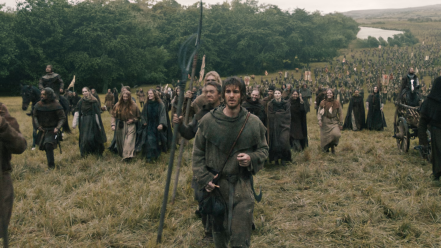
The country at that time chose not to tax the establishment classes, the Church and merchants, and pushed even more pressure on the peasantry by taxing them. This gave rise to the Peasants’ Revolt. The rage and violence that came from below, and then from above, mirrors so much history as we know it. The violence that came from below in Gaza three years ago was matched with genocidal intent by Israel afterwards. While there are certain misgivings audiences may have about the film in terms of its direction, the analogy that audiences can make with today is clear.
The Standard of Living
Since appearing at the Theatre Royal Haymarket in London, the play ‘The Standard of Living’ written by James Graham and directed by Nicholas Hytner, is about the life of John Maynard Keynes. He is considered a heretical economist in today’s world because he believed in state intervention in order to protect citizens from what he called ‘the dysfunction of capitalism.’ While we could argue that capitalism is always dysfunctional, clearly there are times when it is more dysfunctional than normal.
Keynes’ influential work ‘The General Theory of Employment, Interest and Money’ came out in 1936 during the period dubbed ‘the Depression.’ This had a serious impact on F.D. Roosevelt and his New Deal for America. It also played a major role in transforming the post-WW2 era of the UK. The Labour Government of 1945 brought out a huge housebuilding programme that not only created new – and much needed – houses, but also created much more needed jobs.

‘The Standard of Living’ stars Rory Kinnear as Keynes and takes us through his life not only as an economist but also as a member of the Bloomsbury Group of bohemian writers and painters. They included Virginia Wolff, Dora Carrington, Lytton Strachey and Vanessa Bell as well as the Scottish artist Duncan Grant whom Keynes considered ‘the love of my life.’
Keynes was both a radical economist for his times but equally radical was his promotion of the arts and culture generally. He was also bisexual, which was wildly at variance with the prevailing norms of the time. His economic adversary back then was Friedrich Hayek and he appears, played by Laurie Kynaston. Hayek, as we know to our cost, was the favoured economist of Thatcher, yet Hayek greatly admired Keynes and his work. Also appearing in the play is William Beveridge, played by George Taylor.
The Man with the Plan
Beveridge gave us the report, commissioned by Churchill, ingloriously titled, ‘Social Insurance and Allied Services’. It is more generally known today as the Beveridge Report of 1942. A new film ‘The Man with the Plan’, written and directed by Christine Edzard, looks back to Beveridge and the radical ideas behind his report.
The film is a kind of docudrama and the main character is a young student named as Flea. Her name implies both insignificance yet something that can bite and irritate. Her character is played by Sophie Jenkin. She attends class one day to be told about the Beveridge Report by her tutor, who becomes the narrator of the film, and he is played by Mark Thomas.
Beveridge described his Report as revolutionary, and he sought to tackle what he called the ‘Five Giants of Reconstruction’. They were disease, squalor, ignorance, idleness and want. Beveridge maintained that these giants morphed into one another. The character of Beveridge is played by Simon Callow and the language he uses in the film comes directly from the Report. Callow is seen in a kind of flashback set of sequences set in black and white, which fits the world of 1942.
Though a Liberal peer, Beveridge turned out to take his task extremely seriously, no doubt much to Churchill’s annoyance. The usual way it seems to be in this country when there is rising discontent, is to simply call for a report to take the sting out of the present. And reports can take many years to be published. The Saville Report, for example, came out in 2010 after previous findings under Widgery in 1972 were considered a whitewash. Saville found that the demonstrators on Bloody Sunday 1971 posed no threat on the day, and that the deaths of 13 civilians by the Parachute Regiment was entirely their fault.
Callow is an excellent choice as Beveridge with his upper-crust accent and pinstriped suit. The student Flea is also well conceived as she seems to take her studies as seriously as Beveridge took his Report. Her mind seems to run wild with all that she uncovers, and in such a mental daze she becomes transformed as Alice in Wonderland.
Politicians, the press (conveniently wearing the heads of sheep), bankers, market traders, speculators and spivs all appear to say how Beveridge’s plans are unworkable, naïve and utopian. Yet at the end of the film appear real-life campaigners and activists demanding action. There is an appearance by Professor Michael Marmot of the Department of Epidemiology and Public Health at University College, London who tells everyone that Beveridge’s plan is ‘not just possible today, but necessary, vital for today. We have to address the causes of the causes – and they reside in those five giants of Beveridge. So we need social action, we need to rediscover the public good.’
Rediscovering the public good should be why every politician takes up office. Yet, as we know, there are reactionary politicians who prefer warfare to welfare, lower taxes for the already sumptuously rich at the expense of the public sector. We have been living with these choices for generations now. The fact that this film challenges this by looking afresh at Beveridge is to be welcomed. It is intended to be shown in libraries and community centres.
‘The Man with the Plan’ is cleverly conceived. Another dramatic device was to have a tree with those struggling at the bottom and the sumptuously rich sitting on swings way beyond the top, just getting richer and richer. While Beveridge intended idleness to represent mass unemployment, the filthy rich remain the idlest class of all, producing the carnage and chaos beneath them.
‘The Man with the Plan’ is a film that looks back to the past in order to shed light on the present. Similarly, that is what in differing ways, ‘The Standard of Living’ and ‘The Uprising’ are doing. All three pieces are urgent looks at what ails our age. They are also warnings from history. Keynes and Beveridge both came to understand that state intervention was essential to the maintenance of the state itself. We know who undermines the state – it is always the greed of the rich and their greed can give rise to fascism or to socialism. Opting for the former guarantees simply a more oppressive and brutal status quo, whereas socialism could unleash a more equitable world where everyone can prosper.
Culture can point the way
Culture is important to raise our awareness. These three pieces do that by shedding light on our times today. Walter Benjamin, however, put it differently. He saw revolution not so much as a tool to accelerate historical progress but more as an emergency brake to disrupt the constant chaos of the present. In Spain it is housing, in France it is education that seeks to apply emergency brakes.
In times where chaos reigns there is also vast amounts of money being made. This is true in all these cultural productions. The rich can simply never have enough. We should know this by now. And in the absence of progressive politics and a lack of progressive politicians, culture can enrich and point the way. It is to be hoped that out of it may come the rupture (as opposed to the Rapture!), the emergency brakes to ultimately take us in completely different directions.
The narrator of ‘The Man with the Plan’ reminds us that: ‘The state is not some dictator or Google or Amazon – or ‘they’. The state is you. You!’
We surely need to realise this, and act accordingly.