The book is available here
By Jim Aitken
‘Study, learn more, learn forever.’ – Lenin
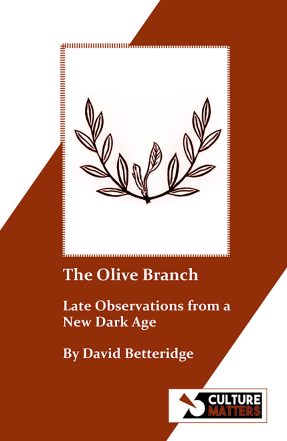
This collection is subtitled ‘Late Observations from a New Dark Age.’ Clearly, we are taken into our own era with wars, genocide and ecocide, militarism, racism and fascism, and the failure of reformism to address any of this – just as before. While there is a bleakness in all this, considering we have been here before, David Betteridge gives us another part to his subtitle which declares a defiant note of optimism – ‘A sequence of poems and prose advancing an argument in favour of delight.’
Yes indeed, to that. The collection seems to have a high degree of urgency about it. Simply looking at the layout bears this out. The collection divides itself into four books – Pushing Back, Giving Life to our Lives, Pressing Ahead and Still Further. The sense of urgency springs from the words of movement, the words of action he uses for his titles.
And two of his books have sub-divisions. Book One contains three sections – Against Misrule, Against Wars and Against Earth Crimes. Book Three also contains three sections – Towards Understanding, Towards Delight and Towards a Politics of Hope. Books Two and Four are without sections. Such an intricate layout seems designed to do two things. First of all, we are being presented with a narrative. And secondly, we are being invited on a journey.
This is not merely urgent but extremely ambitious. We are living in perilous times and urgency and ambition are essential. Betteridge is taking on a tall task. It is commendable that he is still up for the fight. Clearsighted writing that urges others to follow is vital right now.
And to aid us on our journey the poet offers us a series of quotations he labels ‘Some Readings, For Readying.’ Yet once the journey is over we are given another series of quotations, this time called ‘More Readings, In Retrospect.’ Obviously, the writer is saying our journey is only beginning once we have read his work. This makes ‘The Olive Branch’ a collection that is ‘heavy with thought,’ a term he uses in the poem ‘A Fish Rising.’ There simply could be no better title to help understand this collection.
Interestingly, there are two names that appear in the quotations at the front and the back of the collection. These names belong to Rosa Luxemburg and to Nan Shepherd. Where Rosa was a redoubtable socialist revolutionary, Nan, who wrote her novels in the Doric dialect of Scotland’s north-east, also wrote one of the finest books on Nature as she would walk the Cairngorms. This book was called ‘The Living Mountain’ which was published in 1977.
Politics, Nature and Culture
So what is going on? David’s collection seeks to combine Politics with not only Nature but also with Culture. And he also seeks a strong place for his native city, Glasgow, within a Scotland struggling to join the world of nations. The collection can also be seen in deeply personal terms as the urgency he has given the collection prefigures a new world order that would be fairer than it is; would be engaged in learning anew; would protect the planet and all creatures who live upon it; would be cultured and cultivated, and socialist as opposed to the current death-driving capitalism we see today.
The title poem ‘The Olive Branch’ is a well-chosen one. There is great need for peace and reconciliation in our world. The poet takes us to Palestine and he makes good use of a quotation from Mahmoud Darwish – ‘If the Olive Trees knew the hands that planted them, Their Oil would become Tears.’ The genocide we see there is also part of an ongoing ecocide we have been witnessing. David sums up the madness well:
It is not graves that should so dominate,
surely, but rather groves;
our ancestral olive groves, alive
with the meanings that they have for us
being givers of good, sources of wealth,
embodiers of who we are
The identification of people with their olive trees in this way beautifully combines Politics and Nature. Both are inextricably linked because we, as humans, are inextricably linked to the environments we live in. The constant plunder and destruction of Nature for resources, development and warfare must inevitably backfire on us all. The Palestinians today with their olive groves and houses in ruin bring back the killing of the Great Plains bison from some sixty million strong in the 19th century to near extinction at the start of the 20th century.
The words of the Native American leader Chief Seattle seem to sum up all that David is seeking to achieve in this poetry collection:
Humankind has not woven the web of life. We are but one thread within it. Whatever we do to the web, we do to ourselves. All things are bound together. All things connect.
The attempt to discover the underlying unity in all things is the great attempt of poetry. In different ways we find this in Eliot and Yeats, in Milton and in Blake, in Baudelaire’s ‘Correspondences’, in Emily Dickinson and Marianne Moore. And it is there in Hegel too, in Buddhism, and Aristotle’s ‘Poetics,’ we should recall, prescribed three unities of action, time and place.
And we find it in MacDiarmid in his poem ‘On a Raised Beach’ from his days in Shetland:
We must be humble. We are so easily baffled by appearances
And do not realise that these stones are one with the stars.
It makes no difference to them whether they are high or low,
Mountain peak or ocean floor, palace or pigsty.
There are plenty of ruined buildings in the world but no
ruined stones.
Stars and stones, man in society and in nature seeking to link all things together and failing because all that is important, we are told, is having money, as much as you can get of it. And, however you acquire it is less important than possession of it. You will be admired for having it simply because this is the false need our system demands. Stuff the planet that sustains and links us all in one web, and call those without any of the ‘inert commodity’, as Marx called it, a bunch of losers.
In an insightful prose piece called ‘Imagination’ David talks of his friendship with the writer and scholar, Tom Hubbard. They speak of the ‘Integrative Vision.’ This term seeks to link ‘disparate fields of study.’ Tom had used a quotation often used by MacDiarmid, actually borrowed from the polymath, Patrick Geddes – ‘watertight compartments are useful only to a sinking ship.’ According to Tom, Coleridge’s ‘Biographia Literaria’ ‘is a good source of insights into how imagination works.’ By way of discussing Coleridge’s ‘Xanadu’, David goes on to suggest, ‘We can site our own versions of Xanadu anywhere we choose.’ In this way we give life to our lives.
Trump and the billionaire techno-fascists
What is important about this is how, if we fail to use our faculties in ways that enrich us internally, we are left with the frenetic world as it now is giving us no room whatsoever to consider alternative worlds and greater states of being. The billionaire techno-fascists who are leading us into the abyss have chosen a man to get them there who has barely mastered the English language. The idiocy he represents is designed to hold back alternative modes of thought and imagination while the techno-fascists continue to make more and more money. And, of course, this mania for more is at the expense of the planet and the people in it – including those who support the man who has barely mastered the use of the English language.
In another prose piece David considers the imaginative creation of his own ‘Outlook Tower.’ This was actually created by Patrick Geddes and it sits at the top of Edinburgh’s High Street. Geddes hoped to see his city in relation to other parts of Scotland, beyond Scotland into Europe and the rest of the world. Everything is linked by history, by work, by culture. David tells us he wants:
A place that draws on the world’s glorious plurality of cultures, past and present, with prefiguring of the future; a commonweal that takes all discords and disparities and recomposes them as counterpoint, as in music… a place where our senses are sharper than usual, our judgements wiser, our actions more helpful, our conversations more amicable… this non-stop renaissance.
Naturally, it could be argued, as we see today, that there are fascist imaginations and outlook towers in operation but they simply represent the same as now, though much, much worse. Fascism is essentially the continued extension of capitalism as we have it, only more draconian in terms of freedoms, rights of workers and the persecution of groups deemed dangerous or alien. David and Tom did discuss ‘the pitfalls of Imagination’ and no doubt they had fascism in mind.
The slippery slope to getting there is actually created by Conservative and reformist parties like Labour who give us the acronym TINA – there is no alternative. Yet it is alternative outlooks that require alternative modes of thought contrary to capitalism and fascism. There are examples worth using from our own Scottish past and many of these ideas come together as the writer recalls his visit to the UCS work-in of 1971 to hand in a donation on behalf of his Trades Council.
At the time of his visit to John Brown’s shipyard the song, ‘Imagine’ by John Lennon had just been released. Here was a song with a genuinely alternative outlook. David was hugely impressed by what he saw there as the workers took over the yard and continued to work. What he saw was ‘workers’ power actually existing.’ Politics, with a sound historical understanding, came together to forge an entirely different outlook, one that was both political and cultural. David quotes from a speech later given by Jimmy Reid, one of the leaders of the Work-In:
To measure social progress purely by material advance is not enough. Our aim must be the enrichment of the whole quality of life. It requires a social and cultural, or if you wish, a spiritual transformation of our country.
These sentiments remain as true today as they did then for Betteridge. When you read those words of Reid you realise the grim nature of today’s world that can only talk of growth as the panacea for more of the same but without any internal growth of mind, devoid of vision and alternative outlook.
Further back, Betteridge gives us the shining example of ‘the great John Maclean’ in a prose piece called ‘The Accuser.’ He quotes Maclean’s speech from the dock in 1918:
I am not here, then, as the accused; I am here as the accuser of capitalism dripping with blood from head to foot.
Such a comment poses the obvious question – what has changed in the last one hundred years? This is precisely why Betteridge seeks alternatives; ones that can fuse politics, meaning radical socialist politics, with nature and culture. Yes, it is a tall order but this collection manages it quite brilliantly. We can even see the early shoots of this happening to a degree in the world’s most obscene capitalism, the United States. Why not here and why not in Scotland?
There are some poems towards the end that deal with mountains, with Scottish ones. Walking up them can do several things at once. They provide good exercise, take in nature and provide expansive views. They can also enable us to see on our way the remnants left behind from those who went before us. Understanding their past enables us to question our present.
But more than that, as in ‘Climbing Ben Dorain’, mountains enable you to reflect and to think big. There is a metaphorical quality here when the writer says ‘a little further, and a little further still.’ Betteridge is pushing his reader on in the challenge to make the world a better place. He is doing so for future generations to still have a world.
And he urges us on with radical politics to be interlinked with nature and with culture. Betteridge’s ‘The Olive Branch’ is a major work, a vital and urgent one. It has been wonderfully augmented by photographs and images given to him by friends. David spoke of being blessed by good friends down all his years. Friendship is one of ‘The Four Loves’ examined by CS Lewis in his book of the same name published in 1960. These friends, past and present, have clearly played their part in the publication of this book.
Erich Fromm, the German social psychologist and psychoanalyst, dissected the nature of brutal dictators and their apparent appeal. He also argued for love, saying that it must involve joyful contact with others, and with humanity too. In his work, ‘The Sane Society’ (1950), he says, ‘The danger of the past was that men became slaves. The danger of the future is that men may become robots.’
David Betteridge’s ‘The Olive Branch’ is an exemplary antidote to such a prospect.
The Olive Branch: Late Observations from a New Dark Age by David Betteridge, ISBN 9781918132014, 40 colour and black and white images, 150 pps., £14, available here.