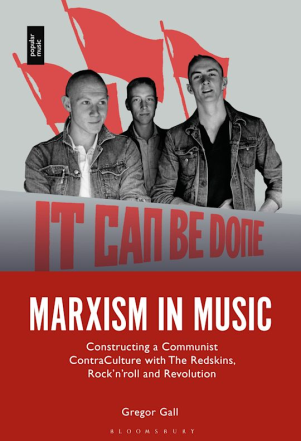
The book is available here – until the 31 October, there is a 35% discount code available – MARXISM35 – on the hardback book, so £52 (with free postage within UK).
By Professor Gregor Gall
The early to mid-1980s were a purple patch for political pop. In addition to established bands like The Clash and The Jam, there were the likes of The Style Council, Heaven 17, The Housemartins, The Farm, Fun Boy Three, The Specials, and UB40. These bands made it into the Top Forty singles chart and some went even further towards the Top Ten.
But in the 1980s, there were many more bands that were even more left-wing than these ones. But they did not much trouble the even the outer reaches of the mainstream charts. The roll call includes but is not limited to: The Pop Group, Gang of Four, McCarthy, Easterhouse, That Petrol Emotion, New Model Army, Newtown Neurotics, The Three Johns, and The Men They Couldn’t Hang.
But there was an even more left-wing band that sought to consciously spur on and organise resistance to Thatcherism, and which did achieve a small modicum of chart success.
This band was The Redskins, which existed from 1981 to 1986. The Redskins’ one and only album, Neither Washington Nor Moscow, released on 12 March 1986, reached No. 31 in the mainstream chart in Britain.
And yet despite The Redskins’ short existence and limited musical output of the aforementioned album and just seven singles, they achieved something that no other rock’n’roll band achieved in Britain in the 1980s. This was to consciously recruit to and sustain the ranks of socialists, especially those of a revolutionary persuasion.
The two main members of the band, lyricist and lead singer, Chris Dean, and bass player, Martin Hewes, were members of the British Trotskyist, Socialist Workers Party (SWP). Therefore, it was no accident that their album was entitled Neither Washington Nor Moscow with the additional words ‘But International Socialism’ adorning the inside sleeve. ‘Neither Washington Nor Moscow But International Socialism’ was for many years the standfirst underneath the title of the SWP’s weekly newspaper, Socialist Worker.
‘Neither Washington nor Moscow but International Socialism’ signified the revolutionary credentials of the SWP’s ‘third camp’ position, whereby it is asserted that only the working-class could emancipate itself and this required an international movement.
This conclusion of considerable influence in prosecuting the case for revolutionary socialism comes not from my own experience as a Redskins fan as a student in the mid-1980s but from the research for my Marxism in Music: Constructing a Communist Contra-Culture with The Redskins, Rock’n’roll and Revolution.
In the comparative study with two other far-left bands, The Housemartins and Easterhouse, many interviewees and well over one hundred fans and followers who gave testimony told how the lyrics of The Redskins pushed people in a direction of radical and revolutionary socialism. The lyrics were a taster, an introduction, which stimulated fans’ and followers’ interest to know more, whether about the Russian October revolution or the abortive Spartacist German revolution of 1918-1923.
This did not mean they joined the SWP although many did. Some joined Labour, as I did initially and which then still had a sizeable left-wing, hoping to steer it towards leftwards. Others were already in the SWP or Communist Party or the Militant, the leading Trotskyist tendency in Labour.
The Redskins’ lyrics, set to the uplifting synergy of punk, soul and funk, helped sustain the spirits of these already committed activists as well as giving them something to dance to at parties and discos. Their ‘Lean On Me!’ and ‘Keep On Keepin’ On!’ are exemplars.
Whether fans and followers agreed with the SWP-style politics The Redskins promoted or not, the exhortation to steer left, stay left and get active was clear and followed by many. The Redskins realised music was a much better way to reach a generation of youth with socialist ideas rather than expecting them to read Socialist Worker or attend SWP branch meetings.
Bass player, Martin Hewes, put it this way:
The music was a delivery device for getting people’s attention. Once we had got their attention it was possible to draw people into a debate about politics. The real difference between us and other political bands was our involvement with the SWP. Being members of a political party meant that we were accountable and couldn’t just waffle on about ‘personal issues’. Consequently, we always connected our ideas with a world that existed outside and independently of youth culture. This is why we were never ‘preaching to the converted’ because the SWP would have [then] had a membership of 50,000.
In fact, it had a membership of 4,000, half the size of the Militant Tendency but double the size of the Workers Revolutionary Party (WRP).
But a large part of the reason for the popularity of The Redskins was also their commitment to supporting struggles. It was not just the ideas contained within ‘The Power Is Yours!’ or ‘It Can Be Done’. Over and above using their profile in the weekly mass music press of the time (Melody Maker, NME, Record Mirror, Sounds) and the opportunity to speak to audiences from the stage in order to attack the Thatcher and the Tories as well as Labour leader, Neil Kinnock, The Redskins played countless benefit gigs.
Indeed, a quarter of the 250 gigs they played were benefit gigs, especially during the year-long Miners’ Strike of 1984-1985. Others were for the anti-Apartheid movement for which they also donated the royalty proceeds of their ‘Kick Over The Statues!’ (1985) single to the Federation of South African Trade Unions (FOSATU) and the African National Congress (ANC).
The Miners’ Strike was a watershed event for many and especially so amongst the then youth of the working-class and student milieu. It clearly polarised politics between Thatcherism and the labour movement, often being dubbed ‘a civil war without guns’. The Redskins, along with others like Billy Bragg, threw themselves into supporting the miners by raising money for them and trying to raise their spirits too.
The Redskins were not the only left-wing band of their time but they did have a very clear and identifiable USP. Apart from The Style Council, The Housemartins were the biggest selling left-wing band of the 1980s in Britain. They sounded revolutionary. On the inner sleeve of their first album, London 0 Hull 4 of 1986, they exhorted: ‘For too long the ruling class have enjoyed an extended New Year’s Eve Party, whilst we can only watch, faces pressed up against the glass. [We] say: ‘Don’t try gate crashing a party full of bankers. Burn the house down!’.
Not enough Robin Hoods
But The Housemartins were radicals and not revolutionaries, highlighted especially by their attraction to Jesus and Christianity. After the aforementioned exhortation, this was followed by the declamation to: ‘’Take Jesus – Take Marx – Take Hope’. They were more like Christian socialists in the vein of Tony Benn and thoroughly social democratic in their view of ‘socialism from above’ and not ‘socialism from below’ in the vein of the self-emancipation of the working-class. Indeed, The Housemartins’ first single, ‘Flag Day’ (1985) opined: ‘Too many Florence Nightingales/Not enough Robin Hoods/Too many halos not enough heroes coming up with the goods’.
Easterhouse, hailing from Manchester and not Glasgow as one might think by virtue of the band’s name, were associated with the Revolutionary Communist Party (RCP), a split of a split from the International Socialists, the predecessor of the SWP. Brothers, Andy and Ivor Perry, combined these unorthodox Trotskyist politics with militant Irish republicanism. The music was ‘indie jangle pop’ in the manner of The Smiths while the tone of the lyrics was somewhat downbeat, stemming from the RCP’s perspective that the working-class was no longer a social agency in itself and there was no bona fide Marxist tradition left in Britain. Consequently, they had much less of an appeal and did not become communist contenders as the title of their debut 1986 album suggested they thought they might.
With upful music extolling revolutionary socialist politics, one might have thought that the SWP would have welcomed The Redskins with open arms. Though the John Baine (aka Attila The Stockbroker) thesis that SWP founder, Tony Cliff, told the band to disband (because it was more important to sell Socialist Worker outside factory gates) was far-fetched, the SWP response ranged from agnostic to antagonistic.
This was because like virtually all Communist and Trotskyist organised currents put together, not only are music and culture not appreciated for what they can do for the communist cause but economism eclipses everything else. This is the worldview that workers, aided of course by correct vanguard party, will only reach a revolutionary consciousness through strike action. Only then will workers be able to make a revolution.
This party-organised Communist and Trotskyist left has contested capitalism in the economic (through supporting strikes) and political (through standing in elections) arenas but has never contested capitalism in the cultural arena. Sure, it has critiqued capitalist culture but it has never gone so far as to produce its own communist contra-culture. At most, individual communists and Trotskyists have produced politically progressive cultural artefacts and reproduced proletarian culture.
The Redskins provided a fleeting glimpse of what could be done. Alongside their musical output, they also organised for June 1986 the ‘Month of Sundays’ revue to bring together like-minded cultural workers like musicians, poets and comedians. It was a micro-microcosm of a communist contra-culture.
While forty years on and while times may be said to be somewhat different today, The Redskins showed in a Gramscian way that contesting capitalism in the cultural, and thus ideological, arena could credibly bring results in the crusade to help create communism.
Gramsci’s injunction was that ideological hegemony was required for a communist revolution to be achieved, where class struggle is not primarily of an economic nature but rather of a political, cultural and ideological kind. Thus, he advocated a long-term strategy of a ‘war of position’, as opposed to only a ‘war of movement’ (or ‘manoeuvre’), represented by a frontal physical assault upon bourgeois democracy through seizing the state via an insurrection.
The ‘war of position’ was regarded by Gramsci as necessary but not sufficient, as was the ‘war of movement’, but the former had to be achieved before the later could be achieved. The Gramscian context was achieving communism not in a backward monarchist police state such as Russia but in the advanced capitalist parliamentary democracies of western Europe and North America.