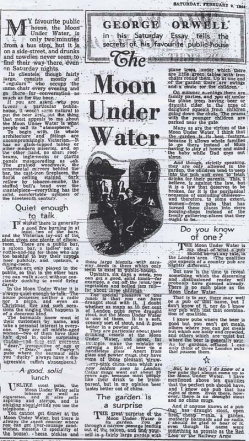
A reproduction of Orwell’s essay
By Kristian Williams
In a newspaper column from 1946, George Orwell imagined an ideal pub, with the doubly dreamy name, “The Moon under Water”:
To begin with, its whole architecture and fittings are uncompromisingly Victorian. It has no glass-topped tables or other modern miseries, and, on the other hand, no sham roof-beams, inglenooks or plastic panels masquerading as oak. The grained woodwork, the ornamental mirrors behind the bar, the cast-iron fireplaces, the florid ceiling stained dark yellow by tobacco-smoke, the stuffed bull’s head over the mantelpiece — everything has the solid, comfortable ugliness of the nineteenth century.
In winter there is generally a good fire burning in at least two of the bars, and the Victorian lay-out of the place gives one plenty of elbow-room. There are a public bar, a saloon bar, a ladies’ bar, a bottle-and-jug for those who are too bashful to buy their supper beer publicly, and, upstairs, a dining-room. . . . In the Moon under Water it is always quiet enough to talk. The house possesses neither a radio nor a piano. . . .
He goes on to describe the physical layout, the back garden (in which children are welcome), the dishware, the food, and almost as an afterthought, the beer itself. (“It is a soft, creamy sort of stout, and it goes better in a pewter pot.”) The emphasis, however, is on the kind of informal culture that can arise in such a place:
The barmaids know most of their customers by name, and take a personal interest in everyone. They are all middle-aged women . . . and they call everyone ‘dear,’ irrespective of age or sex.
Pubs, and similar establishments, being “one of the basic institutions of English life,” appear quite regularly in Orwell’s work. George Bowling visits several in Coming Up for Air, and is disappointed in how they had changed — more commercial, less intimate, worse beer (“poor stuff . . . too bitter, a kind of sulphurous taste. Chemicals.”) Gordon Comstock, in Keep the Aspidistra Flying, resentfully feels himself excluded from the imagined paradise of the pub. (“To be in there, just to be in there! In the warmth and light, with people to talk to, with beer and cigarettes and a girl to flirt with! . . . No! Impossible to go in. . . . He couldn’t go shoving into that saloon bar with only fourpence halfpenny in his pocket.”)

There are no pubs in Burmese Days, but its negative counterpart is the Kyauktada Club, an establishment at once snobbish and shoddy, where the castoff sons and second-rate scoundrels that compose the colonial aristocracy — that is to say, the white people — gather among themselves to drink bad gin and compete for status. The Club “—a dumpy one-storey wooden building—” is also nevertheless “the real centre of the town . . . the spiritual citadel, the real seat of the British power, the Nirvana for which native officials and millionaires pine in vain.” And thus the Club is central to the drama of the novel, as its constituents clamor against the introduction of a token native member. In each case the drinking establishment is treated, not merely as an institution, but as a microcosm of British society.
The Moon under Water, then, is not only a fantasy pub, but an ideal of sociality very much in line with Orwell’s notion of progressive patriotism and democratic socialism. It likewise reflects his tendency toward nostalgia, recalling the England of his boyhood — “the time before the war, before the radio, before aeroplanes, before Hitler,” (as his narrator puts it in Coming Up for Air) when the present seemed solid and secure, the past was kept alive as a matter of habit and tradition, and “they didn’t think of the future as something to be terrified of.” It is a conservative sentiment, but not of the type that is likely to impede any actual progress toward equality.

It is interesting from this point of view to consider the four drinking establishments, only one of them properly a pub, that Winson Smith visits in Nineteen Eighty-Four. There is, first of all, the canteen at the Ministry of Truth, a..
….low-ceilinged, crowded room, its walls grimy from the contact of innumerable bodies; battered metal tables and chairs, placed so close together that you sat with elbows touching; bent spoons, dented trays, coarse white mugs; all surfaces greasy, grime in every crack; and a sourish, composite smell of bad gin and bad coffee and metallic stew and dirty clothes.
It is the sort of ill-lit cafeteria as might appear in a film about reform school — except that “there was a small bar, a mere hole in the wall, where gin could be bought at ten cents the large nip.” The canteen is institutional, impersonal, uncomfortable, and most un-homelike. It is by design not the sort of place where people would be inclined to linger.
Secondly, and relatedly, there is the “Community Centre” where Winston spends an evening. There he “took part in the solemn foolery of a ‘discussion group’, played two games of table tennis, swallowed several glasses of gin, and sat for half an hour through a lecture entitled ‘Ingsoc in relation to chess’.” All of this is done, of course, from a sense of obligation rather than pleasure. “His soul writhed with boredom.” Even recreation has been corrupted by officialdom.
Third, there is the prole bar into which Winston ventures on a whim, hoping to get some sense of the past. It is loud, crowded, and announces itself at the entrance with “a hideous cheesy smell of sour beer.” Smith imposes on an ancient-seeming prole, and asks him about life before the revolution. The old-timer obliges, or tries to, but his recollections are useless, too specific and yet too vague. “The old man’s memory was nothing but a rubbish-heap of details.”
Finally, where Smith ends his days after his arrest and torture, there is the Chestnut Tree Cafe, a “haunt of painters and musicians” and “somehow ill-omened. The old, discredited leaders of the Party had been used to gather there before they were finally purged.” Winston even saw there once three such men, during their period of social exile, “sitting in silence before glasses of the gin flavoured with cloves which was the speciality of the cafe. . . The place was almost empty. A tinny music was trickling from the telescreens. The three men sat in their corner almost motionless, never speaking. Uncommanded, the waiter brought fresh glasses of gin. There was a chessboard on the table beside them, with the pieces set out but no game started.”
In a solitary repeat of this scene, Winston Smith, at the end of the novel, takes his own place there:
The Chestnut Tree was almost empty. . . . A tinny music trickled from the telescreens.
Winston sat in his usual corner, gazing into an empty glass.. .. Unbidden, a waiter came and filled his glass up with Victory Gin, shaking into it a few drops from another bottle with a quill through the cork. It was saccharine flavoured with cloves, the speciality of the cafe….. He picked up his glass and drained it at a gulp. As always, the gin made him shudder and even retch slightly. The stuff was horrible. The cloves and saccharine, themselves disgusting enough in their sickly way, could not disguise the flat oily smell…… A waiter, again unbidden, brought the chessboard and the current issue of ‘The Times’, with the page turned down at the chess problem. Then, seeing that Winston’s glass was empty, he brought the gin bottle and filled it. There was no need to give orders. They knew his habits. The chessboard was always waiting for him, his corner table was always reserved; even when the place was full he had it to himself, since nobody cared to be seen sitting too close to him. He never even bothered to count his drinks. At irregular intervals they presented him with a dirty slip of paper which they said was the bill, but he had the impression that they always undercharged him.
The place sounds almost comfortable, in the way that a hospice must be — a combination of luxury, utility, and doom.
The drinkeries of Nineteen Eighty-Four are all nearly the opposite of what Orwell imagined in “The Moon under Water”; and that is because the Ingsoc revolution had destroyed the type of society that would make that imagined pub possible, and which in turn the pub might be thought to represent. But of course that type of pub was already disappearing in Orwell’s time. In a 1943 review, he quoted a report on “The Pub and the People” to the effect that “the pub as a cultural institution is at present declining.” The reasons for this decline were always numerous, and have only accumulated as the extinction has gained pace. There are the economic pressures, including competition from big chains and rising rents, the changes in public taste, the erosion of leisure time, and the displacement of the communities that provided the stable base of support implied by the very concept of “my local.” Moreover, as Orwell explains:
the whole trend of the age is away from creative communal amusements and towards solitary mechanical ones. The pub, with its elaborate social ritual, its animated conversations and – at any rate in the North of England – its songs and week-end comedians, is gradually replaced by the passive, drug-like pleasures of the cinema and the radio.
These more modern entertainments have in the decades since invaded the pub itself. Televisions, video poker, the digital simulacrum of a jukebox, and the handheld devices that the patrons bring in themselves — plus that most Orwellian addition, the surveillance camera — now seem to dominate the decor of any modern bar. All serve, to a greater or lesser extent, to push our attention elsewhere, away from the place that we are in and the people that we are with. They are antipathetic to the concept of cultural democracy.
Even so, as we mourn the passing of the “third space” — neither home nor work, a common place where people gather and mingle freely — Orwell’s ideal of the Moon under Water survives, if only in our daydreams. It is the bar that we wish other bars were, a place that we feel we have a right to but we never expect to find, a kind of side-street utopia. It is more than a bar; it is an image of community, of commonality, of connection — and most of all, of a society that values such things, along with opportunities for leisure, for simple social pleasures, and for the minor physical indulgences symbolised by a nice pint of beer.